Collect items in a shared note during the week, then give the conversation a fixed, short slot of around 15 minutes with three questions: what is coming up, what has changed, and who is doing what. One person writes each decision down as it is made. Anything that cannot be settled in the slot goes on a "later" list with its own time, instead of stretching the meeting until everyone is tired and cross.
Why household planning runs long
A planning chat that should take a quarter of an hour often takes an hour for a handful of predictable reasons:
- Nobody knows what is on the agenda, so items are remembered one by one, in no order.
- Logistics and grievances share the same slot. "Who's collecting the parcel?" turns into "you never collect anything".
- Things get decided that one person could have decided alone, with everyone weighing in.
- Settled items are reopened because nobody wrote down what was agreed last time.
- People who could not attend are given jobs they have not agreed to, which then have to be renegotiated.
Each of these has a small fix. You do not need all of them; start with whichever describes your household best.
Prepare facts, not a performance report
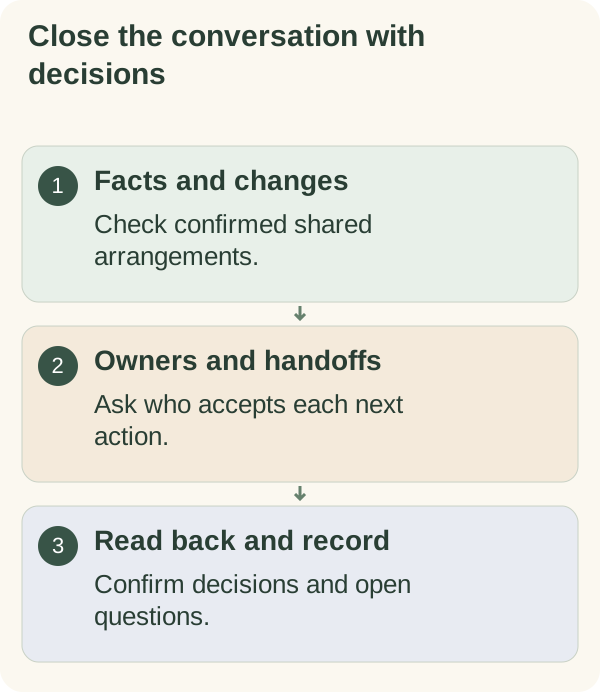
Before the conversation, check dates, appointments, expected visitors and shared needs for the coming week or two. Separate confirmed arrangements from ideas. Avoid bringing a tally of who did the most work as a substitute for talking about how much each person can take on.
Choose a time and format everyone involved can use. Someone who cannot attend needs a fair chance to add items and agree to tasks before responsibilities are assigned to them.
A 15-minute agenda you can read aloud
| Minutes | Item | The question to ask |
|---|---|---|
| 0 to 2 | Open | "Anything urgent before we start?" |
| 2 to 6 | Coming up | "What's in the calendar that affects more than one of us?" |
| 6 to 10 | Changes | "What no longer fits, or needs an answer this week?" |
| 10 to 13 | Owners | "Who will take each of these, and what do you need to do it?" |
| 13 to 15 | Read-back | "Here's what we agreed. Have I got it right? What's on the later list?" |
Use a short shared agenda
- Commitments:
which shared arrangements are confirmed?
- Changes:
what no longer works or needs a decision?
- Owners:
who agrees to handle each action?
- Handoffs:
what information or help does that person need?
- Close:
where do the decisions live, and when is the next check?
Decide what does not need the meeting
A quick rule shrinks the agenda before you start:
| If the item... | Then |
|---|---|
| Affects only one person | They decide and post a note in the shared record |
| Is information, not a decision | Add it to the record; no discussion needed |
| Needs shared money or shared time | Bring it to the conversation |
| Has been argued about more than twice | Give it its own conversation (see below) |
| Can wait a fortnight without harm | Put it on the later list |
Example: Alex and two housemates
An illustrative example (the person is made up): Alex shares a flat with Maya and Sam. Their Sunday "house chat" had grown to an hour and usually ended in a disagreement about the bins.
What they tried: a shared note on the kitchen wall where anyone could add items during the week, a 15-minute chat after Sunday dinner using the agenda above, and a rule that the bins question would get its own conversation. Sam works Sundays, so he adds his items by Saturday night and replies to the read-back message to accept or swap tasks.
What went wrong at first: the first two chats still ran over, because every item led to a side discussion.
What they changed: Maya started writing side topics straight onto the later list, and they set a phone timer. By the third week the chat fitted the slot. The bins conversation took twenty minutes on a separate evening and ended with a rota they all signed up to.
Keep decisions specific
"Who will confirm the delivery slot, and by when?" is a decision the group can make. "We need to be more organised" describes a feeling without giving anyone a next action. If something cannot be settled in the time available, write the question down and agree when you will discuss it. Do not label it as agreed just to end the meeting.
When the same argument keeps coming back
Most household planning advice assumes the agenda is neutral. Often one topic is not, and it quietly takes over every conversation.
- If one item has come up more than twice without resolution, name it as its own topic and book a separate time for it, when nobody is rushing.
- If the real issue is fairness of the workload, talk about each person's capacity for the coming weeks rather than past scores.
- If one person always ends up as the reminder for everyone, the guide to keeping track of household tasks without reminding everyone covers ownership and a shared list.
- If the conversations leave anyone feeling unsafe or afraid at home, that is not a planning problem. Contact a local support service or, in an emergency, the emergency services.
Use one accessible record
Pick a place everyone can reach and agree it is the only place decisions live. Keep sensitive information out of a widely shared calendar when a private note will do.
Week of: ________
Agreed:
- [Action] | Owner: [name, said yes] | By: [day]
- [Action] | Owner: ________ | By: ______
Later list (with date to discuss):
- [Question] | Discuss on: ______
Next check: ________
End when the decisions are clear
Read back what changed and check that each owner agrees. A name written next to a task is not consent if that person has not accepted it.
Then, if someone carried a lot this week, say so. A specific thanks takes a minute and changes how the next conversation feels; the thank-you message builder helps you name what they did if you would rather write it down. Sharing a home is one of the most everyday ways of looking after the people around you, and a shorter, fairer planning chat is a manageable step toward doing it well. The guides in Find the words for someone help when a conversation needs gentler wording.
For a regular structure, the household check-in guide shows how to share routine tasks week by week. Use the weekly review tool for a simple reflection structure, adapting it together. Take a small connection step if you first need to invite someone to the planning conversation. The boundary fields in the Low-pressure connection cards help you prepare, and the decisions then go in the record everyone agreed to use.
Questions people often ask
How long should a household planning meeting be? Short enough that nobody dreads it. Around 15 minutes suits many households when items are gathered in advance.
What if someone refuses to take part? Keep the slot short and the record visible, and invite them to add items in writing. Do not assign them tasks they have not accepted.
Should children be involved? That depends on your household. If they join, keep their part brief and about things that affect them.
How often should we have one? Weekly suits busy households. Others manage with every fortnight, plus a quick message when something changes.