You stop being the household's reminder when each task has one owner who covers all of it: noticing when it needs doing, planning it and doing it. Agree those owners in one short conversation, write down what "done" means for each task, and keep the list where everyone already looks. Then the list does the reminding, and a missed task becomes something to raise at a weekly check-in rather than a daily nag.
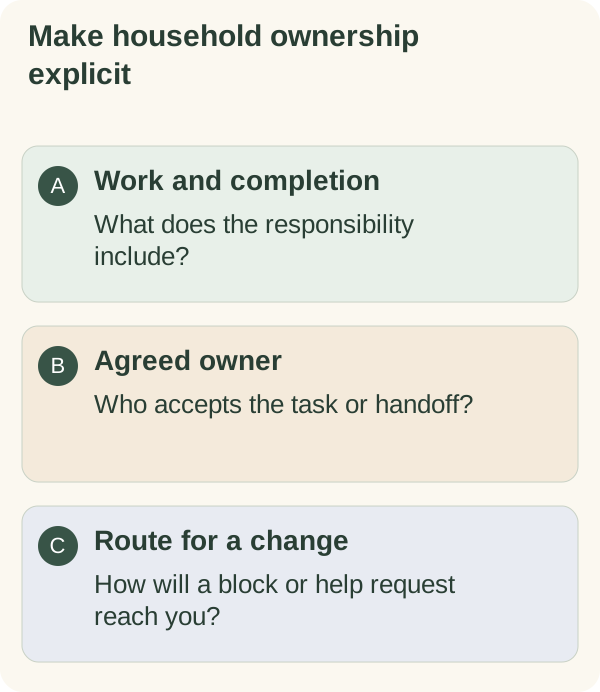
Sharing household work fairly is one place where planning your days reaches the people around you: each person holds a few clear tasks, instead of one person holding the whole list in their head.
The work behind the chore
Take bin night. Someone has to notice it is Tuesday, check whether it is the recycling week, see whether the bags need replacing and then put the bins out. If one person puts the bins out but another person does all the noticing and checking, the second person is still doing most of the work. They are also the one who sends "bins tonight?" every week.
| Part of the task | What it involves | Who usually ends up with it |
|---|---|---|
| Noticing | Spotting that it needs doing, or that supplies are low | The person who cares most about it |
| Planning | Deciding when, buying what is needed, booking anything | The same person, often |
| Doing | The physical job | Whoever was asked |
| Checking | Making sure it was done and done well enough | The person who noticed |
A shared list only removes reminders if the owner takes on all four parts. "Owns the bins" should mean noticing, planning, doing and checking the bins.
Write each task so it finishes without you
Vague task names cause most of the follow-up messages. "Bathroom" means a quick wipe to one person and a full clean to another. Add a short "done means" line to every task:
- Bins: out by 9pm the evening before collection; new bags in.
- Bathroom: sink, toilet and mirror cleaned; mat in the wash; low supplies added to the shopping list.
- Food shop: list checked against the fridge; shop done by Saturday; receipts in the agreed place.
- Plants: watered on Thursday; anything looking unwell mentioned at the check-in.
If the owner meets the "done means" line, the task is done. Nobody needs to inspect it, and nobody gets to redo it to their own standard without raising it first.
A household task list you can copy
| Task | Owner | How often | Done means | If the owner can't |
|---|---|---|---|---|
| __________ | __________ | __________ | __________ | __________ |
| __________ | __________ | __________ | __________ | __________ |
| __________ | __________ | __________ | __________ | __________ |
The last column matters. Agree in advance what happens when an owner is away or ill: a named swap, or the task waits. That stops a missed week turning into an argument.
Keep the list where everyone already looks: the fridge door, a shared note on your phones or a board by the door. Agree out loud that the list is the reminder. Once you have said that, nobody needs to send messages about it.
The conversation, word for word
The setup talk is short if you bring a draft list and ask rather than assign. Some lines that tend to work:
I'd like to stop reminding everyone about jobs. I don't like doing it, and I don't think you like hearing it. Could we spend twenty minutes agreeing who owns which tasks, start to finish?
Here's everything I could think of. Which of these would you rather own?
What does done look like for this one, so neither of us has to check?
If you can't do yours one week, what should happen?
A name next to a task only counts once that person has said yes. If you want help finding honest words for the opening message, take a small connection step walks through drafting a short, low-pressure note that you review and send yourself. The guide to making a household planning conversation shorter has more on keeping these talks brief.
Set up the shared list in one sitting
- List every task for a week.
Include the invisible ones: noticing supplies, booking repairs, birthdays.
- Write "done means" for each.
One short line.
- Agree owners.
Each person picks; nobody is assigned without saying yes.
- Fill the last column.
What happens when an owner can't do it.
- Put the list where everyone looks.
Agree it is the only reminder.
- Pick a check-in time.
Ten minutes, once a week.
Example: Daniel and his housemates
The example below is illustrative; the person in it is not real. Daniel shares a house with two others. He realised he was sending the same messages every week ("bins tonight?", "we're out of washing-up liquid") and was starting to resent it, while his housemates felt nagged.
They spent twenty minutes on a list. Daniel took the food shop and supplies, one housemate took bins and recycling, the other took the bathroom and hallway. Each task had a "done means" line, and the list went on the fridge.
After two weeks, recycling had been missed once. At the Sunday check-in it turned out the collection was fortnightly and nobody was sure which week it was. They added the council's collection dates to the list, and the housemate who works from home swapped recycling for the hallway. Daniel's own change was harder: he stopped sending messages on the day, even when he noticed something, and saved it for Sunday. The messages stopped within the month.
When someone can't take on as much
Fair does not always mean equal. Most articles on chore lists skip this part:
- If someone has exams, a demanding work season or a new baby: agree a lighter load for a set number of weeks, with a date to look at it again.
- If someone has a health condition or disability: let them choose tasks that suit them. The list does not need to say why, and health details should never go on it.
- If children are part of the household: give them tasks with a clear "done means" suited to their age, and treat an adult as the backup owner.
- If an owner keeps missing the same task: ask what gets in the way before reassigning it. It may be timing, not willingness.
- If one person ends up doing most of everything: list every task done in a week, including the invisible ones, and look at the split together. That is a conversation about expectations, and more reminders will not fix it.
A weekly check-in instead of daily reminders
Ten minutes, same time each week. Three questions: what got missed, does any task need a new owner or a new "done means", and is anything coming up next week that changes the plan? The weekly review template gives a simple agenda shape; it does not assign tasks or message anyone for you. The household check-in guide goes into running that meeting so it stays short.
Keep the list a record of tasks, not a scoreboard of people. Clear old completed items off so the list shows only what is live.
The agreement field in the Small home reset kit is a good place to draft who needs to agree before the conversation.
Questions people often ask
Should we use an app or a paper list? Whatever everyone already looks at. A list on the fridge that everyone reads beats an app only one person opens.
What if someone agrees and then doesn't do it? Raise it at the check-in, not in the moment. Ask what got in the way and whether the task, the timing or the owner should change.
How do we split tasks fairly when we work different hours? Match tasks to when people are home. Someone out all week might take weekend jobs or the noticing-and-ordering jobs that can be done from anywhere.
Is it worth doing this for just two people? Yes. Couples often have the biggest gap between who does the visible work and who does the noticing.