Do the evening kitchen reset in the same short order every night: put food away first, then deal with the dishes and the sink, then clear one surface for the morning, then stop. Cupboards, the fridge shelves and the floor belong to another evening. Keeping the same few steps in the same order makes the reset quick enough to happen on tired nights, and a five-minute version covers the nights when even that is too much.
A predictable close to the kitchen day is one of the smallest routines in Plan your days, and it means tomorrow morning starts one step ahead instead of one step behind.
The closing order, and why it runs this way
- Food away. Leftovers, open packets, anything that should be in the fridge. Food has its own rules about cooling and storage, so it goes first, before you get tired. FoodSafety.gov's four steps cover chilling and storing food; follow that and the instructions on packaging rather than anything a cleaning routine says.
- Dishes and sink. Wash, load the dishwasher or stack and soak, depending on your setup. An empty sink is what makes the morning feel easy.
- One surface. Clear and wipe the counter you will use first tomorrow, using cleaning products as their labels direct.
- Bin, only if full. Take it out if it will not last the night.
- Stop. Everything else is for another day.
The order matters because evenings run out. If you start with the job you least mind, such as wiping surfaces, you often run out of energy before the food is away. Putting the one job with real consequences first means a reset cut short still covers what matters.
Close the kitchen tonight
- Put food away.
Check packaging and storage guidance for anything you are unsure about.
- Clear the sink.
Wash, load or stack, so the sink itself is empty.
- Ready one surface.
The one you need first in the morning.
- Check the bin.
Out only if it is full.
- Turn off the light.
The reset is finished, even if other jobs are visible.
The full reset and the five-minute version
| Step | Full reset | Five-minute version |
|---|---|---|
| Food | Away, with leftovers in containers | Away |
| Dishes | All washed or loaded; dishwasher started | Loaded or stacked neatly by the sink; pans soaking |
| Sink | Emptied and wiped | Emptied |
| Surface | Main counter cleared and wiped | One spot clear for the morning |
| Bin | Emptied if more than half full | Only if overflowing |
| Tomorrow | Quick look at what breakfast and lunch need | Skip |
The five-minute version is not a failure of the full one. It is the reset you choose on a late night so that the habit survives the week.
A closing card for the fridge door
Copy this onto a card and stick it where you will see it at the end of the evening:
KITCHEN CLOSE
1. Food away  (check the label if unsure)
2. Sink empty
3. One surface clear: ______________
4. Bin, only if full
5. Stop

Tired tonight? Do 1 and 2 only.
Not part of the close: cupboards, fridge shelves, floor, oven
Those happen on: ______________
Example: Maya's shared-flat kitchen
A fictional example, written to show the steps in practice. Maya shares a kitchen with two flatmates who cook at different times. Her evening resets kept failing: she would come in at ten to make tea, find the counter covered in other people's pans and either clean everything, resentfully, or nothing at all.
She separated her own close from the state of the kitchen as a whole. Her close covered her food, her dishes and the one counter she uses for breakfast. Then she suggested one shared rule to the flat: whoever cooks last puts their food away and clears the hob and counter they used. Both flatmates agreed.
After a week, she made one more change. She had been leaving her close until before bed and skipping it about half the time, so she moved it to straight after her own meal, when she was already standing in the kitchen. The fridge shelves, which had been nagging at her, became a Sunday job.
Late dinners, someone else's cooking and other awkward evenings
Most reset routines assume you cooked, you ate at home, and the kitchen is yours. Here is what to do when it isn't that simple:
- If you get home after everyone else has eaten: put your own food and dishes away and leave the rest to whoever cooked, under whatever agreement your household has.
- If you cooked late and are exhausted: use the five-minute version. Food away still comes first.
- If the dishwasher or the sink is out of action: stack, soak and keep to the minimum, and report the fault to whoever is responsible for repairs.
- If there are young children or pets in the home: before anything else, put knives, hot pans and cleaning products out of reach, even in the short version.
- If there has been a breakage or a spill that could cause a slip: deal with that carefully first. If it involves an appliance, follow its instructions or get it checked.
- If you are not sure whether a leftover is still safe to keep: use official food safety guidance, not memory or a routine card.
Link the reset to tomorrow's food
One small look ahead fits at the end of the full reset: is there something for breakfast, and does tomorrow's lunch need anything doing tonight? Keep food in its proper storage rather than leaving it out as a reminder. If what keeps the kitchen busy late is deciding what to eat each day, the meal planner moves that decision to once a week.
When the reset keeps stopping halfway
Notice where it stops, then change that step rather than the whole routine:
| It usually stops at... | Likely reason | Try |
|---|---|---|
| Before it starts | It comes too late in the evening | Move it to straight after the meal |
| The dishes | Too many dishes by evening | Wash or load while cooking, or use fewer pans |
| The surface | Cluttered with things that have no home | Give post, bags and chargers a place outside the kitchen |
| Someone else's mess | No shared agreement | Agree a "last cook clears" rule |
Wind down for the evening helps you choose a final step for the night, and the kitchen close can be that step. On a hard day, the smaller-plan guide is a reminder that the five-minute version, or no reset at all, can be the right call.
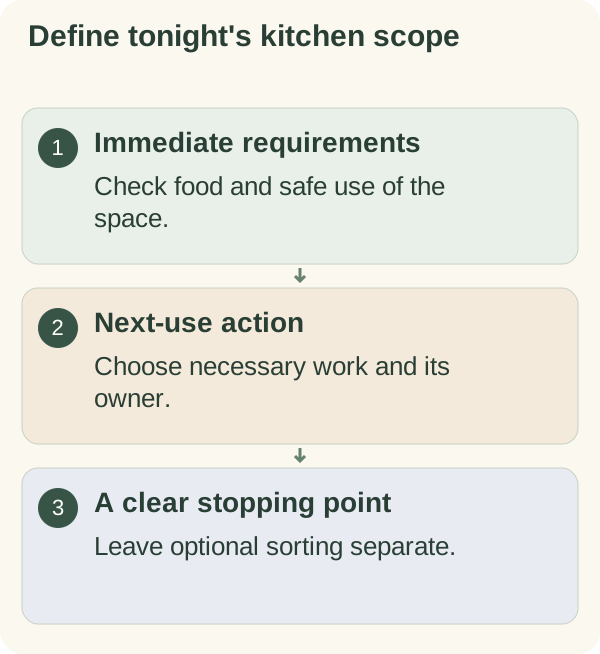
The Small home reset kit has fields for what is necessary now, who needs to agree and a sensible stopping point, which is a useful way to set up a shared kitchen rule.
Questions people often ask
How long should an evening kitchen reset take? Long enough to finish the five steps in your kitchen. Keep the five-minute version for nights when that is too long.
Should I clean the floor every night? It is not part of the core reset. Deal with spills as they happen and give the floor its own slot in the week.
I hate washing up at night. Is it fine to leave it? If that works for your household, put the food away and stack the dishes neatly. Just remember the morning then needs time for them.
Does wiping the counter make it hygienic? This page sets the order of jobs; it is not a hygiene method. Follow product instructions and official food safety guidance for how to clean food surfaces.