In an overwhelming week, clean only what keeps your home usable for the next few days: the dishes you need to eat from, the rubbish before it overflows, and one clear surface where you can eat or work. Decide in advance which jobs you are not doing this week and write them down, so they stop nagging at you. That is a complete routine for a hard week, not a failed version of your normal one.
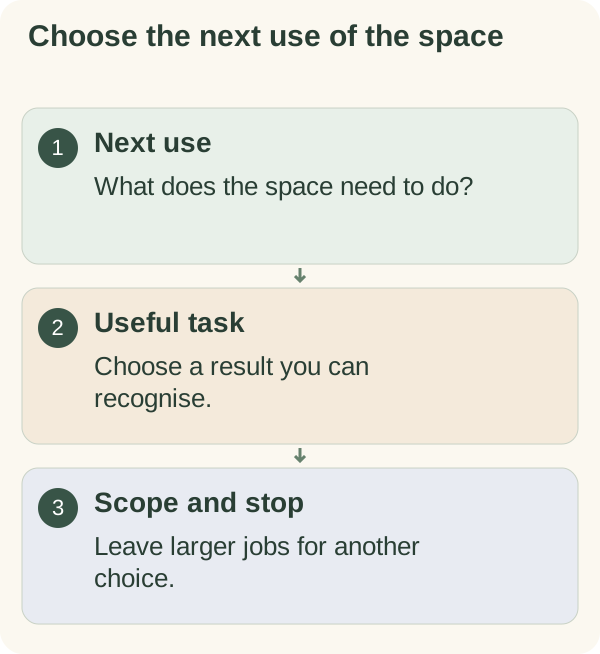
Planning a hard week around a few small jobs is the same idea that runs through Plan your days: one manageable step at a time, with room to do more once the week eases.
Why your usual cleaning schedule falls apart under pressure
Most cleaning schedules give each day a room or a job: bathroom on Monday, floors on Friday, a bigger session at the weekend. They quietly assume every day has some spare time. In a week of deadlines, caring for someone, travel or a cold, that schedule is behind by Tuesday. Each missed slot then sits on the list as a debt, and by Thursday the plan feels worse than having no plan at all.
The answer is to sort cleaning by consequence instead of by room. Ask two questions about each job:
- If I skip this for five days, does the home become harder to use, or does it just look less tidy?
- Will skipping it create a bigger job later, such as a smell, a pest problem or a blocked walkway?
Jobs that pass either test belong on this week's floor. The rest can wait without any real cost.
Sort every job into floor, normal or bonus
| Level | What it covers | Typical examples |
|---|---|---|
| Floor | Skipping it causes a real problem within days | Washing what you eat from, taking rubbish and food waste out before collection, dealing with spills, keeping halls and stairs clear |
| Normal | Your usual weekly upkeep | Bathroom, floors, changing bedding, dusting |
| Bonus | Projects and improvements | Sorting cupboards, windows, the fridge shelves, rearranging a room |
In an overwhelming week you commit to the floor only. Normal jobs happen if a gap appears. Bonus jobs go on the parked list until a lighter week.
Your floor may look different from this table. A home with a pet, a baby, allergies or a shared kitchen will have its own must-do jobs. If anyone in the home has health needs connected to cleanliness, their doctor or care team's advice comes before any general plan, including this one.
Pin each floor job to something that already happens
Floor jobs survive a hard week when they ride on a moment you already have. Creating a new "cleaning time" in a week that has none rarely works. Some pairings that tend to hold:
- After the evening meal: wash or load what was used today.
- The evening before collection day: rubbish and recycling out.
- While the kettle boils in the morning: clear the one surface you need that day.
- On the way to bed: move anything on the stairs or hallway floor out of the way.
If a moment disappears because of a late meeting or an evening out, the job moves to the next moment. It does not become a second job you owe.
Set up this week's floor
- Look at the next five days.
Mark the heavy days and any evenings you will be out.
- Choose two or three floor jobs.
Only the ones that cause a problem if skipped.
- Pin each one to a moment.
A meal, bin night, the morning kettle.
- Write the parked list.
The normal and bonus jobs you are choosing to leave, with a date.
- Pick a check day.
The day you will ask whether the week has eased.
An overwhelming-week card to copy
Write it on paper or in a note on your phone. Keep it short enough to read in ten seconds.
OVERWHELMING WEEK CARD          Week of: __________

FLOOR (doing these whatever happens)
1. _______________________   when: ______________
2. _______________________   when: ______________
3. _______________________   when: ______________

IF A GAP APPEARS (choose one, not all)
- _______________________
- _______________________

PARKED UNTIL ________ (not this week, on purpose)
- _______________________
- _______________________

Someone who could take one job: ______________
Check day: __________   Has the week eased?  yes / not yet
The parked list does more work than it seems to. Writing "bathroom: parked until Saturday" turns a nagging thought into a decision you have already made, which is easier to carry through a busy week than a vague sense of falling behind.
Example: Daniel's deadline fortnight
The example below is illustrative; the person in it is not real. Daniel lives alone and had two weeks of late finishes before a work deadline. His usual habit was a long Saturday clean, and he knew it would not happen either weekend.
He chose a floor of three jobs: wash up after dinner each night, bins out on Wednesday evening, and clear the desk end of the kitchen table each morning. He parked the bathroom, floors and bedding until the Saturday after the deadline. His one gap job was changing the bedding if Sunday turned out free.
The first week held. In the second week he missed bin night, and by Friday the kitchen bin was overflowing. Two changes followed. He set a repeating phone reminder for Wednesday evening, because bin night was the only floor job with a fixed deadline he could not move. He also cut the morning table job, which he had been skipping anyway, and found the week ran fine with two floor jobs. When the deadline passed, he did the bathroom first, because it was the parked job he had thought about most, and went back to his usual Saturday routine the week after.
If you are ill, caring for someone or dealing with something bigger
Most cleaning advice assumes the week is busy, not that you are unwell or that the whole household has changed shape. Some concrete adjustments:
- If you are ill: shrink the floor to one job, or hand it to someone else. Rest comes first. If you are unsure whether you are well enough to do things, ask a doctor or pharmacist; the cleaning can wait.
- If someone in the home has an infectious illness: this page does not cover cleaning for illness. Check official health guidance for your country, or ask a health professional what is needed.
- If you are caring for a new baby or a relative: let the floor follow their needs, such as bottles or extra washing, and park almost everything else.
- If friends or family offer help: name one specific job. "Could you take the bins out on Tuesday?" gets a yes far more easily than "let me know if you need anything".
- If the week is hard because of grief or a crisis: pausing the routine completely is a reasonable choice. If you are struggling to cope day to day, talk to your doctor or someone you trust.
Whatever the reason, follow the instructions on cleaning products and appliances even when you are rushing. A smaller routine does not change what those labels say.
Sharing the floor in a home with other people
If you live with others, agree the floor for the week rather than hoping someone notices your list. A short message is enough:
This week is heavy for me. Could we agree just three jobs until Sunday: dishes after dinner, bins out on Tuesday, and keeping the hallway clear? I can do the dishes. Could you take the bins?
Name the end date so it does not sound like a permanent new arrangement. For a longer-term split of jobs, see keeping track of household tasks without reminding everyone.
Coming back up from the floor
When the week eases, resist doing the whole parked list in one go. That turns a recovered weekend into another overwhelming day. Pick the one parked job you have thought about most, do it, and restart your normal schedule from the next usual slot. Keep the card. The next time a hard week arrives, you only need to fill in the dates.
If you want to repeat a floor job on set days, the free habit tracker can hold it. A one-off catch-up job for the first lighter day fits better in the daily planner.
Build a small routine shows an illustrated way to choose one repeatable action and give it a place in your day. Filling in a browser worksheet does not create a Telegram habit or give a job to anyone else in your home.
The first card in the Small home reset kit asks which area needs attention, what is necessary now, what could wait, who needs to help and where to stop. Those fields map neatly onto floor and parked jobs.
Questions people often ask
How many jobs should go on the floor? Two or three. If you find yourself doing none of them by midweek, cut to the single job with a fixed deadline, which is usually the bins.
Is it a problem to leave the bathroom for a week? For most homes, a week of parked normal jobs is ordinary and easy to recover from. If someone in your home has particular health needs, ask their doctor or care team what matters.
What if the person I live with wants the normal schedule to continue? Explain that it is for a set number of days, agree the floor together and offer a date when the usual routine resumes. If they want more done, they can take one of the normal jobs that week.
Should I do a big clean at the weekend to catch up? Only if you have the energy for it. Otherwise do one parked job and let the normal schedule take care of the rest over the following week.