Keep one short private cue per person, about your own next move ("Ask Maya how the driving test went"), and look at your cues once a week at a time you already pause, rather than setting a daily reminder. When a cue comes up, decide afresh: send something, change it or let it go. Never record how quickly the other person replies. Follow-up is about remembering them, not monitoring them.
Two kinds of follow-up, two sets of rules
People use "following up" for two quite different things. Mixing them up is how a kind habit turns into chasing.
| Following up on their news | Following up on your unanswered message | |
|---|---|---|
| Example | They mentioned an interview, a move or a hospital appointment | You sent an invitation or question and heard nothing |
| What it says | "I remembered what matters to you" | "I'm still waiting for an answer" |
| When to send | Around the date, or shortly after | Only if there is a real reason to need an answer |
| How many times | Once is usually enough | Once at most, then stop |
| Reply expected? | No | Ideally, but you cannot require one |
The first kind is almost always welcome. The second needs more care, because it puts a small demand on someone who may already be stretched.
Identify whether a response is actually needed
A booking question with a deadline, a casual greeting and a sensitive conversation all carry different expectations. If a genuine deadline applies, say so plainly: "I need to confirm numbers by Friday." Do not invent urgency because you would prefer a faster reply.
Silence does not tell you what someone is doing or feeling. Avoid reading meaning into a delay, a "seen" marker or a gap in your own records.
Write the cue small
A good cue is short enough that you would not mind someone glancing over your shoulder at it.
| Too much | About right |
|---|---|
| "Sam: interview at the design firm Thursday, nervous about salary talk, old boss was awful, check he's okay" | "Ask Sam how Thursday went" |
| "Alex hasn't replied in 12 days, sent two messages, seems annoyed?" | "Decide whether to message Alex again" |
| "Daniel's mum in hospital, ward details, surgery date" | "Send Daniel a kind message this week" |
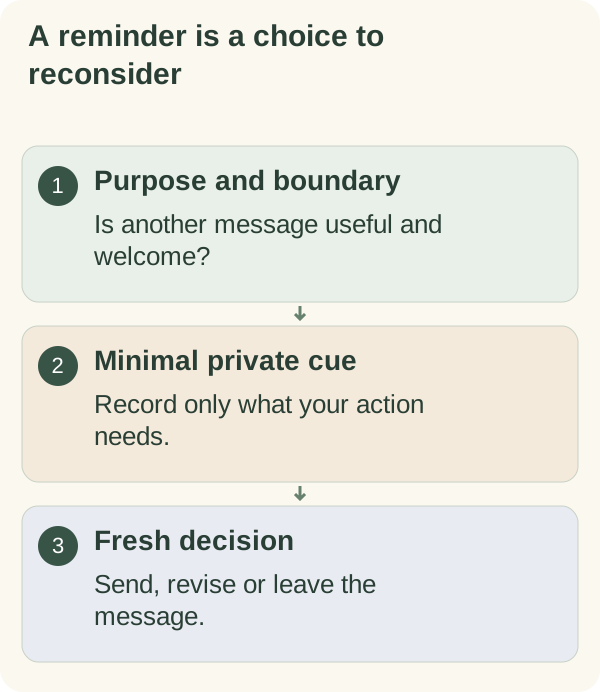
Write a minimal follow-up cue
- Purpose:
why might another message help?
- Boundary:
is follow-up welcome, given what they have told you?
- Timing:
when would you like to reconsider it?
- Privacy:
keep only the detail you need for your own action.
- Choice:
when it comes up, decide again whether to send, change or leave it.
Keep sensitive content out of the reminder
You do not need to copy someone's private circumstances, health details or a whole conversation into another system to remember to ask after them. If you use a reminder app or service, check its actual privacy and notification settings yourself. A note written during an article exercise does not create a notification or send anything.
Messages you can adapt
These are illustrative. Each one asks for nothing back.
AFTER THEIR BIG DAY
"Was thinking of you on Thursday. Hope the interview went the way
you wanted. No need to report back unless you feel like it."

AFTER A HARD STRETCH
"Still thinking of you. No need to reply, I just wanted you to know.
I'm around on Saturday if a walk or a call would help."

AFTER YOUR OWN UNANSWERED INVITATION
"Just checking whether the 14th could work for you. Completely fine
to leave it if the timing's wrong."
Sometimes the follow-up is really a thank-you: they helped you move, covered a shift or listened at the right moment. The thank-you message builder helps you name what they did and what changed because of it. When the follow-up is support for someone going through a hard time, the encouragement message helper starts from what you know and what you can honestly offer. Both connect the quiet planning side of Armored Kitten with its greeting studio: the cue reminds you, and the message is the step.
Example: Alex's friendship spreadsheet
A fictional example, written to show the steps in practice. Alex worried he was a forgetful friend, so he built a spreadsheet: every friend's name, the date he last contacted them and a colour that turned red after three weeks.
What happened: within a month the sheet was mostly red. Opening it felt like opening a pile of bills, so he stopped opening it, and then felt worse.
What he changed: he deleted the "last contacted" column completely. Now he keeps a short note with three or four cues at most, written as his own actions. He reads it on Sunday evening during his weekly review and nowhere else.
What it looked like after: one Sunday the note said "Ask Maya how the driving test went" and "Decide whether to message Sam again". He sent Maya a short message, and she replied with a photo of her new licence. For Sam, who had not answered an invitation, he sent one light follow-up, then removed the cue. Sam replied a fortnight later after a hectic month, and the invitation went ahead.
If you use the Armored Kitten Telegram companion, the weekly review guide shows a short weekly reflection where a cue check like this fits.
When you have followed up once and heard nothing
This is where well-meant follow-up most often tips into pressure.
- If it was an invitation or question, one follow-up is enough. After that, remove the cue and assume the answer is "not now". You can invite them to something new another time.
- If you feel the urge to try a different app or channel, pause. Switching channels can feel like being tracked. Only do it if the first channel may genuinely have failed, such as a changed number.
- If you feel hurt, that is understandable. Write the feeling down for yourself rather than putting it into a second follow-up.
- If you have a real concern for their safety, that is no longer a follow-up question. Contact someone who can check on them, or local emergency services if you believe they are in danger.
When someone told you something heavy
If a friend shared something painful, such as a loss, an illness or a crisis at home, follow-up matters, and it needs a lighter touch.
- Ask how they would like you to check in. "Would you like me to message now and then, or would you rather reach out when you're ready?"
- Keep the cue vague and never store their details in a shared or work system.
- Remember you are a friend, not their support service. If they seem to be in serious distress or mention harming themselves, encourage them to contact a doctor or a crisis line, and contact local emergency services if they are in immediate danger.
Remove cues that no longer belong
If the person declines, asks for space, or the question stops mattering, update or delete the cue you control. An old recurring prompt cannot override a boundary they have since expressed. Remembering to ask how someone's week went is one of the smallest ways to look after the people around you, and it should stay that small.
Use take a small connection step to choose an appropriate action. Read small ways to reconnect for an opening that does not require a long exchange. The next-action and boundary fields in the Low-pressure connection cards help you decide whether a follow-up cue is appropriate at all. More guides on finding the right words are in Find the words for someone.
Questions people often ask
How long should I wait before following up on a message? There is no rule that suits every friendship. If nothing depends on the answer, waiting a week or more, or simply waiting for them, is kinder than a quick nudge.
Is it weird to remember someone's important dates? Most people are glad to be remembered. Keep the note private and the message light.
Should I follow up if they said "I'll let you know"? Only if a real decision depends on it. Otherwise, take them at their word.
What if I forgot to follow up and the date has passed? Send it anyway: "I realised I never asked how the move went." Late is usually better than never.