Invite without pressure
- Step 1Offer one specific plan
- Step 2Make declining easy
- Step 3Give the person time to reply
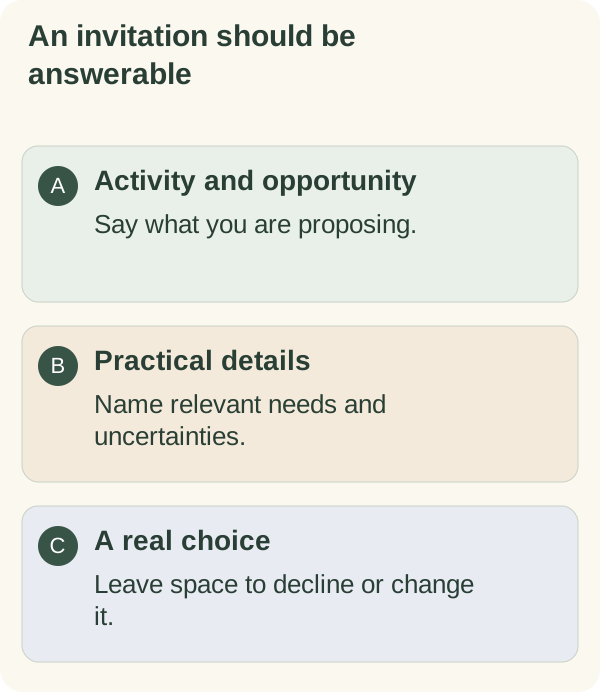
A low-pressure invitation names one concrete plan, gives the details someone needs to answer (roughly when, where and what it costs), and includes a genuine easy way to say no. Send it in a single message, accept the first answer graciously and do not treat silence as a yes. "I'm going to the Saturday market around ten; want to come? Free to wander, no worries if not" is easier to answer than "we should hang out sometime".
What makes an invitation feel like pressure
The pressure in an invitation is rarely about the activity. It usually comes from one of these:
- Vagueness. "We should get together" leaves the other person to do the planning, so it often goes nowhere.
- Hidden costs. A plan that turns out to be an expensive dinner or a long journey puts someone in an awkward spot after they have said yes.
- Big stakes. A whole evening with people they have not met is a lot to agree to on a first invitation.
- Guilt framing. "You never come out any more" makes saying no feel like a confession.
- Invented deadlines. "I need to know in an hour" when you do not, is a way of forcing a decision.
- Chasing. A second and third message turns a choice into an obligation.
Remove those and most invitations become easy to send and easy to answer.
Three low-pressure shapes
| Shape | What it sounds like | Good when |
|---|---|---|
| Tag-along | "I'm already going to the craft fair on Sunday. Want to come?" | You would go anyway, so a no costs nothing |
| One small plan | "Coffee near the station on Thursday after work, about an hour?" | You want time with this person specifically |
| Standing open invite | "I walk by the river most Sunday mornings. Join any week you like." | You want to stay open without asking each time |
A tag-along carries the least pressure, because the plan exists whether or not they come. A small plan says "I want to see you", which is lovely and slightly more exposed. A standing invite works best once you already know each other a little.
Draft the invitation
- Opening:
begin in a way that fits how well you know them.
- Activity:
one plan, said simply.
- Time:
a rough time, or two options to choose between.
- Details:
place, cost, travel or access information that affects their answer.
- Easy no:
a line that makes declining feel normal.
A fill-in invitation
Hi [name], [one line that fits your relationship].

I'm [activity] on [day] around [time] at [place].
[Cost / access detail, e.g. "It's free to get in" or "about the price
of a coffee" or "step-free from the station".]

Would you like to come? [Easy no: "No worries at all if it doesn't
suit" / "Happy to do something another time instead."]
If you need an answer by a certain time for a real booking, say why: "I need to book the table by Wednesday." A genuine deadline, explained, is not pressure.
How to reply to every answer
Deciding this in advance stops a no from stinging and a maybe from turning into a week of wondering.
| Their answer | A reply that keeps it easy |
|---|---|
| Yes | Confirm the practical details in one message: time, exact place, how to find you. |
| Maybe | "No rush. I'll be there either way, so just come along if it works out." |
| A different suggestion | Check your own availability honestly, then say yes or offer one alternative. |
| No | "No problem at all. Another time." Do not immediately offer three new dates. |
| No reply | Treat the plan as not happening. If there is a real reason, one light follow-up at most. |
A yes still needs confirming. Silence is not a confirmed plan.
Example: Maya invites someone she has just met
Illustrative example only; this is not a real person's story. Maya got chatting with Alex at a Saturday pottery class and liked her a lot, but they did not know each other well.
First attempt: at the end of class Maya said "We should hang out sometime." Alex said "Yes, definitely." Neither suggested anything, and three weeks passed.
Second attempt: Maya messaged with a tag-along: she was going to a craft fair the next Sunday afternoon, entry was free, it was a short walk from the class, and "no worries if you're busy". Alex replied that Sunday did not work but suggested coffee after the next class instead.
What Maya changed: she now always includes one concrete plan and treats a counter-suggestion as good news rather than a polite no. The coffee happened, and became a habit after class.
When cost, access or confidence might get in the way
These are the situations most invitation advice skips, and they are often the real reason someone says no.
- If you do not know their budget, choose something free or cheap, or say the likely cost up front so they do not have to ask.
- If you are not sure the place suits them, ask simply: "Is there anything about the venue that would make it tricky? Happy to pick somewhere else." Do not describe a place as easy for everyone unless you have checked.
- If they have mentioned finding social plans hard, keep it short, small and with a clear end: "Just a quick coffee, I've got to be back by four."
- If you are inviting a group, send each person you most want there a short personal message as well as the group post. A group message alone is easy to miss.
- If they have said no several times in a row, leave a standing open invite and stop asking directly. They know where to find you.
- If you need to cancel yourself, do it as early as you can, with a short reason and no fuss.
Send it yourself after reviewing it
Read the message once more for tone and details before you send it through your own messaging app. A draft in a guide or tool has not reached anyone yet. You do not need to share private conversation details with a tool to make an invitation sound personal.
An invitation like this is a small step toward someone else, the side of Armored Kitten that is about the people around you rather than your own to-do list. Use take a small connection step to choose and shape the message. Read small ways to reconnect if getting back in touch is the part that feels difficult. The invitation and options fields in the Low-pressure connection cards are a quick check before you decide whether to send. For more help with wording, see Find the words for someone.
Questions people often ask
How do I invite someone without seeming needy? Make it about the plan, not about you: one concrete activity, a rough time and an easy no.
Should I invite by text or in person? Either works. A message gives them time to check their week; an in-person invitation is best followed up with the details in writing.
What if they say "maybe" and then go quiet? Take it as a no for this time and do not chase. A future invitation is still fine.
How many times can I invite someone who keeps saying no? After two or three, switch to an open invitation and let them choose when.