The smallest way to reconnect is one short, specific message that asks very little back: a memory you share, a question about something they told you, or a line saying something made you think of them. You do not need to explain the silence first. Send it, let them answer at their own pace, and choose your next step from whatever comes back.
You also do not have to contact anyone if doing so would feel unsafe or unwelcome. This guide is for friendships you would like back, where the only thing in the way is that time has passed.
Why the first message feels bigger than it is
The longer a gap runs, the more you imagine you owe: an explanation, an apology, a summary of the last year. That imagined debt is usually what stops people from writing at all. The person receiving your message sees something much smaller. A two-line note is easy to read and easy to answer. A long explanation asks them to respond to your guilt before they can respond to you.
So keep the first contact light. You can talk about the gap later, if it ever needs talking about. Often it does not.
Openers sorted by the time you have
Pick the row that fits today, not the one that sounds most impressive. All of the wording below is illustrative; change it until it sounds like you.
| Time you have | Kind of opening | Example to edit |
|---|---|---|
| Under a minute | A "this reminded me of you" note | "That song from our road trip came on the radio. I laughed out loud on the bus." |
| A couple of minutes | A question about something they shared | "Last time we spoke you were about to start the new job. How has it turned out?" |
| About five minutes | A card or greeting for a real occasion | A birthday, a new home, a finished course or a holiday you both used to mark |
| Ten minutes | A voice note | Tell them one small thing from your week and ask one thing about theirs |
| An afternoon, later on | An invitation with one clear plan | "I'm free most of Saturday. Would a short call or a walk suit you some time?" |
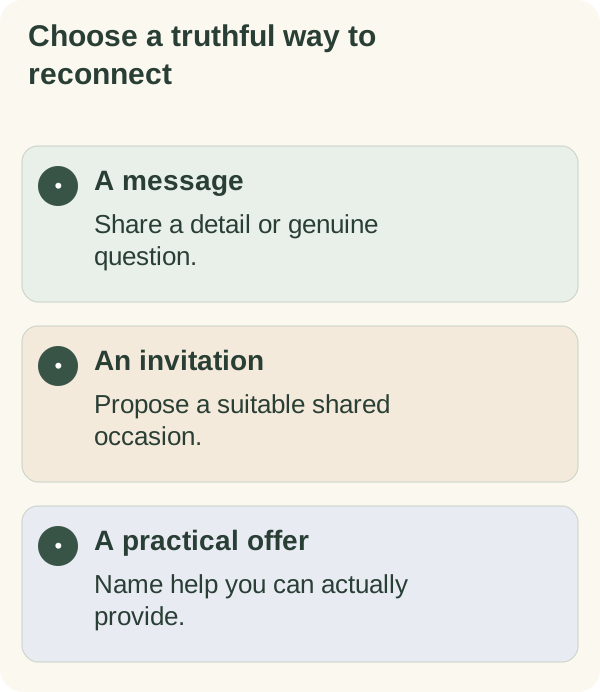
A message asks a question. A card marks a moment. An invitation proposes time together. A practical offer names something you can do, such as "I can pick up that parcel on Thursday if it helps." These are different openings, and it is fine to start with the smallest one and move up later.
Let an occasion do the explaining
After a long silence, an occasion is the easiest reason to write, because it answers the question "why now?" before anyone asks it. A birthday card, a note when they finish something they were working on, or a greeting on a holiday you used to spend together all say "I remembered you" without needing a backstory.
This is the point where Armored Kitten's companion and its greeting studio meet: the companion helps you choose one manageable step toward someone, and a card is often exactly that step. When a card fits, choose a personal greeting and add one real detail. For friends who live far away, the guide to birthday messages for a long-distance friend helps with timing, and unique birthday messages for friends has ideas when the usual lines feel flat. More guides on finding the words sit in Find the words for someone.
Offer something you can keep
If you know the person is having a demanding stretch, a specific offer can mean more than a question. Keep it to something you can actually do: a call at a time you are free, help with one errand, or dropping round with food you were making anyway. "Let me know if you need anything" sounds kind but hands the work back to them. "I could bring soup on Wednesday evening" is easy to accept or decline.
The encouragement message helper lets you work with your own details in the browser. Treat its suggestions as starting points and edit the result yourself.
Example: Sam writes to an old flatmate
Here is a made-up example to show how it can work. Sam and Daniel shared a flat at university. Daniel moved away for work, and over two years their messages thinned out to nothing. Sam kept opening a draft that began with three sentences of apology, then closing it.
What he did: Daniel's birthday was a week away. Sam dropped the apology draft and sent a birthday card instead, with one line about the night the smoke alarm went off over burnt toast and a short "Hope the new city is treating you well."
What happened: Daniel replied four days later. The reply was warm but brief.
What he changed: Sam's first instinct was to answer by proposing a monthly call. He held back, replied with one easy question about Daniel's work, and only asked about a call a couple of weeks later, once a few messages had gone back and forth. He also stopped treating the gap as something he had to settle before the friendship could restart. It never came up.
A reconnect message you can fill in
Copy this, fill the brackets and delete anything that does not sound like you.
Hi [name],

[One true detail: something you saw, remembered or heard about them.]

[One easy question OR one specific offer you can keep.]

[An easy out, for example: "No rush to reply" or "Whenever suits you."]

[Your name]
Check it before you send
- The person:
someone you are comfortable contacting, who has not asked for space.
- The detail:
a real memory, question or offer, not a general "we should catch up".
- Read it aloud:
cut any line you would not say to their face.
- Your choice:
send it through your own messaging app, save it for a better day or leave it.
When you were the one who went quiet
Most reconnecting advice assumes the drift was mutual. Sometimes it was not, and that changes what the first message should do.
- If the gap was ordinary busyness, one light sentence is plenty: "I've been bad at keeping in touch, and I've missed hearing from you." Then move on to the detail or question.
- If you missed something important to them, such as a wedding, a loss or a hard diagnosis, acknowledge it plainly and briefly, without asking them to reassure you. The guide to writing a sincere apology message helps when an apology is genuinely owed.
- If the friendship cooled after a disagreement, a cheerful "thought of you" note can feel like skipping over it. Decide first whether you want to repair things. If you do, say so honestly rather than hoping a breezy opener will do the work.
- If they asked for space, respect it. Do not use a birthday or holiday as a way around that request.
- If you are unsure whether they would welcome contact, a single low-key message with an easy out is the most respectful test. If it goes unanswered, leave it there.
Let the reply be theirs
One message does not commit either of you to a long conversation. If there is no reply for a while, you do not know why. People lose messages, have hard months and mean to answer later. Avoid turning a delay into a story about what they think of you.
If they reply briefly, match their length. If they reply with a lot, you have your answer about whether they want more contact. Either way, the next step comes from their response, not from a plan you made before sending.
Use the companion as a drafting aid
You can ask the companion to help make a message shorter or clearer. Share only the context you want processed, and leave out private details that belong to the other person. Review the words and send them yourself. The companion does not replace human relationships or contact your friend on your behalf.
Try a small connection step, write an encouragement message, or choose a personal greeting when a card suits the moment. The first card in the Low-pressure connection cards has space for who you want to contact, the opening and your next action. Other guides on catch-ups, invitations and check-ins are collected in Friendship check-ins and shared accountability.
Questions people often ask
Is it strange to message someone after years of silence? Usually less strange than it feels. A short, specific note with no pressure to reply is a gentle way to find out whether they would like to be back in touch.
Should I mention how long it has been? A brief nod is fine if leaving it out feels odd. You do not need to account for every month.
What if they never reply? Let one message stand. You can write again on a future occasion if it feels right, but avoid sending a string of follow-ups.
Text, call or card? Start with whatever they are most likely to answer comfortably. For many people that is a message or a card, with a call suggested once you are talking again.