Draft an apology
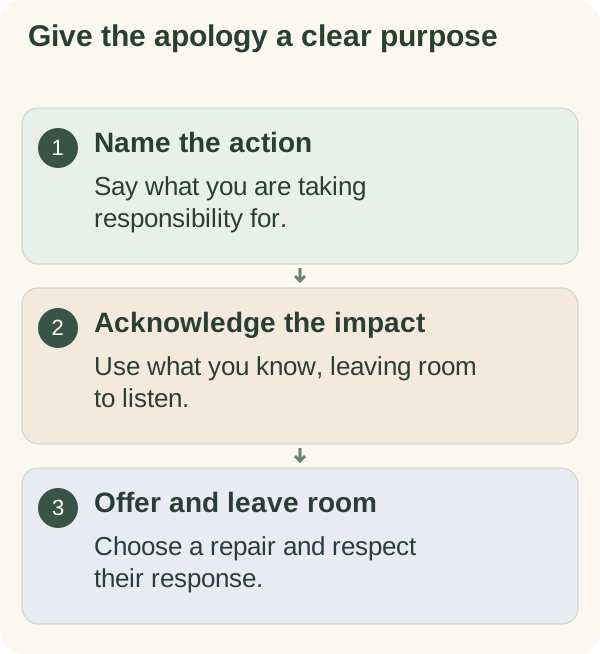
- Step 1Name what you did
- Step 2Acknowledge its effect
- Step 3Offer a concrete repair
Name what you did, acknowledge the impact you know about and offer a repair you can keep. Write the apology in your own words, then leave the other person room to decide whether and when to respond.
A short apology you can adapt
I'm sorry I missed your birthday dinner without letting you know. You had arranged a place for me, and I left you waiting. I should have contacted you. If you would welcome it, I'd like to arrange another time to celebrate you. I understand if you need space.
This is illustrative wording. Replace the occasion and offer with what actually happened. If you do not know how the person experienced it, describe the effect you can honestly acknowledge rather than telling them how they feel.
Build the message around four choices
1. Say what you are apologising for
“I'm sorry I interrupted you during the meeting” identifies an action. “Sorry about everything” leaves the reader to work out what you mean.
Choose the part you are responsible for. You can acknowledge your conduct without making claims about another person's motives or accepting a version of events you do not believe is true.
2. Acknowledge the impact
Use what you know: “You had prepared the presentation, and I did not give you room to finish.” If the impact is unclear, leave space to listen rather than completing the story for them.
An explanation may matter, but keep it separate from blaming the person receiving the apology. Read a sentence beginning “I'm sorry, but you…” again and decide whether it is taking responsibility or starting a different conversation.
3. Offer a specific repair
Choose an action you can actually take. Correcting shared notes, returning an item or communicating a change earlier next time are more concrete than promising that nothing will ever go wrong again.
Where the offer involves their time or company, ask instead of assuming: “Would you like me to arrange another meal?” leaves a choice. A practical correction at work may need to happen through the agreed work process as well as appearing in the message.
4. Leave the response to them
You can say that no reply is needed if you mean it. Avoid adding a demand for reassurance or following the apology with repeated requests to confirm forgiveness.
Respect a stated request for space or no contact. An apology is not permission to bypass a blocked channel or send another kind of message to obtain an answer.
Short sorry messages by situation
These are starting points, not accounts of things that happened. Change the detail, tone and offer before using one.
For a friend
- I'm sorry I cancelled without enough notice. You had made time for me, and I should have told you earlier.
- I made a joke at your expense. It was unkind, and I'm sorry.
- I forgot our plan and left you waiting. I'm sorry. If another occasion would suit you, I would like to arrange it properly.
- I'm sorry I shared something you told me privately. I will not repeat it, and I will correct what I can with the person I told.
For a partner or family member
- I'm sorry for raising my voice last night. I want to discuss the issue without speaking to you that way.
- I agreed to handle the errand and did not do it. I'm sorry I left you to deal with the result.
- I'm sorry I looked at my phone while you were trying to talk. If you want to continue the conversation, I will put it away and listen.
- I dismissed what you were telling me. I'm sorry. I would like to understand more if you want to explain.
For a coworker
- I'm sorry I interrupted your update. I will make room for you to finish at the next discussion.
- I sent the wrong version of the document. I'm sorry for the confusion. The corrected file is in the agreed project location.
- I missed the deadline and should have flagged the delay earlier. Here is the current state and the next delivery time I can offer for agreement.
- I'm sorry I left your contribution out of the notes. I have corrected the attribution and will share the updated version through our usual channel.
Only say that a correction is complete when you have actually made it. Use your workplace's reporting process if the mistake needs more than a personal message.
For a missed birthday or event
- I'm sorry I missed your birthday. I hope you had a day that felt like yours. I would still like to celebrate you if that would be welcome.
- Happy belated birthday. My message is late, but I wanted to send you my love and wishes for the year ahead.
- I'm sorry I missed the celebration without getting in touch. You had included me, and I should have replied.
- I'm sorry I could not be at your show. If you would like to share a recording or tell me about it, I would love to hear.
Keep the birthday message centred on the person, rather than making it a long account of your guilt. For a more celebratory note, browse birthday messages for friends.
For something you said
- I'm sorry I made that personal comment. It was not mine to judge.
- I spoke as though I knew what you were thinking. I did not, and I'm sorry.
- I'm sorry for the harsh wording in my message. I want to restate the concern more respectfully.
- I repeated something I had not checked. I'm sorry. I will correct the claim with the people who received it.
Choose a card and tone that fit the apology
A light headline may fit a missed birthday between close friends. It may be a poor fit for a serious hurt. Read the design's headline and message together, and change anything that distracts from the responsibility you want to acknowledge.
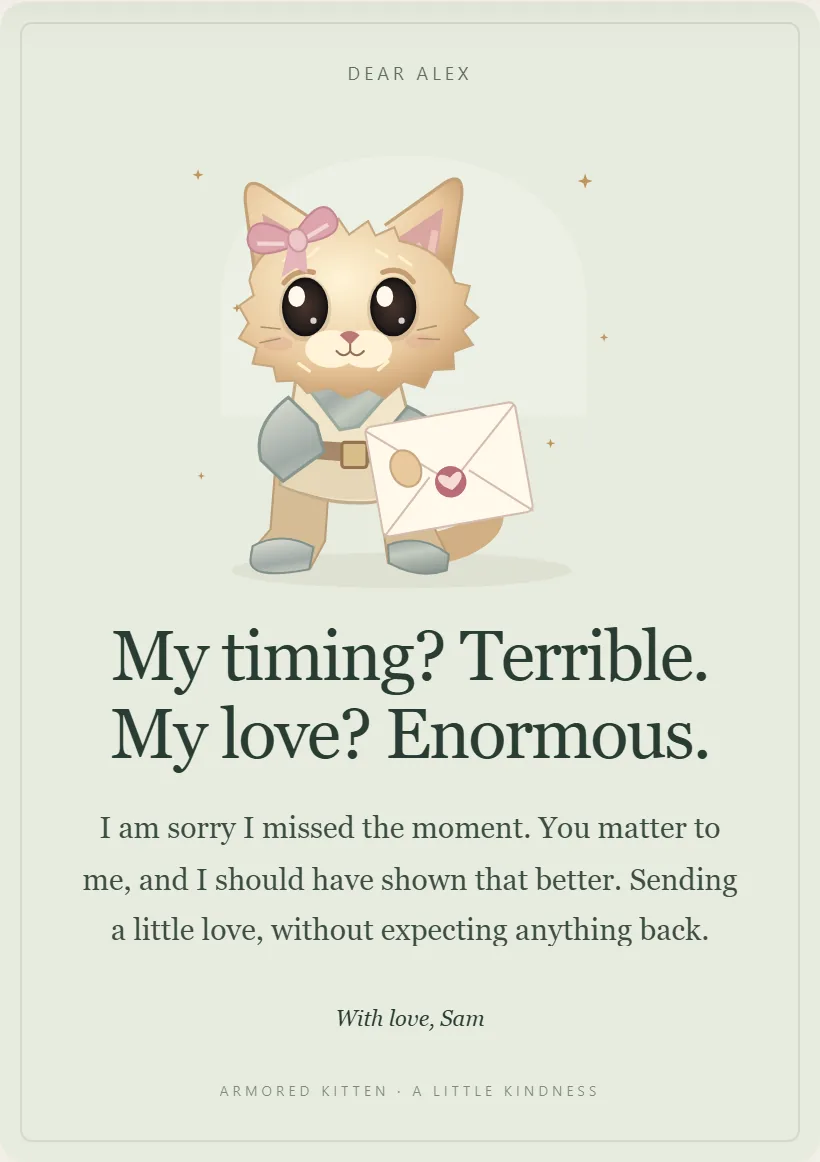
Start with a sorry card if a card is welcome. Write the apology before adding optional details. A photo, joke or gift need not accompany it. If you prefer speaking, see the voice-message guide and review the words you intend to record.
Questions before sending
How long should the message be?
Use enough detail to name the action, acknowledge its effect and describe a useful repair. A few sentences may do that. More complicated matters may need a conversation or the relevant formal process; a fixed sentence count does not decide whether the apology is adequate.
What if they do not reply?
You do not know the reason from silence alone. Leave room for their choice and respect any boundary they have stated. Avoid using another message, a gift or a new contact channel to press for a response.
Can a belated birthday message include an invitation?
Yes, if it is an invitation you would like to make and can keep. Offer it without treating acceptance as part of forgiving the missed occasion.
Should I include a gift?
Consider whether a gesture would be welcome in the actual relationship. It does not replace the correction you promised, and the apology can stand on its own.
Read it once as the recipient
Check that the message names your action, contains only true details and offers no promise you cannot keep. Remove any line that asks the reader to manage your guilt. Then choose whether the timing and channel are appropriate before sending.
When a card fits, make the sorry message your own. For a separate future invitation, the low-pressure connection guide can help you leave room for a decline.