Agree four things together and write them down: what the check-in covers, when it happens, what kind of reply is wanted, and how either of you can pause or stop it. Review that agreement after a few weeks, not only the task. Many uncomfortable check-ins trace back to something that was never said at the start, so naming it early keeps the arrangement kind. If it has already drifted, change one specific thing rather than putting up with it or quietly disappearing.
Define the role
Hearing an update, asking one agreed question and giving advice are three different jobs. Choose which one the check-in is. Either person can decline or offer something smaller, and the person doing the task keeps responsibility for their own decisions.
An informal check-in is not professional care, and it does not guarantee the task gets done. If a concern comes up that sits outside what you agreed, such as health, money trouble or how someone is coping, look for the right kind of support rather than stretching the check-in to cover it.
The check-in agreement card
Fill this in together. It takes ten minutes and saves weeks of guessing.
| Question | Our answer | Example |
|---|---|---|
| What does the check-in cover? | "My course assignments, nothing else" | |
| When does it happen? | "Tuesday and Friday evenings, by message" | |
| What reply is wanted? | "Just an acknowledgement. Advice only if I ask." | |
| What stays private? | "No screenshots or mentions to anyone else" | |
| What happens after a missed update? | "Nothing. Or one 'all okay?' after two days." | |
| How does either of us pause or stop? | "Just say so. No reason needed." | |
| When do we review this card? | "After four weeks" |
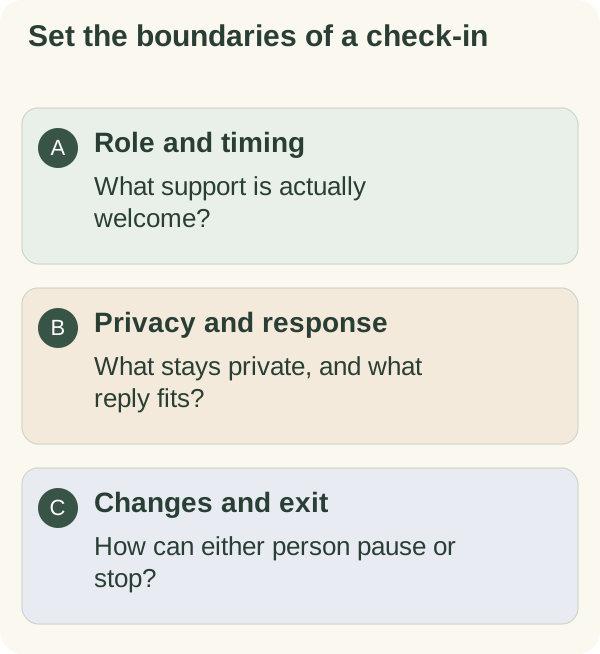
Agree on check-in boundaries
- Topic:
name the action or routine being discussed.
- Timing:
choose a suitable occasion or frequency.
- Response:
agree what kind of reply, if any, is wanted.
- Privacy:
decide what stays private and must not be passed on.
- Exit:
agree how to change, pause or end the arrangement.
Signs the arrangement has drifted
Check-ins rarely go wrong all at once. They drift. Each of these signs has a matching fix:
- If you feel a small dread when a message arrives, the frequency or tone has moved away from what helps. Reduce how often you check in or narrow what you report.
- If advice arrives that you did not ask for, restate the role: updates only, advice on request.
- If a missed update leads to guilt or an apology, agree again that a gap is just a gap. The guide on what a missing habit entry means makes the same point for your own records: no entry is a question, not a verdict.
- If one of you is doing all the supporting, either make it mutual or agree that one-way support is fine for now and say so.
- If check-ins have grown into long debriefs, set a length again: "Let's keep these to a couple of lines."
- If the supporter feels responsible for the outcome, remind each other where the responsibility sits: with the person doing the task.
Decide what a missed reply means
Silence may mean nothing was recorded, availability changed or someone wants to reconsider. Do not assign a failure state to it automatically. Agree whether a follow-up is welcome at all, and what it would look like, rather than assuming that repeated messages are part of support.
An illustrative line to use at the start: "I'll send a short update after each study session. No chasing if I don't. Tell me if getting these stops suiting you." Use it only if it matches what you both understand.
Scripts for changing or ending it
Pick the one you need and adjust the words.
REDUCE IT
"These have really helped. Could we drop to once a week? Twice is
starting to feel like a lot with everything else on."

STOP THE ADVICE
"Can I ask a favour? For now I'd just like you to hear the update,
not solve it. I'll ask if I want ideas."

PAUSE IT
"I need to pause our check-ins for a few weeks while work is mad.
Can I message you when I'm ready to start again?"

END IT
"I think I've got what I needed from our check-ins, and I'm really
grateful. Shall we call it done? Happy to return the favour any time."

WHEN YOU ARE THE SUPPORTER AND NEED TO STEP BACK
"I want to be honest: I can't keep up with the check-ins at the
moment. I'm still glad to hear how it's going now and then."
Example: Alex and Sam's study check-ins
Illustrative example only; this is not a real person's story. Alex was studying for a professional exam and asked Sam for daily check-ins. Sam was happy to help.
What drifted: after three weeks, Sam had started adding comments such as "only an hour today?" Alex began dreading the messages and twice did not send an update rather than face the reply. Sam, meanwhile, felt he was failing Alex when an update did not arrive.
What they did: they sat down with the agreement card. Check-ins moved to twice a week. Sam would reply with an acknowledgement only, unless Alex added "thoughts?" at the end. Sam also said he needed Fridays free of anything that felt like a responsibility, so the second check-in moved to Thursday.
What changed: Alex started sending updates again, including honest ones about bad weeks. Sam stopped feeling that the exam result was partly his job. They reviewed the card again a month later and changed nothing.
Keep access proportionate
A plain description of what you did is usually enough. Do not exchange passwords, private documents or sensitive personal information just to prove progress. Ask permission before sharing someone's message, photo or result with a wider group, including a group chat you both belong to.
When the goal touches health, money or mood
These are the check-ins where boundaries matter most, and where well-meaning friends most easily overstep.
- Health or exercise goals: share what you did, not medical details. The friend does not set targets or judge what is safe. Ask a doctor or suitably qualified professional about anything to do with your health, injury or a condition.
- Money goals: report actions such as "paid the bill" or "checked my spending", never account access, balances you would rather keep private or passwords.
- Mood or coping: a friend checking in can be comforting, and it is not a substitute for professional help. If either of you is worried about the other's safety, contact a doctor, a crisis line or local emergency services rather than relying on the check-in.
Review the agreement itself
If a check-in becomes uncomfortable, too frequent or unhelpful, raise the change directly, using a script above if it helps. Ending an optional arrangement does not require completing a final streak or explaining every earlier gap. Armored Kitten's companion is built on the idea that a missed day is not a verdict, and a check-in between friends works best on those same terms.
Read working alone accountability for a bounded session exercise. Use take a small connection step to prepare a boundary conversation before sending it yourself. The check-in-boundaries card in the Low-pressure connection cards records only what both people understand and accept. If you need gentler words for a hard conversation, Find the words for someone has more help.
Questions people often ask
How often should accountability check-ins happen? As often as is still helpful and not a burden for either of you. Review it after a few weeks rather than guessing perfectly at the start.
Is it okay to ask my accountability partner to stop giving advice? Yes. Asking for updates only is a clear, reasonable boundary.
What if my friend gets upset when I change the arrangement? Thank them for what they have done, explain the specific change and leave room for them to say what they need too.
Should we put the agreement in writing? A few lines in a shared message is enough. It helps when you review it later.