Choose by available time
- Step 1Group meals by effort
- Step 2Shop for the slots you expect
- Step 3Keep a backup ready
When you cannot predict your evenings, plan meals by the kind of evening they need instead of by day. Sort a few familiar meals into three groups: ones for an evening with time, ones for a short evening, and ones for when you get in with nothing left. Shop for fewer meals than there are nights, and each evening pick from the group that matches the evening you actually got, using up the most perishable ingredients first.
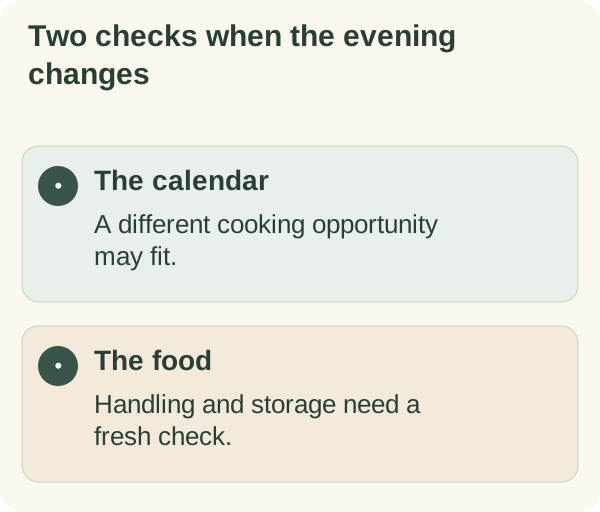
A Monday-to-Sunday meal plan assumes you know what Monday to Sunday look like. If you work shifts, get called in, look after someone whose needs change or simply have a job that runs late without warning, that grid breaks on the first day. The answer is a menu you choose from, not a timetable you follow.
Sort meals by the evening they need
Look at the meals you already cook and ask what each needs from you: how long, how much attention and how many steps. Then group them. A typical sort looks like this, though your own meals will differ:
| Kind of evening | What it can hold | Kinds of meal that fit | Shopping note |
|---|---|---|---|
| Full evening | Time to chop, simmer and wash up | A stew, a roast, a dish you are trying for the first time | Buy for these only when you can see a free evening coming |
| Short evening | About as long as it takes to boil pasta | Stir-fries, omelettes, a pasta dish with few steps | Keep the ingredients for one or two of these in |
| Nothing left | Heating something up | Soup or a container of something from the freezer, beans on toast, a ready meal | Keep two or three of these in the cupboard or freezer at all times |
| Not home | Nothing | Eating out, at work or at someone else's | No shopping needed |
Ready meals, takeaway and a sandwich all belong in the third or fourth row. A backup that saves you from a frustrating evening is part of the plan, not a failure of it.
Shop for a few meals and keep the backup topped up
Do not buy for every possible choice at once. Count the evenings you are fairly sure you will be home with some time, then buy for that many full or short meals and no more. If the week turns out better than expected, the backup row and a short top-up shop cover the gap.
The backup only works if it is there. Treat the "nothing left" meals as staples on your shopping list, and replace one as soon as you use it.
Choose tonight's meal when you know what tonight is
The decision moves from Sunday to the moment you know your evening, usually on the way home or when your day's hours are confirmed.
Choose tonight's meal in two minutes
- Name the evening.
Full, short, nothing left or not home.
- Check what needs using.
Which fresh ingredients in the fridge are closest to their date?
- Pick from the matching group.
Choose a meal that uses those ingredients, if one fits.
- Check the storage needs.
Before keeping an ingredient for another day, read its label or storage guidance.
- Note the change.
Cross off the meal you made and, if you used a backup, add one to the list.
Check the food before you move a meal
An unpredictable week tempts you to push meals along by a day, then another. Ingredients do not move as easily as calendar entries. Fresh items with short dates, defrosted food and opened packs each have their own storage instructions. Check labels and authoritative guidance before deciding whether to cook, store, freeze or throw something away. The FoodSafety.gov handling and storage resources are a good starting point for those checks.
A useful note on the fridge might say: "If Tuesday falls through, check the fish first: cook it Wednesday or freeze it, following the pack." That is safer than shifting every meal one day later by default.
This page plans around time, not nutrition. Allergies, a medical diet or concerns about eating are questions for a doctor or registered dietitian. Build your groups from foods that already suit you, within whatever advice they give.
Example: Maya's rota week
Here is a made-up example to show how it can work. Maya works shifts that change week to week, and her rota sometimes changes after it is published. She used to write a seven-day plan on her day off, shop for all of it, and throw away food most weeks.
She started by sorting the meals she already liked. Her full-evening group had two dishes, her short-evening group four, and her backup group was soup from the freezer and eggs on toast. She now shops for three cooked meals a week, chosen when the rota comes out, plus whatever the backup row needs.
In the first week she had more short evenings than expected, cooked two of the three, and used the third meal's chicken by freezing it the day it reached its date, as the pack allowed. In the second week she noticed that she never had the energy for the full-evening meals after a late shift, so she now saves those for her days off. Most weeks she throws away much less, and late shifts no longer come with a decision about dinner.
A menu card you can copy
Write your own meals into each group, then pin it inside a cupboard or keep it in your phone.
MY MEALS BY KIND OF EVENING

FULL EVENING (time to cook and wash up)
1. ____________________
2. ____________________

SHORT EVENING (quick, few steps)
1. ____________________
2. ____________________
3. ____________________

NOTHING LEFT (heat up or assemble)
1. ____________________   Keep in: cupboard / freezer
2. ____________________   Keep in: cupboard / freezer

THIS WEEK
Evenings I'm fairly sure of: ____
Cooked meals to buy for: ____
Use first (shortest date): ____________
Backup row topped up: yes / no
When you only learn your hours on the day
Most advice for busy weeks still assumes you know your schedule a few days ahead. Some people do not.
- If you find out your hours that morning, keep the shopping very light: one or two short-evening meals and a full backup row. Do the two-minute choice as soon as you know the day.
- If people in your home arrive at different times, choose meals that can wait or be reheated for later arrivals, and agree who puts the food away and when.
- If you are often too tired to cook after a long day, move the cooking. Cook a short-evening meal in double on a day off and freeze the second half where its guidance allows.
- If you care for someone whose needs change suddenly, let the backup row carry more of the week, and accept help with meals when it is offered.
- If a planned meal no longer appeals, swap it for another in the same group. Taste is allowed to change your plan too.
Review purchases as well as meals
At the next shop, check what is left and still usable before buying more. Remove meal ideas you keep skipping. If the full-evening group never gets used, it may be the wrong group for this season of your life.
The weekly review helps you look at the practical fit of the week. If several evening tasks are competing, plan an overwhelming day before you add another cooking commitment. The food-decision and review cards in the routine worksheet can hold the next arrangement and what you learned about its fit.
Choosing tonight's meal from a short menu is the same small-step idea behind the habits and goals path: a decision sized to the evening you have, not the one you hoped for. If late finishes are the main problem, building an evening routine when you work late covers the rest of that evening.
Questions people often ask
Is it still meal planning if I do not assign days? Yes. You are planning which meals you can make and having the food for them. The day is chosen later, when you know it.
How many backup meals should I keep? Enough to cover the evenings you usually lose in a bad week. For many people that is two or three, but your own weeks are the best guide.
What if I keep throwing food away? Buy for fewer cooked meals and rely more on the backup row. Cooking less often but wasting less is a good trade.
Can I move a meal to the next day? Often, but check the ingredients first. Some keep well and some do not, so read the label or storage guidance before deciding.