After a demanding week, plan the next three days rather than the whole of the next week. On day one, cover the essentials and sort what the hard week left behind. On day two, bring back one routine you actually want, in a small form. On day three, take ten minutes to see how it went and decide what comes back next. Last week's unfinished list is something to sort, not something you automatically owe.
A demanding week might be a work crunch, a family emergency, a house move or several nights of disrupted sleep. This page does not judge how tired you are or promise any recovery timetable. It helps you decide what the following days hold. If tiredness or low mood carries on for weeks, or worries you, talk to a doctor or qualified professional.
Sort what the hard week left behind
A demanding week leaves three kinds of debris: unanswered messages, unfinished tasks and routines that stopped. Before planning the new week, put each item in one column.
| Still needed | Still wanted | Let go | |
|---|---|---|---|
| Messages | Replies with a deadline or someone waiting | Replies you would like to send | Threads that resolved themselves |
| Tasks | Work with an outside deadline | Projects you still care about | Plans that no longer fit |
| Routines | Anything set by health or care instructions | Habits you miss | Routines you were only keeping out of guilt |
Only the first column is a commitment. The second is a menu to choose from slowly. The third can be removed today, with a one-line note if you might want it back.
Choose a return plan
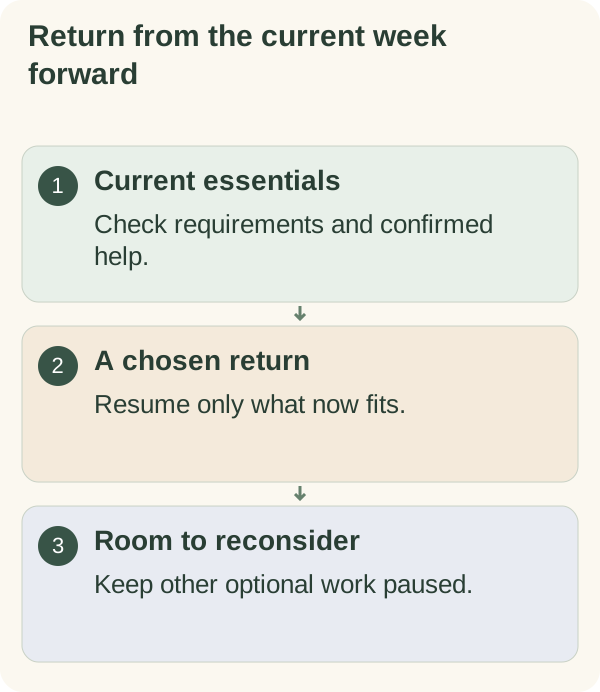
- Necessary:
identify what requires attention in the coming period.
- Support:
confirm help or handoffs that are actually agreed.
- Resume:
choose one optional routine you still want and can reasonably place.
- Leave:
keep other optional work paused, changed or removed.
- Review:
decide when to reconsider the arrangement, if useful.
A three-day return plan
Copy and fill in. Three days is long enough to see whether the return fits, and short enough that you are not committing your whole week while still recovering your footing.
| Day | Focus | Fill in |
|---|---|---|
| Day 1 | Essentials and sorting | Still-needed items: ____ / Messages to send: ____ |
| Day 1 | One open block | Time left unassigned: ____ |
| Day 2 | One routine back, smaller | Routine: ____ / Smaller version: ____ / When: ____ |
| Day 2 | One still-wanted task, if there is room | ____ (or leave blank) |
| Day 3 | Ten-minute review | Did day 2's routine fit? yes / partly / no |
| Day 3 | Next choice | Bring back another routine, keep as is, or pause longer: ____ |
Day one deliberately has no optional routine in it. After a hard week, the first day back usually fills up with things other people need. Accept that, and protect a single open block instead.
Make the first routine occasion specific
Choose a version that is smaller than the one you had before the hard week. For example: "Open the marked book during the available weekend opening and decide whether to read." That is a choice to make in the moment, not an obligation to catch up on all the pages you missed.
If you left a return note on a project before the hard week, read the current state before acting on it. People, requirements or your own interest may have changed. The return note guide covers what to check.
Example: Alex after a deadline week
The example below is illustrative; the person in it is not real. Alex had a week of late nights to finish a tender at work. By Friday the inbox had 140 unread emails, the flat was a mess, and Alex had not been for a run or called a friend in nine days.
On Saturday Alex sorted. Still needed: three emails with deadlines, the rent payment, the laundry. Still wanted: running, a call with a friend, a half-built bookshelf. Let go: a newsletter backlog and a plan to reorganise the kitchen.
Day one (Monday) was emails and laundry, with the evening open. Day two, Alex brought back running in a smaller form: one easy, short loop instead of the usual route, and nothing more ambitious. On day three's review, the run had fitted, but the open evening had been eaten by more emails. Alex moved the email time to a fixed half hour at lunch and kept the evening open on Thursday. The friend call went on Friday.
What changed: Alex had planned to restart running, the bookshelf and a weekly call all on Monday. Choosing only one per day for the first three days meant each of them actually happened. Coming back one routine at a time is the small-steps approach that runs through Armored Kitten, applied to the week after a hard one.
When the demanding stretch is not really over
Sometimes the hard week turns into a hard month, or comes back after a short break. A full return plan does not make sense then.
- If the pressure is still on, skip day two's routine and repeat day one: essentials, one open block, nothing else. Review again in a few days.
- If you return to a huge message backlog, sort by sender and deadline, answer only the still-needed ones, and send one line to the rest when you can: "Catching up after a busy week; I'll reply properly by Friday."
- If a routine you restarted does not fit, shrink it again or pause it on purpose. It does not need to prove anything this week.
- If the demanding week involved illness, injury or a health worry, ask a doctor or qualified professional before restarting anything physical, and follow their guidance.
For a return after a holiday rather than a hard week, the guide to restarting a routine after a holiday covers the different starting point.
Update people whose expectations changed
If someone expects a result you can no longer provide on time, give them an accurate update and agree the next step. A short message works: "Last week overran. I can send the draft on Wednesday instead of Monday. Is that all right?" A private change to your task list does not change what they expect.
Let the review include a longer pause
If the first three days still feel too full, look again at optional scope or ask for support. Keeping something paused is a decision, and it does not need an explanation for every empty day in a tracker. This page organises ordinary tasks and routines. It does not assess the cause of exhaustion or promise recovery from any schedule.
Use make room for a difficult day for today's choices. The weekly review template can help you keep the next week grounded in current circumstances.
For the sorting step, the first card in the Smaller-day planning cards asks what genuinely needs attention and what can wait or be removed.
Questions people often ask
Should I catch up on the routines I missed? No. Restart from now, in a smaller form. Making up missed sessions usually crowds the return and makes the next gap more likely.
Why only three days? Because you will know much more after three days than you do now. Plan the rest of the week once you have seen how the first part went.
What if I want to restart everything at once? You can, but if it does not hold, go back to one routine at a time rather than deciding you have failed.
Is it normal to feel behind for a while? Many people do after a hard week. If it goes on for a long time or affects your health, talk to a doctor.