The best words of encouragement are short, specific and free of pressure. They remind someone you're on their side without telling them how to feel. "I believe in you" and "You don't have to reply, I just wanted you to know I'm thinking of you" often do more than a long speech. Below are gentle messages for tough times, exams, new jobs and illness that you can copy as they are, plus a few things to avoid saying.
How to write words of encouragement that actually help
When someone is struggling, it's tempting to fix things, cheer them up or find the silver lining. Usually what they need is simpler: to feel less alone. A few principles help:
- Acknowledge, don't minimise. "That sounds really hard" beats "It could be worse".
- Be specific about them. Point to a real strength you've seen.
- Skip the advice unless asked. Encouragement is not a to-do list.
- Take away the pressure to respond. Tired people find replies exhausting.
- Offer something concrete, if you can. A meal, a lift, a walk, a call next Tuesday.
You don't need perfect words. Kind, honest and brief is enough.
Words of encouragement for tough times
For a breakup, a setback, a loss of direction, or a season that just keeps being hard.
- I don't have the perfect words, but I have time, snacks and two good ears whenever you need them.
- You don't have to be okay right now. I'm here either way.
- This is a hard chapter, not the whole story.
- I've watched you get through difficult things before. I'm not worried about whether you'll get through this, only about you feeling alone in it.
- Be as gentle with yourself as you would be with me.
- No pep talk, no advice. Just love, and a reminder that you matter.
- One day at a time is still progress. So is one hour at a time.
- You're allowed to rest. Resting is not giving up.
- I'm proud of you for still showing up, even when it's this heavy.
- If you want company, I'll come. If you want quiet, I'll wait.
- Thinking of you today, and tomorrow, and the day after that.
Encouraging messages for exams, new jobs and big goals
For exams and big tests
For students, apprentices, and anyone sitting a licence or certification exam.
- You've done the work. Now trust it. Good luck tomorrow.
- One exam doesn't measure who you are, but I hope it shows how hard you've worked.
- Breathe in, read the question twice, and remember how much you already know.
- Whatever the result, I'm proud of how you prepared for this.
- Sending focus, calm and a lucky pen your way.
- You've been tougher than this test for months. Go show it.
- Sleep well tonight. Your brain did enough today.
- After the exam, the first coffee is on me. Good luck!
- If the first question is hard, skip it and come back. Old trick, still works.
For a new job or a big change
New jobs, new cities and new schools can be exciting and frightening in the same week.
- Feeling nervous just means it matters to you. You'll be fine, probably better than fine.
- They hired you for a reason. Walk in like you know it.
- Nobody expects you to know everything in the first week. Ask questions, eat lunch, be yourself.
- Big steps are scary because they're big. I'm so proud of you for taking this one.
- Good luck on your first day! Text me a highlight when you're home.
- New city, same you, and that's someone worth knowing. Go make friends.
- Wherever you go, you bring your kindness and your work ethic. That's a strong start.
For someone chasing a goal
For the friend training for a race, building a business, learning a skill or starting over.
- Progress is often invisible from the inside. From the outside, it's obvious. Keep going.
- You're further along than you were a year ago, even if it doesn't feel like it.
- Bad days are part of the plan, not proof the plan is wrong.
- I'm not cheering because I'm sure you'll win. I'm cheering because you started.
- Rest if you need to, but please don't quit. You're onto something.
- The courage to begin is the part most people skip. You already did it.
- Every Saturday at 7 a.m., you're out there anyway. I've noticed.
Gentle words for someone who is ill or recovering
Keep these warm and low-pressure. Avoid medical advice, predictions, and stories about other people's illnesses.
- Thinking of you and sending all my love. No need to reply.
- I'm not going to tell you to stay positive. I'm just going to tell you I'm here.
- Rest as much as you need. The world will wait.
- I'd love to drop off dinner this week. Just tell me which day suits, or ignore this if it's too much.
- Missing your laugh. Sending a hug through the screen.
- You don't have to update me. I'll keep checking in quietly.
- Every small step in recovery counts. I'm cheering for all of them.
- Whatever you need, whether that's company, distraction or silence, I'm happy to give it.
- Hoping today is a softer day than yesterday.
Short encouraging messages for a quick text
- Proud of you.
- You've got this. And you've got me.
- Here if you need anything at all.
- Small steps still count.
- Thinking of you today.
- Rooting for you, always.
What to avoid, and why "no need to reply" helps
The power of "no need to reply"
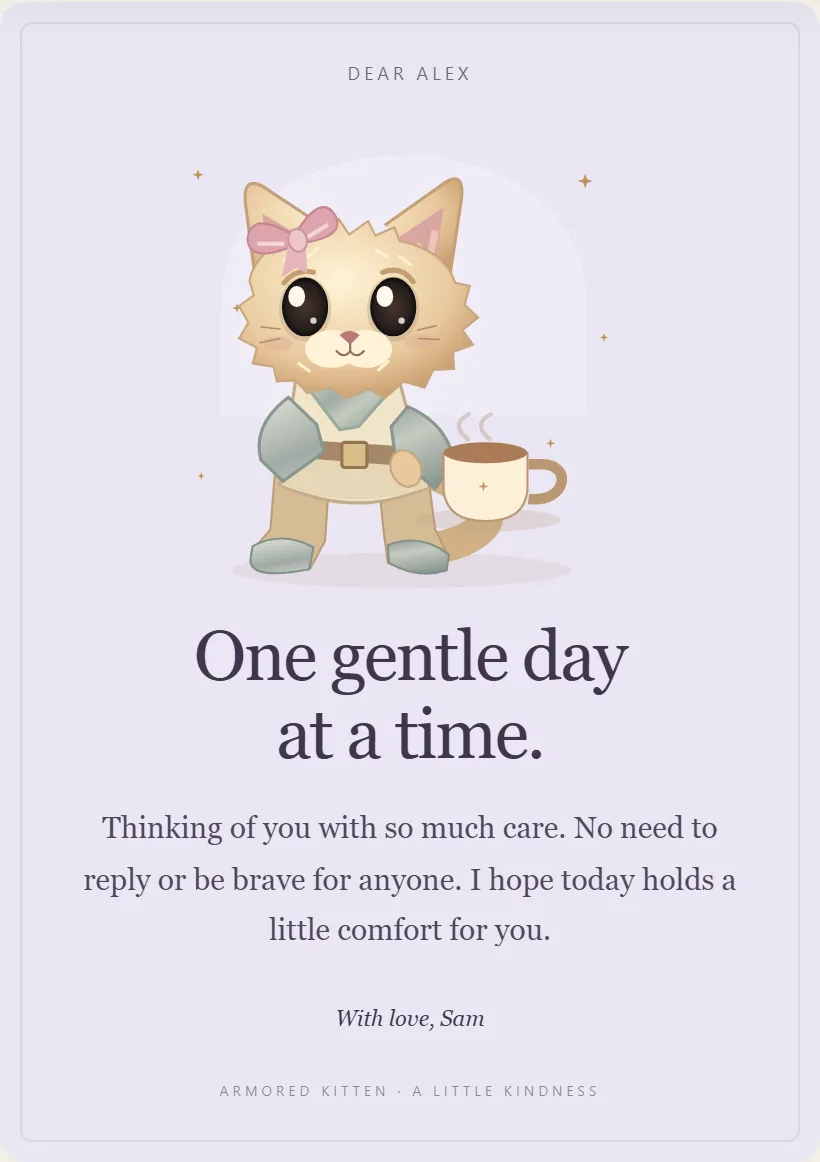
When someone is overwhelmed, even a kind message can feel like another task. Adding "no need to reply" turns your words into a gift with no strings attached. It says: I'm not waiting on you, I'm just here.
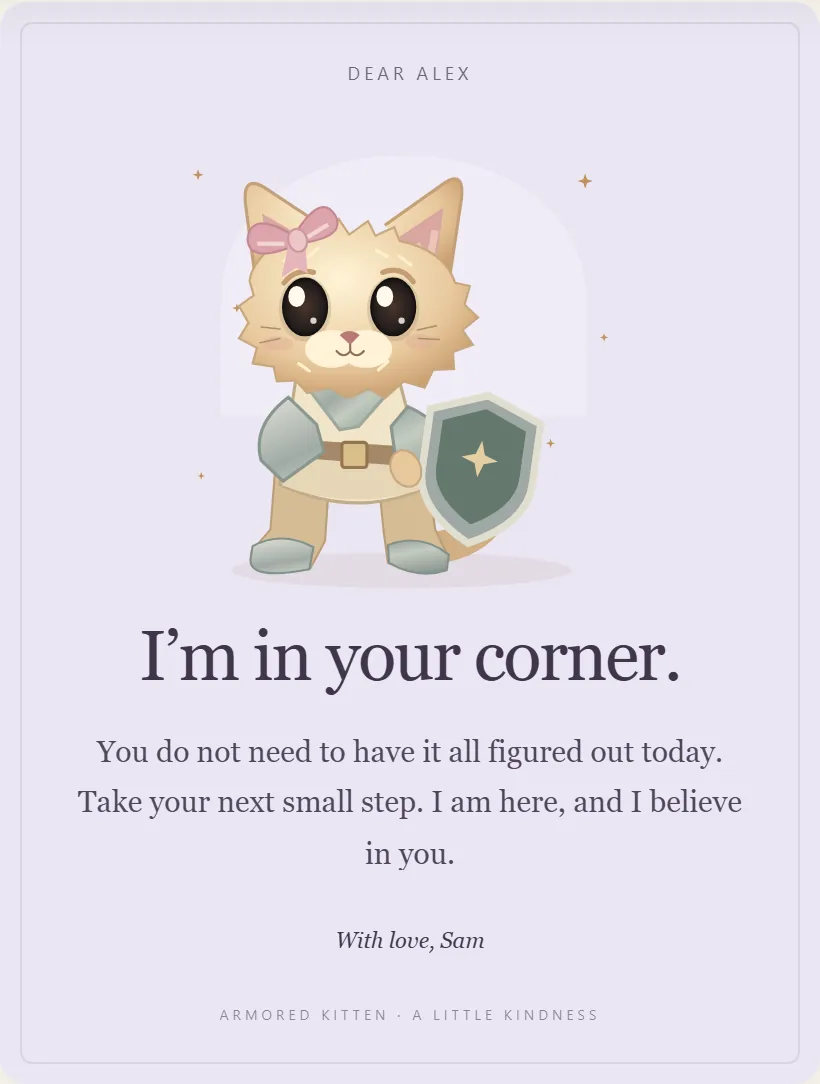
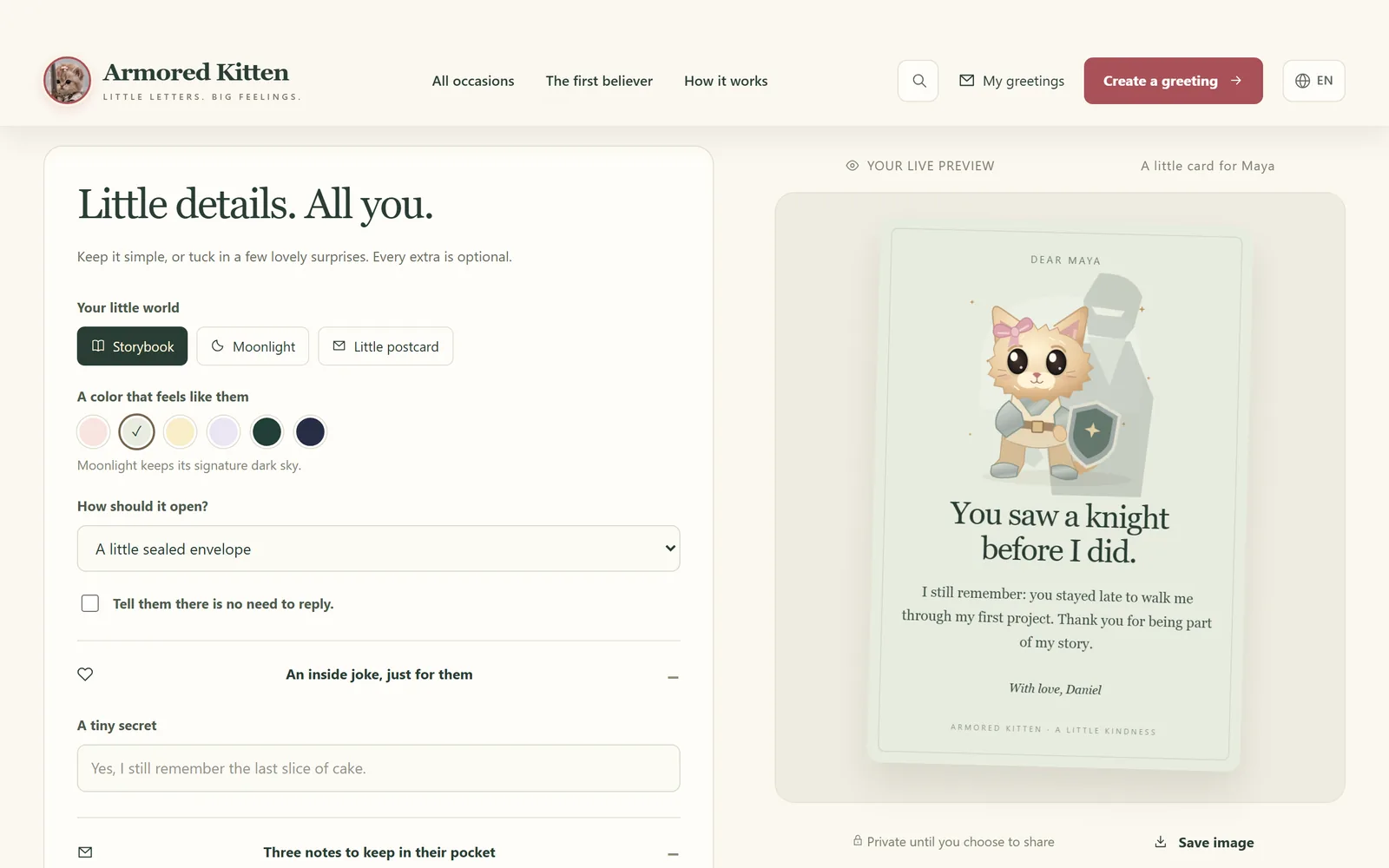
That's why Armored Kitten includes a "no need to reply" option on its cards. You can send a courage card by email or private link, and the person can open it whenever they're ready. If they do feel like answering, they can send a short reply, but nothing is expected.
What not to say
Some well-meant phrases land badly. Try to avoid:
- "Everything happens for a reason." It can sound like their pain is deserved or necessary.
- "At least…" Any sentence that starts this way tends to shrink what they're feeling.
- "I know exactly how you feel." Even with similar experiences, everyone's is different.
- "Just stay positive." It can feel like pressure to perform being okay.
- Unasked-for advice. Wait until they ask, or offer it gently: "Would ideas help, or just listening?"
How to personalize your encouraging message
Five steps to a message that helps
- Name what's happening, gently.
"I know this week has been a lot" shows you noticed.
- Recall a real strength.
Mention a time they handled something hard.
- Offer one concrete thing.
A meal, a call, a walk, a lift to an appointment.
- Remove the pressure.
Add "no need to reply" if they're stretched thin.
- Add your voice.
A short voice note can feel like a hand on the shoulder.
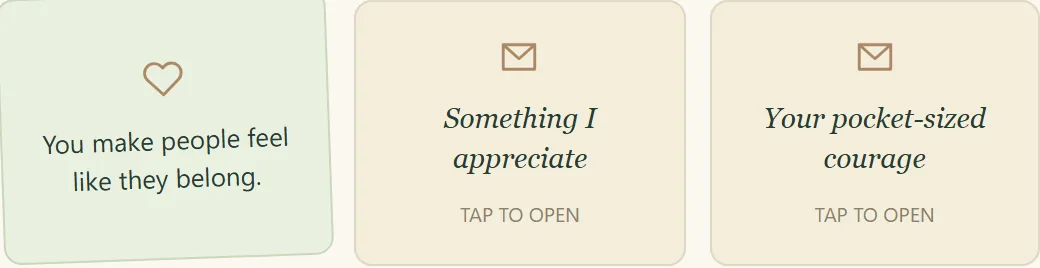
If you aren't sure how to start, the writing helper in Armored Kitten turns one real memory into a starting message for you to edit. It doesn't invent memories or require an AI account. You can also add a photo, a voice note of up to 20 seconds, and three tap-to-open pocket notes, perhaps one for each hard day ahead.
Frequently asked questions
What are good words of encouragement for a friend?
Simple, specific lines work best: "I'm proud of you for still showing up", "This is a hard chapter, not the whole story" or "I'm here, no need to reply". Pair them with a real detail about your friend.
How do I encourage someone without sounding preachy?
Listen more than you advise, acknowledge how hard things are, and avoid phrases like "everything happens for a reason". Focus on being with them rather than fixing things.
What should I write to someone who is sick?
Keep it warm and short, avoid medical opinions, and make it easy for them not to respond. "Thinking of you and sending love, no need to reply" is kind and pressure-free. Our get well cards are made for exactly this.
Is it okay to send encouragement by text or e-card?
Yes. For many people a message they can read in their own time is easier than a call. A digital card with a voice note or photo adds warmth while still letting them choose when to open it.
How often should I check in on someone going through a hard time?
There's no fixed rule. Steady, low-pressure check-ins often help more than one big message. Saying "I'll keep checking in quietly" lets them know you haven't forgotten, without demanding an update.
You don't need perfect words
Encouragement isn't about saying the right thing. It's about letting someone know they're not facing it alone. Pick a line above, make it yours, and send it. For more ways to lift someone up, see our guide on thank you messages for a mentor, or start a courage card and let a tiny kitten in oversized armor say "you've got this" for you.