After a missed day, do not copy everything onto tomorrow. Sort each leftover item on its own: things with a real deadline or someone waiting get a new, realistic slot; things that are still useful but not urgent go on a later list; missed habit sessions are simply dropped, and the habit carries on at its next planned occasion. Tomorrow's plan should be the size of a normal day, not a normal day plus yesterday.
Why catch-up lists grow instead of shrinking
When a day goes wrong, the most natural move is to roll its whole list onto the next day. That next day already had its own list, so it becomes overloaded, and some of it does not get done either. Those items roll forward again. Within a week you can be carrying three days of leftovers, and every morning starts behind.
Habits make it worse. A rule like "I missed my reading, so I'll read twice as much tomorrow" sounds reasonable, but it makes tomorrow's version of the habit harder at exactly the moment you are trying to get back to it. Many people find that the doubled session is the one they skip.
The way out is to stop treating the leftovers as one block and look at each item separately.
Sort every leftover into one of four groups
| Group | How to recognise it | What to do with it |
|---|---|---|
| Real deadline | It has a date that matters: a bill, a form, a submission | Give it a specific new slot before the deadline |
| Someone waiting | Another person needs it to do their part | Tell them where it stands and agree a new time |
| Still useful, no deadline | You still want it done, but nothing breaks if it waits | Put it on a later list, not on tomorrow |
| Let go | A missed habit session, an optional extra, something no longer relevant | Remove it; do not reschedule |
Most leftover lists turn out to be mainly the third and fourth groups. Only the first two need to touch tomorrow at all, and even those may fit better later in the week.
Check deadlines rather than assuming them. Some tasks feel urgent because they were on yesterday's list, not because anything depends on today.
A catch-up audit you can copy
Run through this card once, the evening of the missed day or first thing next morning.
Leftover item: ____________________________

Real deadline?            no / yes: date ________
Someone waiting?          no / yes: who ________
Still worth doing?        yes / no
Is it a habit session?    yes (let it go) / no

Decision:   new slot ________ / later list / let go
Message needed?           no / yes, sent: ______
Once every item has a decision, look at tomorrow. If it is still overfull, move one more "later list" item off it.
Clear a missed day in five steps
- List the leftovers
from the missed day, one per line.
- Sort each one
into deadline, someone waiting, still useful or let go.
- Reschedule only the first two groups,
into slots that are actually free.
- Message anyone waiting
before their expectation passes.
- Restart each habit at its next planned occasion,
at its normal size.
What to say to someone who is waiting
If another person is relying on something you did not finish, a short, specific message is better than silently moving it. Adapt this:
"Hi Sam, I didn't get to the draft yesterday as planned. I can have it to you by Thursday at noon. If that's too late for you, tell me which part you need first and I'll do that today."
It does three things: says what happened without a long apology, offers a real new time, and gives them a choice if your new time does not work. A private change to your own calendar does not change their deadline or their plans.
Example: Alex's day off sick
Here is a made-up example to show how it can work. Alex woke up with a heavy cold and spent the day in bed. That day's list had nine items, plus two habits: a short language lesson and an evening walk.
The next morning, Alex's first instinct was to do everything: nine tasks, a double language lesson and a longer walk, on top of the day's own list. Instead Alex sat down with the audit card for a few minutes.
- Real deadline: one, a form due on Friday. Alex gave it a slot on Wednesday.
- Someone waiting: one, notes a colleague needed for a meeting. Alex sent a message offering them by the end of the day and asked which section mattered most.
- Still useful, no deadline: four, including sorting photos and booking a haircut. They went on the later list.
- Let go: three items that had been optional extras, and both missed habit sessions.
The language lesson came back the next evening at its normal length. The walk waited until Alex felt better. What Alex changed afterwards: the "later list" had grown long over the months, so Alex started reviewing it once a week in a weekly review and deleting anything that had sat there untouched for a month.
When the missed day was a sick day
A sick day is a common reason for a missed day, and also the worst time to plan a double day afterwards.
- If you are still recovering, plan the next day as a reduced day: deadlines and people waiting only. Everything else can wait until you are well.
- If a habit is physical, such as exercise, do not restart it at a higher level to make up. Ask a doctor or suitably qualified professional if you are unsure when it is safe to return.
- If you keep losing days to illness or exhaustion, that is worth raising with a doctor, rather than trying to fix it with a better catch-up system.
For a day that needs to be smaller from the start, the guide on making a smaller plan on difficult days helps you sort what is essential, what can move and what help to ask for.
When something really does have to be made up
Some missed actions are not optional and have their own rules. A missed dose of medication, a missed step in a treatment or care plan, a missed safety check or a missed piece of assessed coursework each come with specific guidance. Do not apply this page's "let it go" rule to them.
- Medication or treatment: follow the instructions you were given, or ask your pharmacist or doctor what to do.
- Care for someone else: check with whoever coordinates the care, and tell them what was missed.
- Coursework or work deadlines: ask your tutor, manager or the organisation about extensions before the deadline passes.
Keep the next day the size of a day
Armored Kitten's purpose is helping you take one manageable step at a time, and after a missed day that means making the next step a normal-sized one rather than a repayment. The habits and goals path has more on keeping habits going through uneven weeks.
Use restart after missing days for one return decision about a habit. The weekly review template can help you examine the remaining items without copying all of them into another week.
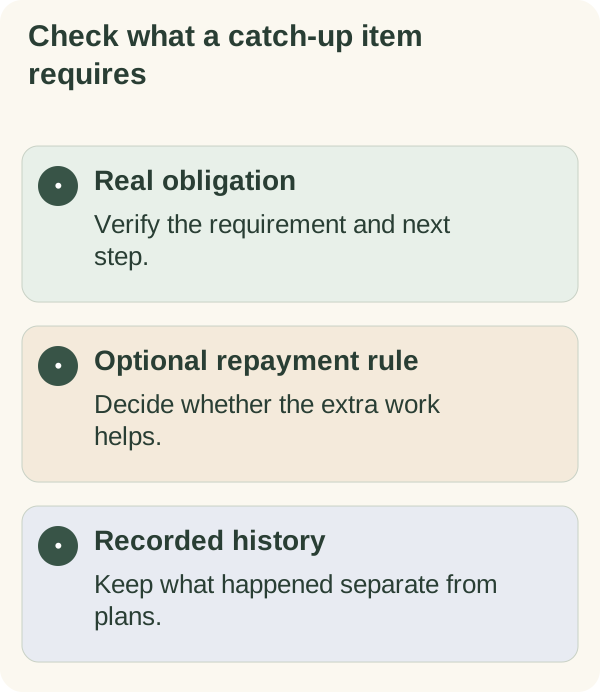
Use the "Review without transferring a backlog" card in the Restart and review workbook to separate real requirements from optional carry-forward work.
Questions people often ask
Should I do double the next day to make up for a missed habit? Usually not. Doubling makes the habit harder at the moment you are returning to it. Restart at the normal size on the next planned occasion.
Is it lazy to delete tasks I did not do? No. If a task has no deadline, nobody is waiting and you no longer want it, deleting it is an honest planning decision. It does not mean pretending you did it.
What if most of my leftovers really do have deadlines? Then the week was overloaded before the missed day. Message the people involved early, and look at what can be moved or handed over.
How do I stop it happening again? Plan each day with a little slack, and keep a separate later list for useful but non-urgent items so they do not sit on every day's plan.