To plan a gym session for a short window, start from the time you must leave and work backward. Take off the journey, changing and any shower, and what remains is your real floor time. Choose one focus for that time from a plan you already know, keep its warm-up and cool-down, and decide before you arrive what you will drop if you run short. If the floor time left is too small to do that calmly, a walk or another day is a better choice than rushing.
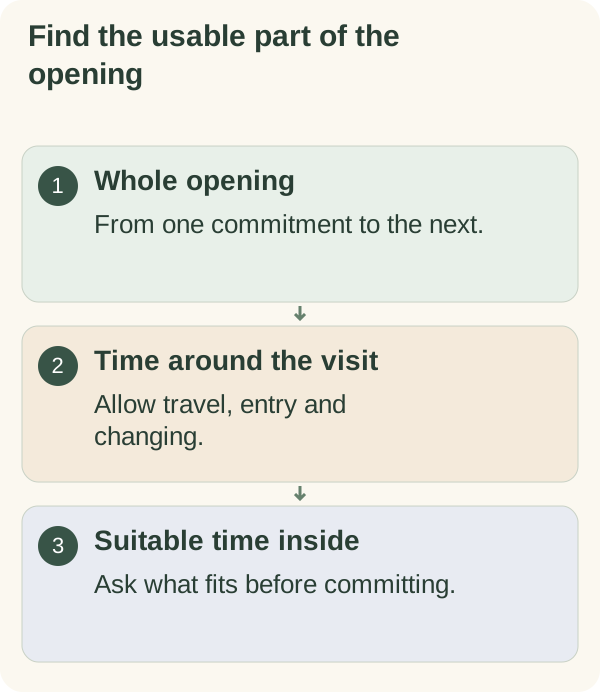
Work backward from the time you must leave
The end of a short window is usually fixed. You need to be back at your desk, at the school gate or on a train. The start is less certain, because meetings overrun and buses run late. So plan from the end.
Take a lunch break from 12:00 to 13:00, with the gym an eight-minute walk from the office:
| Time | What happens |
|---|---|
| 12:52 to 13:00 | Walk back to the office |
| 12:42 to 12:52 | Freshen up and change |
| 12:15 to 12:42 | Time on the gym floor |
| 12:08 to 12:15 | Check in, locker, change |
| 12:00 to 12:08 | Walk to the gym |
An hour off becomes under half an hour on the floor. That is still a useful visit, as long as you plan for 27 minutes and not 60. Leave the office at 12:10 instead and the floor time shrinks to 17 minutes. So write down one more time: the latest you can leave and still have a session worth doing.
Shorten the middle, not the edges
When time is tight, it is tempting to skip the warm-up and cool-down. Those edges help you start and finish safely, so keep them. Make the main part smaller instead.
A short session works best with one focus. If your usual plan has several parts, choose one for today and save the rest for a longer visit. Pick the part that matters most this week, or the one you missed last time. Then write down what goes first if you run short, for example: "If I am late, skip the last item." Making that call in advance stops you from speeding through movements you are still learning.
This guide does not choose exercises, amounts or how hard to work. The person who gave your induction, or a qualified trainer, can tell you which parts of your plan suit a short visit. If you have a health condition, an injury or pain, ask a doctor or suitably qualified professional before you change your routine.
A session outline by floor time
Copy this and keep it with your usual plan. It sets the order and shape of a visit for different amounts of floor time. Fill in the middle column with parts of the plan you were shown.
| Floor time | Structure | Your focus (fill in) | Drop first if late |
|---|---|---|---|
| Under 15 minutes | Consider a walk or another day instead | ||
| 15 to 20 minutes | Warm-up, one focus, short cool-down | ||
| 25 to 30 minutes | Warm-up, one focus, one smaller extra, cool-down | ||
| 40 to 45 minutes | Warm-up, two parts of your usual plan, cool-down | ||
| 60 minutes or more | Your usual full session |
If you have a trainer, take this table to them and ask: "Which parts of my plan suit each row, and what should I leave out?" Write their answer straight into the third column. Then the decision on the day is only which row you are in.
Cut the hidden minutes
Small delays eat a short window faster than a long one. Each of these can give back a few minutes:
- Arrive ready. Wear gym clothes under work clothes, or change at the office if you can.
- Pack the night before. Our guide on preparing for the gym the night before has a checklist.
- Know the floor. If you are new, a first visit at a quiet time helps you learn where things are. See what to expect at your first gym visit.
- Decide on the shower in advance. If you need one, count it. If not, plan to freshen up quickly.
If the gym is busy and your window is 25 minutes
This is the case most plans ignore. In a long session you can wait for a machine. In a 25-minute window, waiting ten minutes takes away almost half your floor time.
- If the equipment for your focus is taken when you arrive, start your warm-up nearby and check again when you finish it.
- If it is still taken, switch to an alternative for the same focus. Choose it in advance, ideally one your trainer or induction showed you.
- If the alternative is busy too, do a part of your plan that needs little or no equipment, then your cool-down.
- If you have used half your floor time without starting the main part, do your cool-down and leave on time. That still counts as a visit.
- If this happens most weeks, the slot is the problem. Try a different time, or ask staff when that area is quieter.
Example: Daniel's lunchtime visits
Here is a made-up example to show how it can work.
Daniel has the 12:00 to 13:00 lunch break above and planned two visits a week, on Tuesday and Thursday. He took his full usual plan each time and aimed to fit it in.
After two weeks, his notes showed: three visits made, one skipped because a meeting ran until 12:20. Twice he got back to his desk late. Once he waited for a bench for most of his floor time and did very little.
He changed three things. He set 12:10 as his latest leaving time; after that, he walks instead. He used the outline above and asked his trainer which single focus suited the 25 to 30 minute row. And he picked a fallback for his main piece of equipment. In the next two weeks he was back on time for every visit.
Plan a short session
- Fix the end.
Write the time you must leave the gym to be on time for what comes next.
- Subtract the edges.
Take off the journey back, changing and any shower.
- Set the latest start.
Note the latest you can leave for the gym and still have a session worth doing.
- Find your row.
Use the outline to choose the structure for your floor time.
- Write what to drop.
Decide what goes first if you are late or the floor is busy.
Classes and booked sessions in a short window
A class or appointment is fixed at both ends, so check it fits before you book. Look at the length, how early you need to arrive and whether late arrivals can join. Do not assume you can leave early for your next commitment. If you might need to, ask the instructor or provider before you book. Also check the cancellation terms, because a window that keeps getting squeezed can lead to missed sessions you still pay for.
When a short window is not worth it
- If the floor time left is in the top row of the outline, choose a walk or another day.
- If you would arrive back late for work, school pickup or an appointment, the visit does not fit.
- If you feel unwell or have pain, skip the session and ask a doctor or suitably qualified professional if it continues.
Skipping one short window is not a failure. Turning up when the visit fits is what builds the routine.
Record the practical result
After each short visit, note when you actually left, how much floor time you had and whether you got back on time. If the time was repeatedly too tight, reconsider the slot. A reminder to leave earlier may help only if an earlier departure is actually available.
Use the daily planner to compare the whole visit with the rest of the day. Then build a small routine around an arrangement that fits. If short visits are part of a wider busy week, see building a gym routine around a busy schedule.
Use the gym planner to note the arrival and departure questions you need answered before keeping the visit.
A short session that happens beats a long one that keeps moving, which is the idea behind all of the habits and health guides; the Fitness page shows how to keep those short visits in one simple plan.
Questions people often ask
Is a 20-minute session worth the trip? For keeping the habit going, it can be. Whether that much time is enough for what you want to achieve is a question for a qualified trainer who knows your goals.
Should I train harder to make up for less time? Not on your own judgment. Working harder or faster than you were shown is how people get hurt when rushed. Ask a qualified trainer whether your short version should differ, and how.
Can I skip changing to save time? If the gym allows it and you can arrive in suitable clothes and shoes, yes. Check the rules at the desk.