The gym you will actually use is usually the one that is easy to reach at the times you are free, feels manageable when it is busy, and lets you leave the contract without a fight. Facilities matter less than most adverts suggest. Before you compare prices, write down when you would really go, then test each gym against that.
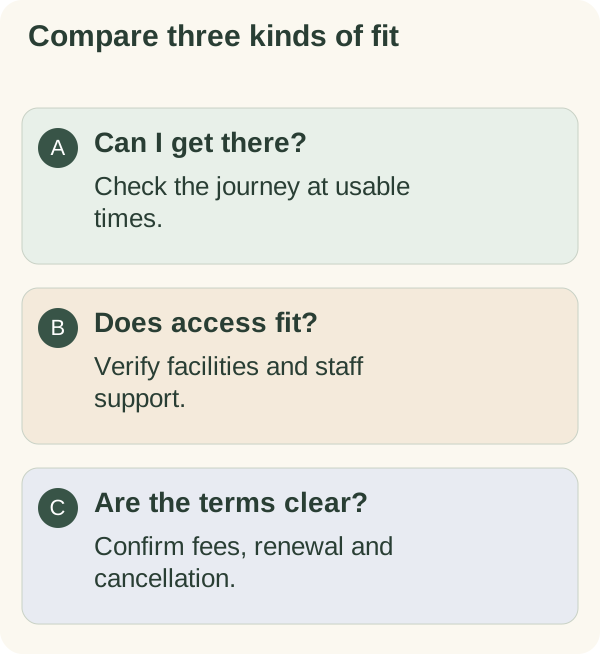
Start with when you would go
Most people pick a gym by looking at the equipment list. A better first step is a calendar. Look at an ordinary week and mark the slots where a visit could fit: before work, a lunch break, on the way home, a weekend morning. Be honest about the slots you would skip when you are tired.
Those slots decide almost everything else. A gym ten minutes from home is not convenient if you plan to go straight from work. A gym that opens at 6 a.m. does not help if the free weights are packed from 5:30 p.m., when you would arrive.
Write the answer as one short line, for example: "Tuesday and Thursday after work, about 6 p.m., plus Saturday morning." Every gym on your list now has a simple test to pass.
Decide what you need and what is only nice to have
Split your wishes into two columns before you visit anywhere. Needs are the things that would stop you going if they were missing. Nice-to-haves are pleasant but would not change whether you turn up.
| Usually a need | Often only nice to have |
|---|---|
| A journey that works at your real times | A pool, sauna or spa area |
| Opening hours that cover your slots | A large number of classes you may not attend |
| Equipment for what you plan to do first | Branded towels, lounges or a café |
| Changing and access arrangements that suit you | Apps with features you will not open |
| Terms you can leave if your plans change | A free gift for joining today |
Your columns may look different. Someone recovering from an injury may treat a staffed floor as a need. Someone who only wants to walk on a treadmill may not care about free weights at all. What matters is deciding before a salesperson shows you the shiny parts.
Test the journey at your real time
Do the trip once at the time you would really travel. Note how long it takes door to door, where you would park or which stop you would use, and whether the route feels comfortable after dark if that applies.
Short journeys matter because the hardest part of a gym habit is often leaving the house. If getting there takes more effort than the session itself, it becomes easy to skip. A gym on a route you already travel, such as near work or a station you pass, removes one decision from every visit.
Visit during the busiest hour you would use
Many gyms look calm on a weekday afternoon tour. Ask to come back, or buy a day pass, for the hour you would actually train. Watch for three things:
- Queues for the equipment you need. If you plan to use squat racks or a particular machine, see whether people are waiting.
- Space to move. Is there a quieter area where you could warm up, stretch or try something new without feeling watched?
- How staff and members behave. Notice whether staff are on the floor and whether anyone seems approachable if you have a question.
If you are nervous about going alone, our guide on going to the gym alone covers how to plan the arrival and what to say at reception.
Ask the same seven questions everywhere
Take the same list to every gym. Writing the answers in one place makes it easy to compare later, and it stops a friendly tour from replacing facts.
Seven questions for the front desk
- What are the staffed hours?
Some gyms are open 24 hours but only staffed for part of the day.
- Is there an introduction for new members?
Ask whether it is included, how long it lasts and whether you need to book.
- What does the price include?
Check whether classes, towels, lockers or an induction cost extra.
- Is there a joining fee?
Ask whether it is ever waived and what that depends on.
- What is the minimum term?
Find out whether you are committing to one month, twelve months or something in between.
- How do I cancel or freeze?
Ask what notice is needed and whether you can do it online, in person or only in writing.
- Can I try it first?
Ask about a day pass or trial and what happens when it ends.
Write down who told you and the date. Offers change, and it helps to have a note if a later bill does not match what you were told.
Read the commitment as carefully as the facilities
The contract is where a good-looking gym can become a costly one. Look for these terms in writing before you sign:
- Minimum term. The shortest period you must pay for, even if you stop going.
- Notice period. How long before your last payment you must tell them you are leaving.
- Cancellation method. Some contracts only accept cancellation by a particular route, such as in person or by letter.
- Price changes. Whether the monthly fee can rise during your membership, and how much notice you will get.
- Freeze rules. Whether you can pause for illness, travel or a busy month, and whether that costs anything.
If a sentence is unclear, ask the gym to explain it and to put the answer in writing. If a term would cost you a lot of money and you are still unsure, get advice from a local consumer advice service before agreeing. A countdown on a sign-up offer is not a reason to skip this step.
Compare two gyms side by side
Here is how the notes might look for two gyms that both seemed fine on a tour.
| Gym A (near home) | Gym B (near work) | |
|---|---|---|
| Journey at 6 p.m. | 25 minutes, two buses | 7 minutes on foot |
| Busy hour visit | Racks free, quiet stretching area | One rack, short queue |
| Staffed hours | Until 9 p.m. | Until 7 p.m. |
| Introduction | Included, bookable | Paid extra |
| Minimum term | 12 months | 1 month rolling |
| Cancellation | Letter, 30 days' notice | Online, end of month |
On paper Gym A has better facilities. In practice, Gym B fits the "after work" plan and is easy to leave if it does not work out. For a beginner, that is often the better first choice. You can always switch later once the habit is real.
Signs to slow down
Take a step back if you notice any of these:
- You are asked to sign the same day to keep a price.
- Staff cannot tell you the cancellation method or notice period.
- The busiest hour you would use is so crowded you could not do your plan.
- The total cost only becomes clear after several extra fees are added.
None of these means the gym is bad. They mean you do not yet have the facts you need. It is fine to leave and decide another day, or to decide that none of your shortlist fits right now.
Choose, then review after a month
Once you choose, treat the first month as a test. Keep a simple note of each visit: when you went, how long the journey took and whether the session felt doable. After four weeks, look back. If you went most of the times you planned, the gym fits. If you kept skipping the same slot, the problem may be the time, not you.
Use build a small routine to set the visits you want the gym to support, and the weekly review template to check how the first weeks went. The gym planner has space for your shortlist and the seven questions, so you can keep each gym's answers together.
Choosing well is the first small step in the habits and health guides: a gym that fits your week makes every later visit easier, and the Fitness page shows how Armored Kitten helps you plan that week one visit at a time.
Questions people often ask
Is a cheaper gym a false economy? Not necessarily. A low monthly price with a short contract is a sensible way to test whether a habit sticks. It becomes a false economy only if it is so crowded or far away that you stop going.
Should I join where my friend goes? Training with someone can make it easier to show up. Check that the gym still passes your own journey and timing test, because you may often go alone.
Do I need a personal trainer to start? No. An induction or introduction session is usually enough to learn how the main equipment works. If you have a health condition or injury, ask your doctor or a suitably qualified professional what kind of activity suits you before you start.
What if no gym on my list fits? That is a useful answer. You could start with walking or home exercise and look again later. Our guide on making walking part of your day is one place to begin.