Choose one section of your journey that you could walk instead: getting off a stop early, parking further away or walking to a different station. Try it once on a day when arriving late would not matter, and time the whole trip door to door. Keep your usual journey as the default for wet mornings, heavy bags and tight deadlines, and decide each day with a simple rule rather than a fresh debate at the bus stop.
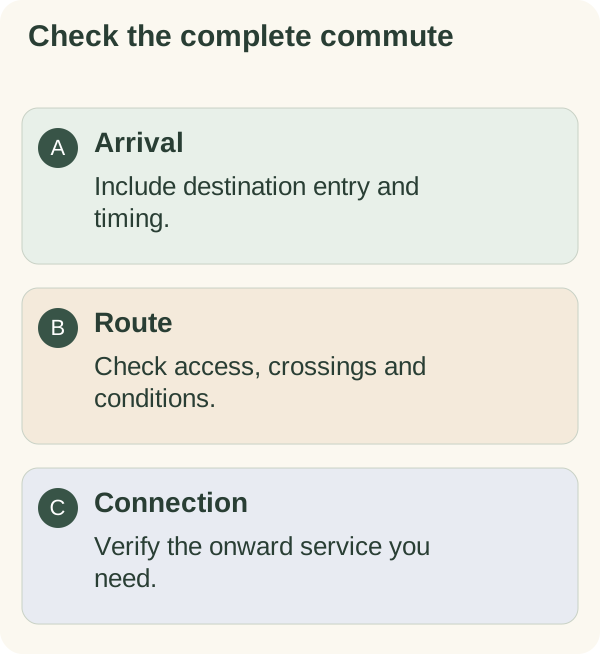
Advice on walking to work often starts with measuring the distance on a map and picking a target time. A line on a map does not tell you whether a crossing is safe at rush hour, whether the later stop has a less frequent service or whether you will arrive at your desk in a state to start work. Treat the walking section as part of a whole journey and check the whole journey.
Find the leg of the journey you could walk
Look at how you travel now and pick the part that is easiest to swap.
| How you travel | A section you could walk | What to check first |
|---|---|---|
| Bus or tram | Get off a stop or two early, or walk to a later stop | How often the service runs, safe crossings, fares by stop |
| Train or metro | Walk to or from a different station, or skip a short connection | Ticket zones and prices, last services home |
| Car | Park further from work, or at a different car park | Parking rules, costs and how the car park feels after dark |
| Drop-off by someone else | Ask to be dropped a little earlier on the route | Whether that point is a safe place to get out |
| Already short enough to walk | Walk the whole way on chosen days | Lighting, weather, what you need to carry |
If you rely on public transport, use the operator's current information for the services and stops you plan to use. Do not give up a reliable connection until you know the walking alternative works.
Test it once on a low-stakes day
Pick a day when being late would not cause a problem: a day with no early meeting, or the way home on a quiet evening. Copy this checklist onto your phone before you go.
Commute walk test run
Date: ________   Direction: to work / home
Section walked: from ____________ to ____________

Left home at: ______   Arrived at: ______   (door to door, including waits)
Crossings that felt awkward or unsafe: ____________
Lighting at this time of day: good / patchy / poor
Did the bag or equipment make it harder? yes / no: ________
Did I arrive ready to start (warm, dry, presentable enough)? ________
Would I do this again? yes / only on ________ days / no
Before you swap a leg of the journey
- Pick the section.
Name exactly where the walk starts and ends.
- Check the route.
Look at access, crossings and how it feels at your real travel time.
- Confirm the connection.
Make sure any service you still need runs when you will reach it.
- Allow for arrival.
Count the time to settle in as well as the journey.
- Keep the old way ready.
Know how you will travel if the walking section does not suit the day.
Decide each morning with a two-line rule
The commute is the wrong moment for a long decision. Write a rule once and let it decide for you:
"If it's dry and I've left by [time], I walk the last section. Otherwise I take the usual journey."
An example plan might be: "Consider walking the final suitable section when conditions and arrival time allow; use the usual journey otherwise." It is an option to evaluate, not a daily duty.
Example: Sam walks part of the way home
The example below is illustrative; the person in it is not real. Sam takes the bus to work. She tried walking the whole way home once a week, but it took far longer than she expected and she arrived late to collect her son from his after-school club. She gave up after two attempts.
She tested a smaller change instead: getting off the bus a few stops early on the way home, only on Tuesdays and Thursdays, when her partner does the collection. She kept the morning journey on the bus, because she has to be at her desk on time and does not want to arrive hot.
It worked through the autumn. By December the walking stretch was dark on her way home, and the shortcut she used ran along an unlit path by some garages. She changed to the route along the main road, which takes a little longer but is lit and busy. She also decided that on very wet days the rule sends her home on the bus all the way, with no need to make it up.
When the walk is in the dark, or you need to arrive ready for work
Most commute articles skip the two things that end commute walks fastest: darkness and arriving in no state to work.
- If the walking section is dark for part of the year, choose lit, busier streets even if they take longer, wear something visible, keep your phone charged and tell someone your usual route.
- If you would rather not walk in the dark at all, use the walk in the lighter months or on the lighter leg of the day only, and ride the whole way the rest of the time.
- If you need to arrive looking presentable, walk the homeward leg instead of the morning one, or carry work shoes in your bag.
- If you carry a laptop, shopping or sports kit, use a backpack or keep the walk for lighter days. A route that works with a small bag may not work with three.
- If you use mobility equipment or need step-free access, check every kerb, crossing and entrance on the section before relying on it.
- If walking causes pain or you have a health condition or pregnancy that affects it, ask a doctor or qualified professional before adding walking to your commute.
Review the journey as a whole
After a couple of weeks, note whether the route, the connection and the arrival all worked. If one part was unreliable, change that part, or keep the walk for days when it suits. A commute walk is one of the most ordinary ways to take the manageable step that Armored Kitten's habits and goals guides are built around: it uses a trip you already make rather than a new hour you have to find.
Use build a small routine to decide when to reconsider the option. If conditions interrupt it, restart after missing days with a fresh journey check.
Use the route card in the walking planner alongside your operator's current service information. Keep the arrival requirement visible. For walks during the working day rather than around it, see the after-lunch walking routine.
Questions people often ask
Will walking part of the way make me late? Not if you test it first and keep the rule. The test run tells you how much earlier you need to leave.
Will it save me money? It might change your fare or parking costs, or it might not. Check the prices for the stops and car parks you would actually use.
Is the way home or the way in better for walking? For many people the way home is easier, because nothing urgent starts when you arrive. Try both and see.
What if my commute is by car only? Parking further away is the usual option. Check the rules, costs and how the walk from the car park feels at your real times.