Once a week, look back at your walks with four questions: which planned walks happened, what made the easy ones easy, what got in the way of the others, and what one thing you will change. Write the answers as short notes rather than totals. If you use a step counter, keep its number as one optional line on the card, not the verdict on your week.
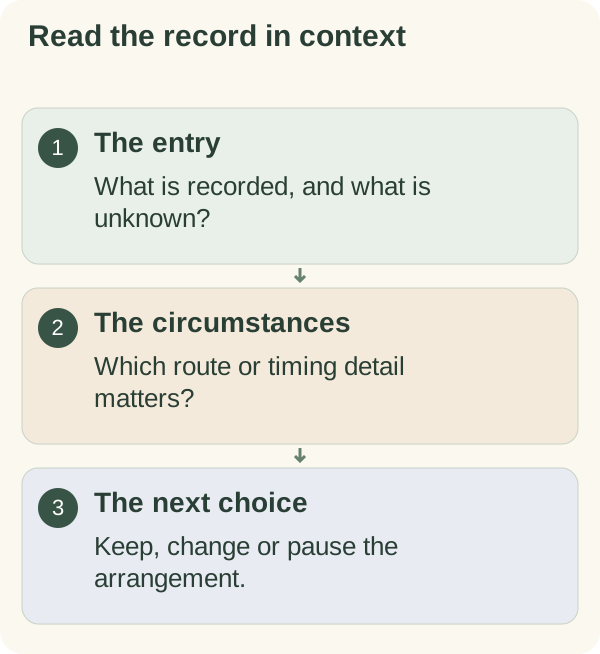
Most walking trackers are built around a daily number. That suits people who like a target, and it is easy to set up. What it misses is the reason behind each day: rain, a late meeting, a walk with a friend that felt better than any solo walk that week. A routine is kept alive by those reasons, so the review should capture them.
Why a step total makes a poor weekly verdict
A total tells you how much movement a device counted. It does not tell you whether your walking plan fits your life. A low week might mean illness, a heavy work fortnight or a week of caring for someone, none of which is a problem with the plan. A high week might come from one long day out, while the planned routine quietly fell apart.
Counts also differ between devices and depend on where you carry them. Check what your own device measures and its limitations if you rely on it. This guide does not validate a particular tracker or set a step target, and it does not replace any target a doctor or physiotherapist has given you.
Give each planned walk one of four states
| State | What it means | What it tells you |
|---|---|---|
| Done | The walk happened roughly as planned | Something about that day worked; find out what |
| Changed | Shorter, indoors, different time or route | The plan bent instead of breaking |
| Skipped on purpose | You decided not to go, for a reason you know | The decision worked; the reason may need a rule |
| Not recorded | You do not know, or did not note it | Nothing yet; do not count it as a miss |
Keeping "not recorded" separate is the step most trackers skip. A blank does not establish why a walk changed. The guide to what a missing habit entry means explains why blanks should stay blanks.
Four questions for the weekly review
The weekly walking review
- What happened?
Mark each planned walk with one of the four states.
- What made the easy walks easy?
Time of day, company, route, weather, mood.
- What got in the way?
Name the practical obstacle, if you know it.
- What one thing changes?
Keep, move, shrink or pause one part of the plan.
Copy this card into a notebook or notes app:
Walking review: week of ____________

Planned: ____   Done: ____   Changed: ____   Skipped on purpose: ____   Not recorded: ____

The easiest walk this week, and why: ____________________________
What got in the way: ____________________________
One note worth keeping (route, company, time, how it felt): ____________________________
Next week I will keep / move / shrink / pause: ____________________________

Step number (optional): ________
Look for an observation you can act on
For example: "The route near the errand was convenient, but the return connection needed checking." That suggests a transport check before another occasion. It does not require a judgment about the week's total activity.
Another observation might simply be that you preferred a quieter place or enjoyed company. You can keep that information without turning it into a numerical rating.
Example: Daniel turns off the goal display
Here is a made-up example to show how it can work. Daniel wears a watch with a daily step goal. In weeks when he walked three times as planned but sat at his desk the rest of the time, the watch showed him falling short most days. He started adding late evening walks just to close the gap, and on busy weeks he felt he had failed before Wednesday.
He switched the goal display off and started using the review card on Sunday evenings. After two weeks, two notes stood out. The Wednesday walk with a colleague had happened every week without effort. His solo Monday walk was skipped every time, always because of the Monday planning meeting.
He kept Wednesday, moved Monday's walk to Tuesday and stopped the late evening walks altogether. The step number stayed on the card as an optional line, which he filled in some weeks and not others.
When the numbers start to make you feel worse
Tracking articles rarely say what to do when the tracker becomes the problem. If it does, these rules help.
- If you check the count many times a day and feel anxious about it, hide the display and look only at the weekly review.
- If you find yourself walking late at night or through tiredness to hit a number, drop the number and keep the notes.
- If you are walking through pain to reach a total, stop and ask a doctor or physiotherapist before you carry on.
- If a blank week hides illness, caring or a crisis, mark it as paused. It is not evidence about the habit.
- If a doctor or physiotherapist has given you a specific walking target, for example during rehabilitation, follow their advice. This page does not replace it.
- If recording anything at all feels like a burden, you can stop. A walking habit does not need a log to exist.
Do not use the record to prescribe activity
Attendance and step data cannot tell you what activity is right for your health and abilities. Use individual guidance where you need it. Avoid adding make-up walks automatically because a total is below an expectation you have not checked.
Choose one adjustment, if one is useful
Keep an arrangement that fitted or change the route, cue or coordination detail that caused a practical problem. You may also decide to stop recording if the log no longer serves its purpose. Reviewing for reasons rather than totals is how Armored Kitten treats habits and goals in general: the record is there to help you pick the next manageable step, not to grade the last one.
Use build a small routine to choose a future opportunity or the weekly review to keep a short observation. If you want a fuller look at the whole week, not only walks, the weekly review template covers that.
Use the review field in the walking planner for one observation you want to use next time, rather than an unnecessary score.
Questions people often ask
Should I stop counting steps altogether? Only if the number is not helping. Many people keep it as one line and let the notes do the deciding.
How long should the review take? A few minutes is enough. If it takes longer, the card is probably asking too much.
What counts as a changed walk? Anything that happened in a different form from the plan: shorter, indoors, another time or another route.
What if I have nothing to write? Write "nothing to change" and keep the plan as it is for another week.