Tie your breaks to moments that already happen in a home workday, such as a call ending, a file uploading or a task getting finished, instead of setting an interval timer that fights your meetings. Keep most breaks small enough to take without asking anyone. Add one break a day where you step outside the front door, and finish the workday with a short walk that does the job your old commute used to do: marking the line between work and home.
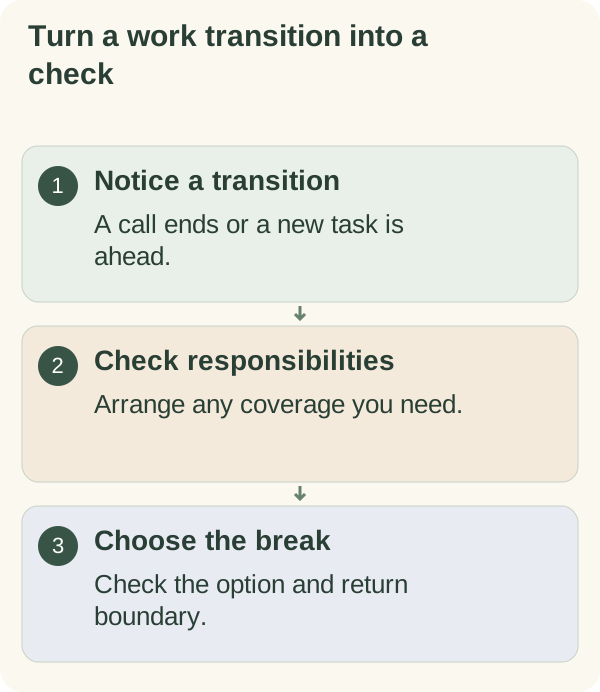
Much of the advice on this topic gives an interval: get up every so many minutes. Intervals work for some people, but at home they often collide with calls and deep work, get dismissed, and leave you feeling you have failed by mid-morning. Transitions are different. They happen anyway, and a break attached to one does not interrupt anything.
Use the seams of the workday, not a timer
A seam is a point where one thing ends and another has not yet started. Here are common ones at home, with a small break and a bigger one for each.
| Seam in the day | Small break | Step-outside option |
|---|---|---|
| A video call ends | Stand up, refill your water, look out of a window | Not usually needed |
| Before opening email after lunch | Walk to the kitchen the long way | Step out to the garden, doorstep or street |
| A file uploads or a report runs | Walk to another room and back | A loop of the building if it will take a while |
| A task is finished | Tidy the desk standing up | Take the post or the bins out |
| End of the workday | Close the laptop and stand up | A short walk round the block before switching to home |
You do not need all five. Pick two or three you already hit every day, and attach a break to each.
Check the work boundary first
Follow your work arrangements for breaks and availability. If you need coverage or a handover, arrange it rather than vanishing while someone expects you to be reachable. A status message helps colleagues know you are coming straight back. If your calendar is so crowded there is no seam at all, that is a workload conversation, and another reminder will not fix it.
Think about the setting you have. A suitable option might be leaving the desk for an ordinary movement break or choosing another activity appropriate to your abilities. This article does not prescribe a movement sequence or tell you to continue through discomfort.
The CDC's activity guidance includes advice on choosing activity and seeking individual guidance where appropriate. Use that kind of guidance for the activity itself rather than treating a work-planning card as a health programme.
Set up tomorrow's breaks tonight
- Look at tomorrow's calendar.
Circle the seams: call endings, the lunch edge, the end of the day.
- Choose two or three.
Pick seams that happen whatever else changes.
- Attach one action to each.
Keep it small enough to do in your slippers.
- Pick the step-outside moment.
One per day is plenty.
- Set your status line.
Decide what colleagues will see while you are away.
Wording for when calls leave no gap
Back-to-back video calls are the most common reason home workers never move. Asking for a small gap between meetings is reasonable, and it helps everyone. Copy and adapt:
To your team or manager:
"Back-to-back calls are leaving me no gap to step away from the desk.
Would it work if I set my meetings to finish five minutes before the hour?
I'll still join the next one on time."

Status message during a short break:
"Away from my desk for a few minutes. Back at [time]."

End-of-day status:
"Finished for today. Back online at [time] tomorrow."
Example: Alex swaps hourly reminders for three seams
Here is a made-up example to show how it can work. Alex works from home as an analyst. He set an hourly reminder to get up. During calls he dismissed it; during focused work it broke his concentration, so he dismissed it there too. By the end of the first week he had stopped noticing it.
He replaced the reminder with three seams:
- After the morning stand-up call: stand, refill water, look out of the window before opening the next task.
- After lunch: step outside to the end of the street before reading email.
- End of the day: a loop round the block, then the laptop stays shut.
The first two held almost every day because they cost nothing. The end-of-day loop slipped whenever work ran late, which happened often. After two weeks he moved it to before his last hour of work, with a status message, and finished the day at his desk. It happened far more often, and the last hour felt less like a slog.
When you are on call, covering a queue or sharing a small home
Generic movement-break lists assume you can leave the desk whenever you like. Many home workers cannot.
- If you must answer within minutes, keep breaks within earshot, carry your phone and stay indoors. A walk to another room still counts.
- If you cover a shared queue, agree break times with whoever covers the rest, so the queue is never empty.
- If other people are home during the day, agree when you will step out so you are not walking into the middle of someone else's call or a child's nap.
- If your space is small, standing breaks and stepping out of the front door may be the realistic options.
- If desk work is giving you pain or stiffness, or you have a condition that affects movement, speak to a doctor, physiotherapist or your occupational health service. This page does not give stretches or exercises.
Do not judge the break only by a number
You might notice that one meeting pattern leaves no usable gap or that a different seam would be more convenient. That observation can inform the next day's arrangement without requiring a step target or a daily score.
Check any reminder controls yourself if you choose to use them. Opening a guide or a companion link does not start a timer or set your work availability.
Breaks attached to seams are a working-day version of Armored Kitten's approach to habits and goals: a step small enough that it happens on a busy day.
Use the daily planner to see where breaks could fit alongside necessary work. Then build a small routine around one suitable decision point. If meetings are what keep squeezing the day, planning a work session between meetings helps you shape the gaps.
The movement-break card in the walking planner has space for the transition, suitable option and return arrangement.
Questions people often ask
How often should I take a movement break? This guide does not set a frequency. Use seams that already happen, and if you need advice on activity for a health reason, ask a qualified professional.
Does walking to the kitchen really count? For a routine, yes. Small breaks that happen are worth more to the habit than long ones that do not.
What if my employer tracks my online status? Use status messages and follow your work's break arrangements. If you are unsure what is allowed, ask your manager.
Can I take a walk during a call? For audio calls where you do not need notes, many people do. Check that your surroundings are suitable and safe to walk in while you talk.