Write down what you actually know about the task, then find the one missing decision that would change what you do. Ask about that decision in a specific question, and while you wait, start only on preparation that stays useful whatever the answer is. If nothing qualifies, mark the task as waiting. That is a real starting point, not a failure to begin.
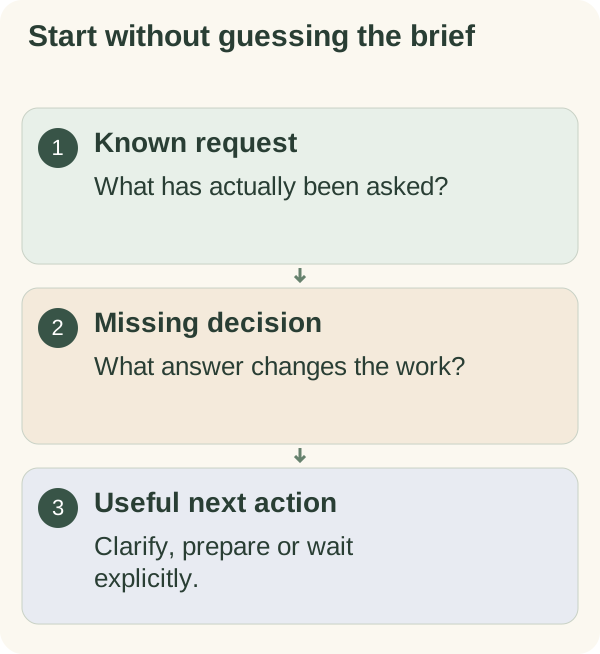
"Update the report" could mean correcting a figure, changing its structure or preparing a different version for a new audience. Starting quickly does not resolve that ambiguity. A small clarification can identify what the task actually requires.
Common advice for unclear tasks is to "just start for two minutes" and let clarity arrive. That works when the vagueness is inside your own head. When the vagueness is in someone else's request, starting fast can mean an afternoon spent on the wrong version. This page is for that second case.
Write the task as you currently understand it
Use a plain sentence with the intended result. For example: "Prepare the report for the next meeting." Then note the details that are still unknown: which meeting, which sections, whose decision and what deadline?
It helps to split your notes into two columns, because guesses tend to disguise themselves as facts once they are written down.
| What the request actually says | What I am assuming |
|---|---|
| "Prepare the report for the next meeting" | The meeting is Thursday's team meeting |
| "Keep it short" | Short means two pages, not two slides |
| Sent by the project lead | The project lead is also the person who decides |
Anything in the right-hand column is a candidate for your question.
Keep the original request somewhere you can refer to it. Your interpretation should not silently replace instructions another person supplied.
Name which kind of vague it is
Most unclear requests are missing one of five things. Naming the type makes the question easier to write.
| Missing piece | What it sounds like | A question that settles it |
|---|---|---|
| The result | "Have a look at the budget sheet" | "Do you want comments, or a corrected version?" |
| The audience | "Write something for the website" | "Is this for new visitors or existing members?" |
| The size | "Pull together some ideas" | "Roughly how many, and how developed?" |
| The deadline | "When you get a chance" | "Is end of this week all right, or is it sooner?" |
| The owner | "Someone should fix the sign-up form" | "Is this mine to do, or should I pass it on?" |
If the request is missing several pieces, ask about the one that would waste the most work if you guessed wrong. Usually that is the result.
Ask a question that changes the next action
Choose the missing detail that prevents useful progress. "What do you mean?" may leave the whole task open. A more specific question is: "Do you want the figures updated, or a shorter version for the meeting?"
Here is an illustrative request you can edit:
I understand the result is a version for the meeting. Before I change the document, could you confirm which audience and sections to prioritise? I can gather the current figures while that is being decided.
Three more versions to copy and adapt:
To a manager:
"Quick check before I start on ____: do you want ____ or ____?
I'll begin with ____ in the meantime, since that's needed either way."

To a client:
"Thanks for this. So I deliver the right thing: is the main aim ____ or ____?
If it's easier, a link to an example you like would answer it."

When the person says "use your judgement":
"Great. My plan is ____, aimed at ____, ready by ____.
I'll go ahead on that unless you'd like a change by ____."
Use only details that are true. Review the question and send it through your normal channel yourself.
Identify work that remains useful either way
You may be able to find the existing file, collect the requested materials or list the information that is missing. Avoid spending substantial time on a speculative version when the unresolved choice could change the work completely.
Preparation that usually survives any answer: locating previous versions, gathering source material, booking the time you will need, and writing a short outline with the open question marked in it. Drafting full sections usually does not survive.
If there is no useful independent action, record that you are waiting for clarification. Waiting on information is a task state, not proof that you failed to start.
An unclear-task card
- Known result:
what has actually been requested?
- Open decision:
what do you need clarified?
- Question:
what could you ask that would change the next action?
- Useful meantime:
is there preparation that remains relevant?
Example: Sam and the volunteer pack
The example below is illustrative; the person in it is not real. Sam works remotely for a small charity. On Monday the coordinator sent a one-line message: "Can you freshen up the volunteer pack before Thursday?"
Sam's first instinct was to redesign the whole pack. Instead Sam filled in the two columns. Known: the pack, the Thursday deadline, the sender. Assumed: that "freshen up" meant a redesign, and that Thursday meant the start of the day. The gap was the result, so Sam sent one question: "Do you mean updating the dates and contacts, or a new layout too? I'll collect the current contact list today either way."
The reply came that afternoon: dates and contacts only, for a Thursday evening session. The job took an hour. What Sam changed afterwards was a habit: when a request uses a soft verb like "freshen", "tidy" or "look at", the first action is always the question, sent before opening the file.
When you cannot ask anyone
Sometimes clarification is not available. The usual advice stops here, but there are still sensible moves.
- If the requester is away until after the deadline, make the smallest version that meets the request, and put your assumptions in two lines at the top so they can be corrected quickly.
- If someone else is covering for them, ask that person the same specific question rather than a general "any idea what they meant?"
- If the vague instruction is your own old note, search for where it came from: the email, meeting notes or message thread around the date you wrote it. Then rewrite the note as a result.
- If the answer arrives after you have started, compare it with what you have. Keep the parts that fit and note what needs redoing, rather than defending the version you guessed.
Revise the plan when the answer arrives
Check whether the clarification changes the scope, deadline or materials. Put the next recognisable action into the list, rather than leaving the old vague instruction beside the new explanation.
For a task with a deadline you cannot meet, agree the next step with the person relying on it. Changing a personal planner does not change that agreement.
Turning a fuzzy request into one clear, doable action is the same small-step approach Armored Kitten uses across its planning and reflection guides: you do not need the whole task solved, only the next part that you can do with confidence.
The daily planner gives you a place to record the result and opening action. Choose a first small step for an illustrated version of the exercise. The companion can help you draft a question, but it does not obtain clarification or contact a colleague for you.
Use the dependency and opening-move fields in the One-session work kit to name the missing answer and any preparation that remains useful.
Questions people often ask
Will asking questions make me look like I do not understand? A specific question shows you have read the request and thought about it. "Do you want A or B?" reads very differently from "what do you mean?"
How long should I wait for an answer before going ahead? Base it on the deadline. If waiting would make the work late, say when you will proceed on your stated assumption, then do so.
What if the instructions are vague because the other person has not decided yet? Then your question helps them decide. Offering two concrete options often gets a faster answer than an open question.
Is it all right to start with something unrelated while I wait? Yes, if it is genuinely ready. Record the unclear task as waiting so it does not quietly drop off your list.