In a busy week, aim for one creative opening rather than a daily habit, and decide what kind of creative time it is before it arrives: making, learning a technique, gathering ideas or sorting materials. Count setup and pack-down as part of the opening, because that hidden time is what usually makes a free hour feel too short. A small kit that is ready to go, and a note left on the unfinished piece, make the next opening easier to use.
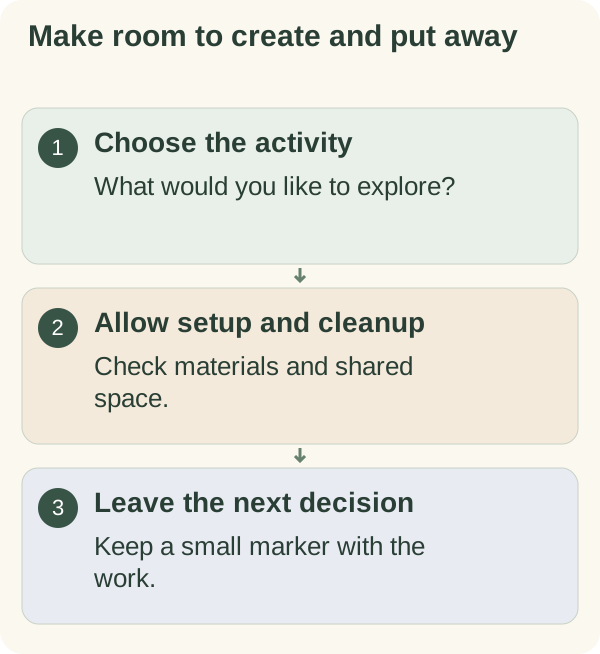
One opening is a reasonable goal for a busy week
Advice about creative time often suggests a fixed daily slot or getting up early. In a week already full of work, family and errands, that can turn a hobby into one more thing you are failing at. One opening that actually happens is worth more than five that get dismissed.
Look at the week as it stands and find a single window that is likely to survive. A gap you have protected before is a better bet than an evening that often gets swallowed by chores. If a second opening appears, treat it as a bonus.
Decide what kind of creative time it will be
Most creative hobbies contain several different activities, and each needs different conditions:
| Kind of creative time | What it looks like | Conditions it needs |
|---|---|---|
| Making | Drawing, writing a scene, knitting rows, editing photos | Space, materials out, some focus |
| Learning a technique | Trying a new stitch, brush stroke or chord shape on scrap material | Focus, freedom to get it wrong |
| Gathering ideas | Collecting references, taking photos, jotting phrases | Very little; fits a walk or a commute as a passenger |
| Sorting materials | Tidying supplies, prepping a canvas, winding yarn | Low energy, some space |
Choosing in advance stops the most common drift: sitting down to make something and spending the whole window browsing supplies or tutorials. If research is what you want, that is fine. It just helps to choose it on purpose.
On a tired evening, gathering ideas or sorting materials can still feel like time with your hobby. On a fresh morning, making is usually the better use.
Count setup and pack-down inside the window
An hour that starts with clearing the table, finding the brushes and filling water jars, and ends with washing up and putting things away, may contain much less actual making than you expect. People often blame themselves for "never getting anything done" when the real problem is invisible setup.
Before the opening, estimate three things: how long setup takes, how long pack-down takes, and what is left. If what is left is too short for making, switch the kind of creative time rather than giving up on the opening.
A ready kit for short openings
A small box or bag holding the short-gap version of your hobby removes most of the setup:
Ready kit for: ____________________

[ ] The basic tools for the short version (e.g. one pen, small sketchbook)
[ ] The current piece, or a scrap to practise on
[ ] Anything that protects the surface or the room
[ ] The note from last time
[ ] A place it lives that I can reach without moving other things
Store anything sharp, hot, toxic or fragile according to its instructions, and out of reach where children or animals live. A kit that is safe to grab is better than materials left out on a shared table as a reminder.
Reserve a creative opening
- Pick the window.
One opening this week that is likely to survive.
- Choose the kind of time.
Making, learning, gathering or sorting, to suit your likely energy.
- Estimate setup and pack-down.
Subtract them from the window to see what is left.
- Prepare the kit.
Put what you need in one place before the window starts.
- Leave a note when you stop.
One line on what to try next, kept with the work.
Example: Maya and the kitchen-table watercolours
Illustrative example only; this is not a real person's story. Maya paints watercolours and shares a small flat with a housemate. Her only flat surface is the kitchen table. Every time she planned a painting evening, setup and cleanup took so long that she often painted for only a short while, and the table had to be clear before her housemate cooked.
She tried three changes in one busy week. She agreed with her housemate that Thursday after dinner was hers until a set time. She packed a ready kit with a small pad, a travel palette, two brushes and a towel, so setup became opening one box. And she decided in advance that Thursday was for making, while a lunchtime walk on Tuesday was for gathering ideas with her phone camera.
Thursday worked. She painted one small study and left a note on the back: "Sky too heavy; try more water next time." The Tuesday walk gave her two photos to paint from.
What changed after trying it: she dropped the idea of painting daily, kept the Thursday arrangement, and started packing down at a fixed point so the table was clear without a rush. The small kit also meant she could do a quick study on a Sunday when the flat was quiet, which she had never done before.
When you have no space of your own
Hobby advice tends to assume a spare room or a desk. Many people share a table, a bedroom or a living room with others, and that changes the plan.
- If the only surface is shared, agree a window and an end time with the people who use it. A clear end time is often easier for others to accept than an open-ended session.
- If you live with young children, choose materials that are safe to use near them, or use the time after they are asleep for making and daytime for gathering ideas.
- If your hobby makes mess or smell, such as paints, glue or clay, protect the surface and ventilate the room according to the product instructions, and agree where things dry.
- If there is truly nowhere this week, switch to a portable kind of creative time: a pocket sketchbook, notes for a story or collecting references.
A simple script for agreeing shared space:
"Could I have the table on ________ from ________ until ________?
I'll clear everything away by then and keep my things in the box on
________. If that evening doesn't suit you, is there another one?"
Let the plan change on the day
If the opening arrives and you no longer want to do the thing you planned, choose another kind of creative time or leave the window empty. A note to yourself in the calendar is information, not a debt. You do not owe your hobby a finished piece every week.
Keep unfinished work easy to return to
Before you pack away, leave one line with the work: "try the lighter blue in the corner", "the second verse needs a rhyme for 'harbour'", "compare these two layouts before cutting". That note is what lets a busy-week opening start with making instead of remembering. Keep it short; a review longer than the session works against you.
Making room for a hobby you enjoy is part of looking after yourself, and the habits and goals guides treat it that way: one opening and one small piece of work, instead of a schedule you have to keep up with.
Try build a small routine to choose the next creative opportunity. If the project has been waiting for a long time, start a task can help you choose an opening action rather than a finished outcome.
Use the activity and opportunity fields in the Practice session planner, including the time needed to stop and store materials appropriately.
Questions people often ask
Is one creative session a week enough? It is enough to keep a hobby in your life. If you want to build skill faster, add openings when your week has room, rather than starting with a plan you cannot keep.
What if I spend the whole opening looking at tutorials? Decide beforehand whether the opening is for learning or making. If it is for making, keep tutorials closed until the last part.
Should I leave my materials out so I remember to use them? Only if that is safe and fair to others in the space. A ready kit stored nearby usually works just as well.
What if I don't like what I made? Keep it anyway for a while, or note what you would change. A session that taught you something has done its job.