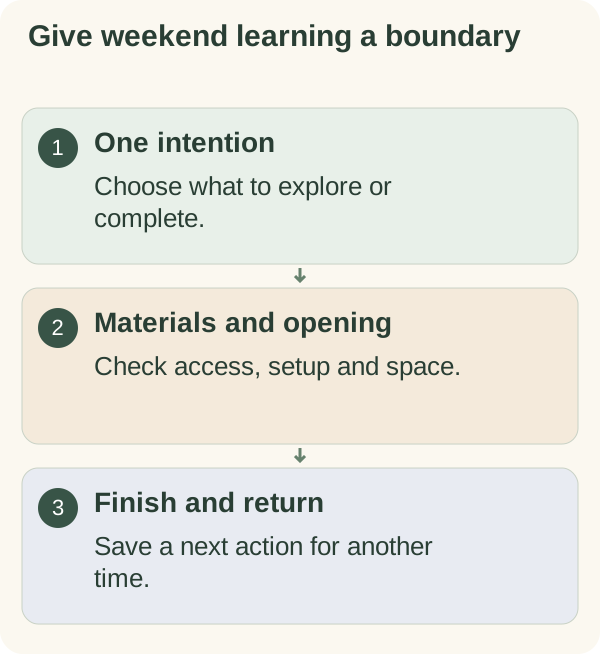
Give a weekend learning session one intention, a fixed start, and a stop time you decide before you begin. Put it where it keeps the weekend's shape, often first thing on one day, and write down what you will do at the stop so you do not drift into the afternoon. Check that the materials and instructions are ready on Friday. Whatever is left becomes a note for next time, not a reason to give up the rest of the weekend.
Why weekend study tends to swallow the day
Many weekend study plans copy the shape of an intensive course: a long morning, a break for lunch, then more in the afternoon. That suits a class with a tutor and a room booked. On your own it often goes another way. The start slips because the materials are not ready, the session never quite ends, and by evening you have neither learned much nor rested. The next weekend, the whole idea feels heavier.
The fix is to treat the session as one event with edges, the way you would treat meeting a friend for coffee. It has a time, a place and an end.
Pick a slot that keeps the weekend's shape
Look at the whole weekend before picking the slot. Mark what already has a claim on it: shared plans, chores, sport, family, travel and rest. Then choose one session on one day.
| Slot | Works well when | Watch out for |
|---|---|---|
| Early on the first day | You want it done and the rest of the weekend free | Late Friday nights making the start unrealistic |
| Late morning | You need a slow start but want the afternoon free | Errands creeping in before you begin |
| Afternoon of the second day | The first day is busy with others | The session clashing with preparing for Monday |
| Split across both days | The task has two natural halves | Turning two short sessions into two long ones |
A morning slot is popular because it leaves the rest of the day open, but it is not the only good choice. What matters is that the slot has a clear start and something after it that you want to get to.
Check readiness on Friday
A session that begins with logging in, resetting a password, downloading files or hunting for notes loses its best part to admin. Do those checks on Friday or earlier:
- the course or materials open on the device you will use;
- the lesson, chapter or exercise is identified;
- any files, books or equipment are in one place;
- if the work belongs to a course, you have checked the real deadline and any prerequisites on the provider's own page.
A video's running time is rarely the whole job. Exercises, pausing to take notes and checking answers add to it, so pick an intention that fits the session rather than a list of lessons.
Decide the stop, and what happens at it
The stop time is only meaningful if you know what you will do when you reach it. Pick something concrete that ends the session: a walk, lunch with someone, a shower, leaving the house. Set a timer or alarm if you need it.
At the stop, you have two options, and only two:
- Stop. Write the return note and close the materials.
- Make a fresh choice to continue, for a stated extra period, only if nothing else was planned for that time and you still want to.
What you should not do is carry on without deciding, or eat into time you already agreed to give someone else.
A weekend session plan you can copy
Weekend of: ________
Session:     Saturday / Sunday   from ______ to ______
Intention:   (one thing to explore or finish)
Ready by Friday?  [ ] access works  [ ] materials together
                  [ ] deadline checked (if any): ______
First move:  ________________
At the stop I will: ________________ (the thing that ends the session)
If I want to continue: only until ______, and only if ______
Return note: lesson / page / exercise ______ ; next action ______
Rest of the weekend: ________________ (what this time protects)
Plan one learning occasion
- Intention:
name one thing to explore or complete.
- Readiness:
on Friday, check access, materials and any real deadline.
- Slot:
pick one session that keeps the shape of the weekend.
- Stop:
choose the end time and the activity that marks it.
- Return:
finish with a note on where to resume and the next action.
Example: Maya's Saturday morning with a self-paced course
This is an illustrative example, not a real person's story. Maya was working through a self-paced course on data skills for her job. She kept setting aside "Saturday" for it. In practice she started late, took long breaks, felt guilty about the unfinished modules and often worked on into the evening, which ate into time with friends.
She tried a bounded session. On Friday evening she opened the course on her laptop, found the next lesson and downloaded the practice file. Her plan said: "Saturday, start after breakfast. Intention: work through the lesson on sorting and filtering and try the first exercise. At the stop, meet Sam for a walk."
At the stop she had finished the lesson but only half the exercise. She wrote: "Exercise 2, step 4. Filter not working on the date column; rewatch the part on date formats." Then she went for the walk.
What changed after trying it: the next Saturday began with that note, so the first move was obvious. She also noticed that a morning session followed by plans with someone gave her a natural end, and she kept that pairing on later weekends.
When the weekend session is really about a Monday deadline
Most weekend planning advice assumes the learning is optional. Sometimes it is not.
- If there is an assessed submission due on Monday, check its actual requirements and how much work remains before you plan anything. A bounded session still helps, but it has to match the real workload.
- If the remaining work clearly cannot fit, contact the provider through its stated process as early as you can, and ask about options. A smaller personal target does not move an official date.
- If the session is for work training, check whether your employer expects it in working hours. Weekend time may not be required.
- If household plans change and the slot disappears, move the session to the other day or to next weekend. Do not try to rebuild it from fragments of a busy afternoon.
- If you are on a roll at the stop and nothing else is planned, continuing for a stated extra period is a fair choice. Make it deliberately, and keep the original activity that marks the end.
Leave the next session easier to start
The return note does the work of protecting the rest of the weekend. When the next step is written down, unfinished work stops feeling like an open loop. Keep it to the place and one action, as in Maya's note, and store it with the materials.
A weekend session with a clear end is one manageable step rather than a whole day handed over to study, which is how the habits and goals section approaches learning: progress you can keep making without giving up rest or the people you spend weekends with.
Use start a task to select the opening move. For a defined workload and confirmed workdays, the daily goal calculator can help you check the arithmetic without deciding your personal capacity for you.
Use the intention, opportunity and return fields in the Practice session planner to plan one occasion with a finish boundary.
Questions people often ask
Should I study on both days of the weekend? One session is a good default. Split the work across both days only when the task has two natural halves, and keep both sessions bounded.
What if I don't start on time? Keep the stop time anyway. A shorter session that ends when planned does more for next weekend than a long one that runs late.
How do I stop myself checking messages during the session? Close what you can before the start, keep your phone somewhere less handy if that helps, and note any thought that arrives on paper to deal with after the stop.
Is it all right to skip a weekend? Yes. Some weekends are for rest, travel or other people. The return note keeps your place until the next session.