Go back to the last lesson, chapter or conversation topic you clearly recognise, not the one your old schedule or a learning service says is next. Make your first session back a review of that familiar material, and write down the questions it raises. Then plan one more session that fits this week. Reminders, streaks and targets from before the break can be reset to suit your life now; they do not describe what you know.
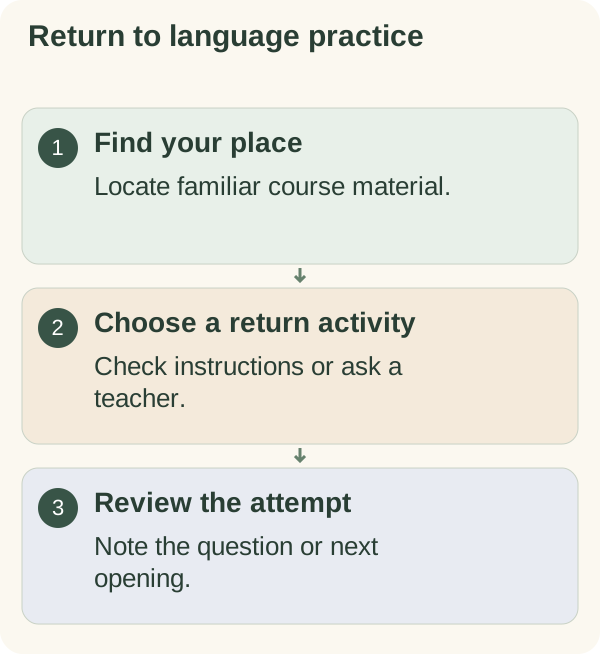
This is a way to organise a return to practice. It does not assess your language level, prescribe a learning method or predict how quickly you will remember material.
Why the old routine is a poor starting point
When people come back to a language, they often try to resume exactly where they stopped: the next unit, the same daily target, the same evening class time. The material feels harder than expected, the target is missed in the first week, and the break starts again. Many guides say to start small. That is sound, but it leaves out the more useful question of where to start.
The answer is the last place you recognise. Recognising a lesson means you can read its instructions, follow most of its examples and remember having worked on it. That place may be a few units before where you stopped. Starting there is not going backwards; it is choosing material you can actually use.
Find the last place you recognise
Gather what you were using: a coursebook, class handouts, your own notes, vocabulary lists, a learning service. Then work backwards from where you stopped.
| What you find when you open it | What it usually means | Where to start |
|---|---|---|
| You follow it with a few gaps | This is still your place | Here, reviewing first |
| You recognise the topic but not the details | Familiar, needs review | A unit or two earlier, then return here |
| The instructions themselves are unclear | Too far ahead for now | Go back until the instructions make sense |
| You cannot find your materials | The old route is gone | Ask your teacher, or start from a review unit |
If you have a teacher or are enrolled on a course with requirements, ask them where to rejoin. A personal return plan does not decide which class level suits you or change a course deadline.
Make the first session a review
The first session back has one job: to reconnect you with material you already know. Good choices include reopening the last familiar lesson, rereading a passage you have studied, listening again to a recording you know, or going through your own notes.
While you work, keep a list of questions: words you cannot recall, grammar points that feel shaky, instructions you do not understand. That list is the most valuable result of the session. It tells you, and a teacher if you have one, what to focus on next.
A return-to-practice note
- Materials:
where is the course, book or set of notes?
- Recognisable place:
what is the last part I clearly remember working on?
- Opening activity:
which familiar lesson, passage or recording do I start with?
- Questions:
what do I need clarified by a teacher or the materials?
- Next session:
where in this week does a second session fit?
A return note and a teacher message you can copy
Keep this note with your materials and fill it in after the first session.
Language:              ________
Materials:             ________ (book / course / notes / service)
Stopped at:            ________
Last place I recognise: ________
First session back:    date ______, worked on ______
Questions I collected:
  1.
  2.
  3.
Next session:          day ______, start with ______
If you have a teacher, a short message helps them pick up from where you are:
"Hello ________, I've had a break from my ________ lessons since ________.
I've reviewed up to ________ and it was mostly familiar, but I'm unsure about
________ and ________. Could we start from there next time, or would you
suggest a different starting point?"
Example: Alex restarts Portuguese after a busy season
A fictional example, written to show the steps in practice. Alex had been learning Portuguese with a weekly evening class and a coursebook, plus a learning service on the phone. A demanding season at work meant three months without opening any of them. The phone service showed a broken streak and a long list of overdue reviews. The class had moved several units ahead.
Alex's first instinct was to clear every overdue review in one weekend and rejoin the class at its current unit. Instead, Alex opened the coursebook at the unit where the break began and worked backwards. The unit two before that was the last one where the instructions and most examples made sense. Alex spent the first session rereading its dialogue and writing questions: two verb forms, a set of food words and one sentence pattern.
Alex then messaged the teacher with the questions and asked where to rejoin. The teacher suggested a review group meeting at a different time for a few weeks.
What changed after trying it: Alex turned off the phone service's daily reminder and set a new one for two days a week, because the old setting belonged to a quieter season. The question list became a regular habit, bringing three questions to every class.
When your reason for learning has changed
Restart guides usually assume the goal is the same as before the break. Often it is not, and that changes the plan.
- If the trip, exam or move you were learning for has passed or been cancelled, decide what you want now. Conversation with friends, reading for pleasure or staying familiar with the language each need different material.
- If you learned for a partner, family member or community, ask them what kind of practice would help both of you, such as speaking together on a regular occasion.
- If your old class has ended or moved, contact the provider about current options, or switch to self-study for now with a clear review starting point.
- If you no longer want to learn, that is a legitimate decision. Keep your notes in case you change your mind, and remove reminders that no longer serve you.
- If the break came after a holiday, the guide on restarting a routine after a holiday covers the wider return to everyday routines.
Keep old reminders separate from current priorities
Look at notifications, targets and streaks in each learning service and change them to suit your current week using that service's own settings. A missed streak is not an assessment of your ability. It only tells you the old plan stopped.
The Armored Kitten companion cannot reset another app's history or change a course requirement. Keep your learning records in the appropriate place and avoid putting private account information into a general planning conversation.
Review the next attempt
After the first session or two, write one observation: the material was more familiar than you feared, you needed to go further back, or a particular question keeps coming up. Use that to choose the next session, rather than returning automatically to the timetable you had before.
Coming back to a language one familiar lesson at a time fits the way the habits and goals section treats any lapsed routine: a small restart that suits this week matters more than recovering everything the break interrupted.
The weekly review worksheet can help you compare the intended opportunity with what actually happened. You can also read the full missed-day guide.
Plan a small restart for an illustrated next step. Any reminder or habit in Telegram needs its own actual setup and confirmation; reading this page does not resume a paused routine for you.
Use the first card and practice-log card in the Practice session planner to choose an opening and note what needs clarification afterwards.
Questions people often ask
Will I have forgotten everything? People often find they recognise more than they expected once they open familiar material. The review session will show you where you actually are.
Should I clear all my overdue reviews first? You do not have to. A long backlog can make restarting feel impossible. Check whether the learning service lets you reset or reduce it, and start from familiar material instead.
Should I rejoin my old class level? Ask your teacher or provider. Tell them how long the break was and what you reviewed; they can suggest where you fit.
How often should I practise after a break? Choose a frequency that fits your current week, and plan one session at a time until the routine feels settled again.