A short practice session works best with one narrow intention, such as a few marked bars, the exercise your teacher set or a question you want to answer, and with the instrument ready before the window starts. Decide what you will play first, when you will stop, and what you will write down at the end. Keep the plan inside whatever your teacher has asked for; this page organises practice, it does not teach technique.
Why short sessions drift
Many practice guides offer a sample structure: a warm-up, the hardest passage, then something you enjoy. That shape can help, but it does not solve the problem most people meet in a short window. The session starts late because the instrument is still in its case, the music is in another room, or nobody decided what to play. By the time the first note sounds, much of the window is gone, and what remains turns into playing through favourite pieces.
A short session goes better when three questions are answered beforehand: what exactly am I working on, what do I play first, and when do I stop?
Make the intention narrow enough to steer you
"Practise the piano" does not tell you what to do when you sit down. A useful intention names a piece of material and a purpose:
| Too broad | Narrow enough |
|---|---|
| Work on the sonata | Play the marked bars in the second page slowly and find where I hesitate |
| Practise scales | Do the two scales my teacher set this week and note which one feels less sure |
| Get better at strumming | Try the strumming pattern from the lesson on one chord change only |
| Learn the new song | Listen through once, then read the first line and mark anything I don't understand |
If your teacher has set practice tasks, use those as the intention. Do not add extra work because someone else's routine online is longer. If you have no teacher, keep the intention to a small, clearly marked piece of material you can name.
Get the instrument ready before the window
Setup is part of the session, so move as much of it as you can to a calmer moment. Depending on the instrument, that may mean leaving it somewhere safe and accessible, keeping the stand up, putting the music open at the right page or having accessories such as rosin, reeds or a tuner within reach.
Follow the care instructions for your instrument and any guidance from your teacher about storage, temperature and handling. Some instruments should not be left out of their case, and a short session is not worth damaging one.
A practice card you can copy
Fill in the card before the session and finish it afterwards. It fits on an index card or in a notes file.
Date / window:        ________________
Intention (one line): ________________
Material:             piece / exercise / page / bars ________
First thing I play:   ________________
I stop when:          the window ends / I've done the intention / ________
Quiet backup:         ________________

After:
What I tried:         ________________
One observation:      ________________
Question for teacher: ________________
Resume at:            ________________
Write and use a practice card
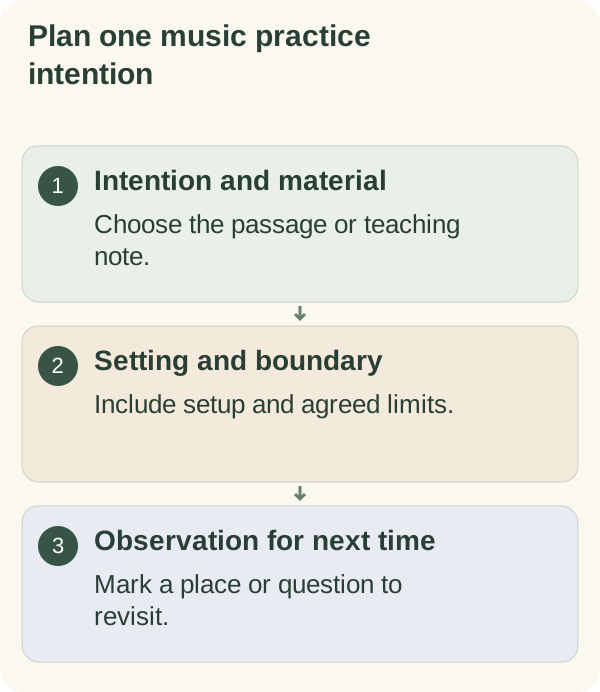
- Intention:
name the one thing you want to explore or review.
- Material:
note the piece, exercise or teaching note, and open it at the right place.
- First move:
decide what you will play as soon as you sit down.
- Stop point:
choose when to stop or reassess, and keep to it.
- Next time:
write what you tried, one observation and where to resume.
Example: Sam fitting cello practice around a toddler's bedtime
Illustrative example only; this is not a real person's story. Sam returned to cello lessons as an adult. His teacher set two short tasks each week: a scale and a passage from the current piece. At home, his practice window was the short gap after his toddler fell asleep and before the neighbours' quiet hours began. Most evenings he spent the start of that window getting the cello out, tightening the bow and finding the right page, then ran out of time.
He made two changes. On Sunday he wrote a practice card for each evening, choosing just one of the two tasks per session. And he set up the stand with the music open in the corner where the cello was stored, so getting ready meant opening the case and picking up the bow.
On Tuesday the card said: "Passage bars 9 to 16, slowly. First move: play bar 9 once. Stop when the window ends." He reached the stop point having worked only on bars 9 to 12, and wrote: "Shift in bar 11 feels unsure. Ask about the fingering."
What changed after trying it: his teacher answered the question at the next lesson, and Sam began bringing the cards along so the lessons started from what he had actually noticed. He also kept one card marked "quiet backup" for nights when the toddler was unsettled.
When you cannot make much noise
Few practice guides deal with thin walls, shift-working neighbours or a sleeping baby, but for many players these decide when practice can happen at all.
- If you share a building, check any house rules and talk to the neighbours most likely to hear you. Agreeing times is usually easier than apologising afterwards.
- If someone at home sleeps or works at odd hours, agree practice windows with them, and keep to the end time you set.
- If your instrument has a quieter option, such as a practice mute, headphones on a digital instrument or a quieter setting, ask your teacher whether it suits what you are working on.
- If playing is not possible today, use a quiet backup: listen to a recording of the piece while following the music, mark bars you want to ask about, or read through the next section. Ask your teacher which quiet work is useful for your instrument.
A short message to a neighbour can be as plain as this:
"Hi, I'm learning the ________ and practise for a short while most evenings.
Would ________ to ________ be all right for you? If the sound bothers you
at any point, please knock or message me and I'll stop."
If something hurts, stop
If playing causes pain, numbness, tingling or strain, stop the session. Tell your teacher, and if the discomfort continues or comes back, see a doctor or another suitably qualified professional. A practice plan should never ask you to play through discomfort.
End with information, not a grade
The last line of the card is the most useful part. Write what you tried, one thing you noticed and where to start next time. Avoid marking a session as good or bad. "Bar 11 unsure" tells you what to do next; "bad practice" does not.
If the session is interrupted, write the resume point before you put the instrument away, if you can. Return the instrument to its proper place rather than leaving it exposed as a reminder.
Decide whether another session fits this week
Choose the next window from your real week. If there is no suitable one, keep the card and plan again later. A missed session does not mean the next one should be twice as long; pick up from the resume point. Fitting a little music into an ordinary week is the kind of small, repeatable step the habits and goals guides are built around, and a card per session keeps that step clear.
Use start a task to choose a first move. If you want to record the occasions you choose, try the habit tracker without treating a blank as a judgment of your musicianship.
Use the first card in the Practice session planner for the musical intention and the log card for what you tried or want to ask.
Questions people often ask
Is a short session worth doing at all? A short session with a clear intention gives you something specific to notice and bring to your next lesson. Whether it fits your goals is a question for you and your teacher.
Should I always warm up first? Follow your teacher's guidance for your instrument. If you have no teacher, ask a qualified one before settling on a routine.
What if I have no teacher? Keep intentions small and specific, use material designed for your level, and write down questions. Many questions are easier to answer once you can name exactly what is unclear.
How do I stop the session turning into playing old favourites? Write the first move on the card and play it before anything else. Favourites can come at the end if there is time.