Leave yourself a way back
- Step 1Choose the book’s current state
- Step 2Record an exact return point
- Step 3Add a line in your own words
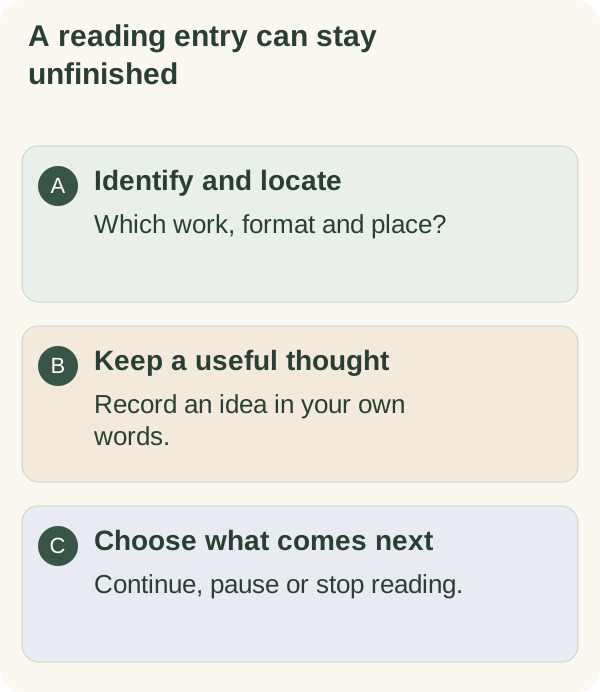
A useful reading log records where you are, not only what you finished. Give each book a status (reading, paused, dipping in, stopped or finished), a resume point precise enough to find your place, and, when something struck you, one line in your own words. That turns the log into a tool for choosing your next read instead of a scoreboard of completed titles.
Why a finished-books list stops helping
A list of finished titles answers one question: how many. It says nothing about the half-read novel on the bedside table, the essay collection you open now and then, or the book you put down after three chapters and never made a decision about. Those unrecorded books tend to linger as vague guilt, and they make it harder to pick something new.
A list that only counts endings also changes how people read. Some keep pushing through a book they dislike so it can be added to the list. Others avoid long books because they will not "count" for weeks. Recording other outcomes removes that pull without throwing away the record.
Five statuses that cover almost every book
Most reading falls into one of these. Use the words that feel natural to you, but keep the categories distinct.
| Status | Use it when | What to write |
|---|---|---|
| Reading | You opened it recently and intend to carry on | Resume point |
| Paused | You want to come back, just not now | Resume point and a reason, such as "save for a quieter month" |
| Dipping in | The book is read in pieces: poems, essays, recipes, reference | Which pieces you have read, if that matters to you |
| Stopped | You have decided not to continue | One line on why, if you know |
| Finished | You reached the end | Optional: what you would tell a friend about it |
"Stopped" is a decision, not a failure. A short reason ("too slow for this season", "I wanted the second half of the argument, not the first") becomes useful later. If several stopped entries give the same reason, that tells you something real about what you enjoy.
"Paused" needs a quick honesty check. If you have not opened a paused book in months and feel nothing when you see it, it may already be stopped. Changing the status is allowed and costs nothing.
Make the resume point fit the format
A vague resume point ("somewhere in the middle") means re-reading pages to find your way back. Match the marker to the format:
- Paper book: page number plus the first few words of the paragraph. Bookmarks fall out, and page numbers differ between editions.
- E-book: chapter name and the location or percentage your device shows.
- Audiobook: chapter number and timestamp.
- Article or long read: where the link is saved and the heading of the section you reached.
- Rereading: note which reading this is, so notes from an earlier time do not mislead you.
A log entry you can copy
Paste this into a notebook, notes file or spreadsheet. Leave any field blank that does not help.
Title and author:
Format: paper / e-book / audio / library copy (due ____)
Status: reading / paused / dipping in / stopped / finished
Resume at: (page + first words / chapter + timestamp / section)
One line worth keeping: (in my own words)
Next choice: continue / pause until ____ / swap for ____ / return it
"Next choice" does more work than any other field. It tells future you what to do with the book, which is the question you actually face when you pick something up.
Set up the log in one sitting
- Pick one place.
A notebook, a notes file or a spreadsheet. Two places means one gets forgotten.
- Gather what is in progress.
Look at shelves, bags, your e-reader and any library account.
- Give each book a status.
If you have not opened it for a long time, call it paused or stopped.
- Add the resume points you can find.
Open each book and note where the bookmark sits.
- Write one next choice per book.
That list is the log's first useful result.
Example: Sam's log after a scattered month
Here is a made-up example to show how it can work. Sam had four books on the go: a library novel, a history book he bought in spring, a poetry collection and an audiobook he played on walks. His old list only recorded finished titles. It had not changed for weeks, so he had started telling himself he no longer read.
He set up the log one evening. The library novel went in as reading, with its due date in the format field. The history book he marked paused, with the note "good but dense; better for a holiday". The poetry became dipping in. The audiobook was reading, at chapter nine and a timestamp.
Seeing everything together changed the picture. He was reading most days; he just was not finishing anything. The due date beside the novel made it the obvious next choice. Two weeks later he moved the history book to stopped, adding "might return for the chapter on canals", and felt relief rather than guilt.
The one thing he changed after trying it: he began adding the first words of the paragraph to paper resume points, because his bookmark kept slipping out of the novel in his bag.
When the log is shared, borrowed or kept for someone else
Most advice on reading logs assumes one adult, one notebook and books they own. Real logs are often messier.
- If a school asks for a child's reading log, follow the school's format for what it requests and keep any extra notes separate. If you are unsure what counts, ask the teacher rather than guessing.
- If you share a log with a partner, friend or book group, agree which columns everyone sees. Personal reflections can live in a private column or a separate notebook. The guide on starting a shared walking or reading routine covers how to set the shared part up.
- If a book is a library loan, the due date is a real requirement. Record it, but check renewals in the library's own account; the log cannot extend a loan.
- If you copy passages, keep quotations short, note the author and title, and summarise in your own words where you can, especially if the log is visible to others or posted online.
- If you have many books marked reading, that is fine. When you cannot remember where you were in one of them, it is paused in practice, and the log should say so.
Use the log to choose, not to check up on yourself
Open the log at the moments it helps: when you finish or stop a book, when a loan is nearly due, or when you have a free evening and cannot decide what to pick up. Read down the "next choice" column and take the first one that appeals. There is no need for a weekly review just to keep the record looking busy.
A log this light suits the way the habits and goals guides treat any routine: one honest line per book is a step you can keep taking, where a completion target soon becomes something to feel judged by.
Use start a task to choose a reading opening. If you want an attendance-style record alongside the log, try the habit tracker, remembering that its entries do not explain what a book meant to you.
Adapt the practice-log card in the Practice session planner for your reading place, observation and next choice; leave irrelevant fields blank.
Questions people often ask
Should books I did not finish count? Count them in whatever sense matters to you. If you like totals, keep a separate tally of books you spent real time with. The log's job is to show where you are, and an unfinished book is part of that.
How much should I write about each book? One line is enough for most entries. Write more only when you enjoy it or need it, for example for a book group or a project.
Is paper or digital better? Use whichever you will open without effort. A notebook that lives beside your bed beats a spreadsheet you never load, and the reverse is just as true.
Will a reading log make me read more? It can make resuming easier, because the place and the next choice are already written down. It cannot create time or interest you do not have, and it does not need to.