Before you promise to finish a stalled creative project, take stock of it: find the latest version, write down what is done and what is undecided, and name the specific thing that stopped you. Then choose one of four paths: continue with one small opening move, shrink the project, pause it properly, or stop and keep the parts worth keeping. If someone else is waiting on the result, tell them which path you chose.
Momentum usually stops at a decision, not a lack of effort
Advice about creative slumps often says to lower expectations and take tiny actions. That helps, but it skips the reason many projects stall in the first place. Very often, work stopped at a particular point: a choice you did not want to make, a material that ran out, a section that went wrong, or a change in your life that removed the space. Small actions around that point will keep sliding off it.
So the first job on returning is not to make something. It is to find out exactly where and why the project stopped.
Take stock before you start making
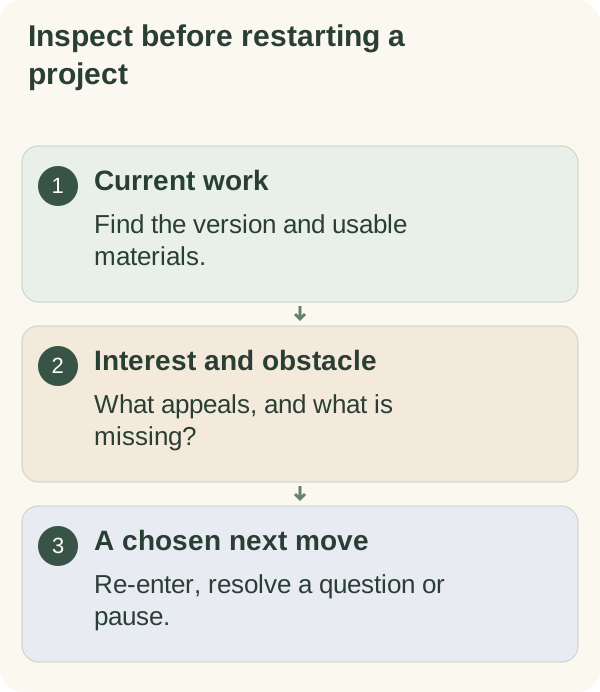
Spend one short session looking, not working. Gather the project and answer these questions in writing:
- Where is the latest version? The most recent file, draft, sketchbook page or physical piece. In a shared project, check what others have changed since you stopped, so you do not overwrite their work.
- What is actually done? List finished parts plainly: "first two chapters drafted", "front panel knitted", "rough cut of the video".
- What is undecided? The open questions: an ending, a colour, a layout, a title.
- What condition are the materials in? Paints dry out, glues expire and tools need care. Follow the storage and safety instructions for anything you use, and replace what is no longer safe or usable.
Name the obstacle
Read your notes and find the point where work stopped. Then match the obstacle to a response.
| What stopped the project | What it needs | What will not help |
|---|---|---|
| A missing material or tool | Buying, borrowing or substituting it | More reminders to work on it |
| An unmade creative decision | A small test of two options, or a deadline for choosing | Starting another section to avoid the choice |
| A part that went wrong | Deciding whether to fix, redo or accept it | Pretending it is fine and carrying on |
| No space or time any more | A smaller version, or a proper pause | Waiting for the old conditions to return |
| Faded interest | An honest look at whether to shrink, pause or stop | Guilt about time already spent |
| Waiting on someone else | A clear question to that person | Silence |
Some projects have more than one obstacle. Deal with the first one you would hit when you sit down to work.
Choose one of four paths
Once the obstacle is clear, choose a path deliberately:
- Continue. Pick one opening move that touches the obstacle directly, such as testing two colours on scrap, or rewriting the paragraph where the draft went wrong.
- Shrink. Reduce the project to something you can finish with the time and space you have: a shorter story, a cushion instead of a blanket, a single song instead of an album.
- Pause properly. Store the work safely, write a re-entry card and choose a moment to look again. A pause with a note is different from a project quietly abandoned.
- Stop and keep what is useful. Keep the parts, sketches or ideas worth saving, and put the rest away or pass materials on. The time already spent was not wasted if you learned from it, and it does not decide whether finishing is right now.
Make a project re-entry card
- Location:
record where the latest work and materials are kept.
- State:
describe what is done and what is still undecided.
- Obstacle:
name the specific thing that stopped you.
- Path:
choose continue, shrink, pause or stop.
- Opening move or next check:
write the one action, or when you will look again.
A re-entry card you can copy
Project:            ________________
Latest version at:  ________________
Done:               ________________
Undecided:          ________________
Materials check:    OK / need ________ / replace ________
What stopped me:    ________________
Path:               continue / shrink / pause / stop
Opening move:       ________________ (if continuing or shrinking)
Look again on:      ________________ (if pausing)
Who needs to know:  ________________
Example: Sam's half-finished quilt
A fictional example, written to show the steps in practice. Sam started a quilt as a gift for his sister's new baby. He pieced most of the top, then stopped for months. Each time he saw the fabric box he felt worse, because the baby was growing and the quilt was still in pieces.
His stock-take showed that the top was nearly done: one row was missing. The obstacle was not time. He had run out of one fabric and could not decide whether to use a different one in the final row. He had been avoiding the decision for months.
He chose to shrink the project slightly. He dropped the last row, which made a smaller quilt that still suited a toddler, and the fabric problem disappeared. His opening move was to lay the finished rows out on the floor and check the new size. He also sent his sister a short message saying the quilt was on its way and would be a little smaller than planned.
What changed after trying it: the decision took one evening once it was written down. He finished the quilting in a few sessions. For his next project, he added a line to his notes when buying fabric: "buy extra for the last row".
When other people are waiting on the result
Guides about creative momentum usually picture a solo project. Many stalled projects involve someone else: a band, a co-writer, a commission, a promised gift or a community event. Before you plan anything, these need a word with the people involved.
- If you are collaborating, check the shared version and any messages before working, then tell the others where you are and which path you chose.
- If you promised something as a gift, a short honest update is kinder than silence. You can change the size, the timing or the plan.
- If someone is paying you, reread what you agreed about deadlines and changes, and contact them before a deadline passes rather than after.
- If you want to stop a shared project, say so directly and offer to hand over your parts or files.
A message you can adapt:
"Hi ________, I've picked ________ back up after a long gap, and I want to be
straight with you about where it is. ________ is done and ________ is still
open. I'm planning to ________ (continue / make it smaller / pause until ________ /
step back). Does that work for you, or would you like to talk it through?"
End each session with a trace
Save the work and leave the next decision written beside it: "test the darker green against the border", "decide whether the second verse stays", "cut the last two panels". That note is what keeps the momentum you just rebuilt. You do not need a completion deadline unless there is a real reason, such as a gift date or an agreement.
Returning to something you made, and deciding honestly what happens to it next, is the same one-step-at-a-time approach that runs through the habits and goals guides, and when the project is for someone else it is also a small way of keeping faith with them.
Use restart after missing days to choose a return occasion. If the project feels vague, start a task with an action you can recognise when it is done.
Use the creative-project card in the Practice session planner for the latest version, actual state, current interest and opening move.
Questions people often ask
Should I restart from scratch? Usually not. Take stock first. Starting over can be the right choice, but only once you know what the old version taught you.
How do I know whether to stop? If the stock-take leaves you feeling relieved at the thought of stopping, and nobody is relying on the result, stopping is probably honest.
What if I find the old work embarrassing? That often means your taste has moved ahead of your earlier work. Note what you would now do differently; that is useful for the next session.
How long should a pause be? As long as you need. Write a date to look again, not a date to finish.