Match a book to a moment
- Step 1Find a recurring opening
- Step 2Choose a format that fits
- Step 3Leave it within reach
Most people who never find time to read already have small reading moments in their week; the book just is not there when the moment arrives. Find two or three of those moments, put something you actually want to read within reach of each one, and match the format to the moment: paper by the bed, an e-book or audiobook on the move. Make starting as easy as opening at the bookmark. If a book is not pulling you back, swap it.
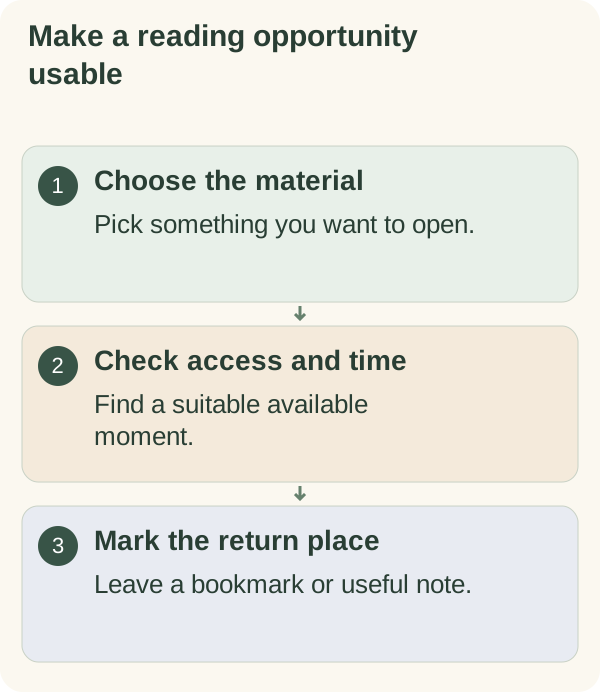
You can enjoy reading without turning it into a daily target. What follows is for making room when you want a little structure, not for measuring whether your leisure time has been productive enough.
The time often exists; the book is somewhere else
Common advice is to set a daily slot or a page quota. For someone whose days are already full, a new slot is one more thing to fit in. A more forgiving starting point is to notice the moments that already exist: waiting for a kettle or a bus, a lunch break, the few minutes in bed before sleep, a train journey as a passenger, a child's swimming lesson.
Those moments get filled with whatever is closest, which is usually a phone. Reading more is often less about willpower and more about what is within reach at the time.
Map your reading moments
Spend one ordinary week noticing gaps where you could read. Then fill in a map like this one.
| Moment | How long, roughly | Where I am | Format that fits | Where the book lives |
|---|---|---|---|---|
| ________ | ________ | ________ | paper / e-book / audio | ________ |
| ________ | ________ | ________ | paper / e-book / audio | ________ |
| ________ | ________ | ________ | paper / e-book / audio | ________ |
Two or three moments are plenty. A typical map might show a commute as a passenger (e-book on the phone), a lunch break (paperback in the bag) and the time before sleep (a book on the bedside table). Leave out anything unsafe or unpleasant, such as reading while driving or cycling, or on a journey that makes you feel unwell.
Choose something you want to come back to
The book itself matters more than any planning trick. If you are reading something because you feel you should, the moments will keep going to other things. Pick a book, article or genre you are curious about. Rereading an old favourite counts. So does a short book, a graphic novel or a collection you can read in pieces.
Check practical access before the moment arrives. A library e-book still waiting for a free copy, a paperback left at work or an audiobook not downloaded for a journey with no signal will all quietly cancel a plan.
Make starting nearly effortless
The first moment of reading is the one most likely to be lost. Reduce it to the smallest step: open at the bookmark and read one paragraph. If you want to keep going, you will. If not, you still opened the book, and the bookmark is still in place for next time.
A reading opportunity card
- Choice:
what do I want to read right now?
- Moment:
which of my mapped moments will I use first?
- Access:
is the book, file or download where that moment happens?
- First step:
open at the bookmark and read one paragraph.
- Fallback:
if that moment disappears, which other one can I use?
Example: Daniel's commute and a tired bedtime
The example below is illustrative; the person in it is not real. Daniel used to read a lot but had not finished a book in months. He blamed long working days. He had tried reading before bed and kept falling asleep after a page, which made him feel he had lost the habit.
He mapped one week. There was a train ride to work as a passenger each morning, a lunch break he mostly spent scrolling, and the tired bedtime. He put an e-book on his phone for the train, kept a slim paperback in his work bag for lunch and left only a light, familiar book by the bed.
The novel he had been "reading" for months was one he had picked up because friends praised it. On the map, he noticed he never chose it when he had a choice, so he swapped it for a crime novel he had wanted to read.
What changed after trying it: the train became his main reading time, and lunch happened on about half his work days. Bedtime stayed short, which no longer bothered him, because it was no longer his only chance to read. He later added one change: downloading the next book before he finished the current one, so the train ride never started with nothing to open.
When the moments are there but reading still does not happen
Most articles on this stop at "make time". These situations need a different answer.
- If you are too tired to read at night, move your main reading to an earlier moment and keep bedtime for something light, or for nothing at all.
- If you pick up your phone to read and end up scrolling, try paper for at least one moment, or turn on a reading mode or move social apps off the home screen. Pick whatever is simplest for you.
- If you find reading physically hard, for example because of eyesight changes, headaches or difficulty following lines of text, talk to an optician, doctor or other qualified professional. Large-print editions, adjustable e-book text and audiobooks are all valid ways to read.
- If you want to read with someone else, a partner, friend or child, the guide on starting a shared walking or reading routine covers that kind of arrangement.
- If a week goes by without reading, start from the next moment on your map. There is no backlog of pages to make up.
Make resuming easy
Leave a bookmark or note where you stopped. For an article, save the link in a place you will actually find again. You do not need a detailed reading journal unless you enjoy one; a page number and a few words are enough.
Record only what you find useful
You might note which moments worked, a book you want to read next or a line you liked. Page counts and daily quotas are optional. A record does not need a mark for every day to be useful.
If you are returning after a break, the restart guide explains how to choose the next attempt without creating catch-up work. You do not need to read yesterday's imagined quota before opening the book today.
Fitting reading back into a full week is a small, kind thing to do for yourself, and it is a good example of the approach in the habits and goals section: one moment and one paragraph at a time, with no streak to defend.
Try the free habit tracker if a record would help you. Then build a small routine when you want to consider repeating the arrangement. The worksheet and the companion's history remain separate; opening a guide does not save a habit or schedule reading prompts.
Use the activity, materials and opportunity fields in the Practice session planner for a reading arrangement you want to try.
Questions people often ask
Do audiobooks count as reading? If you enjoy them and they give you the stories or ideas you want, they count for the purposes of this page. Use whatever format suits the moment.
Should I finish every book I start? No. If a book is not pulling you back after a fair try, swapping it usually leads to more reading, not less.
How much should I aim to read? There is no right amount. Start by using one moment you already have, and see whether you want more.
What if I have no gaps at all? Some weeks are like that. Keep a book within reach anyway, so that when a gap does appear, the choice is easy.