You do not have to choose one hobby and drop the rest, and you do not have to give each one a weekly slot. Keep two short lists: an interest list of hobbies you might pick up, and a commitment list for the few that involve a booking, a deadline or another person. When a free opening appears, choose the hobby that fits that particular opening. The others stay on the list, ready for a different kind of time.
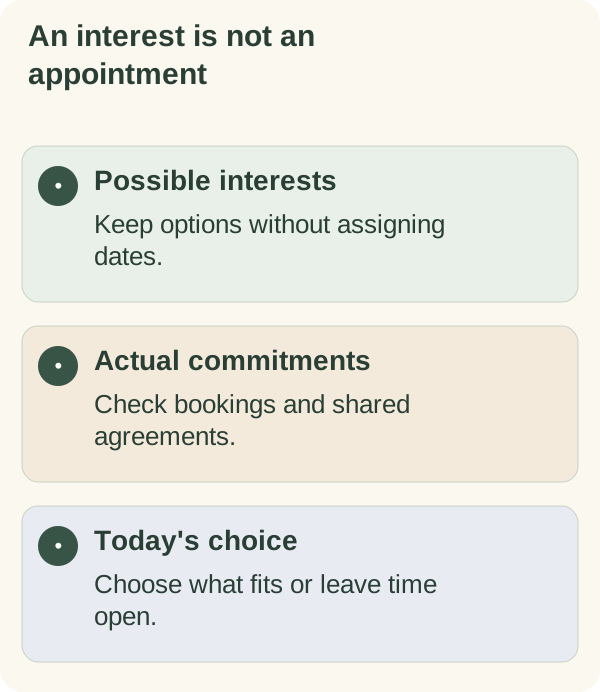
Two lists instead of one crowded calendar
Most advice on this question says to trial a few hobbies and keep the one you like best. That works if you want a single hobby. Plenty of people do not. They enjoy sketching some weeks, music in others and a long walk with a camera when the weather allows. The trouble starts when every interest gets a recurring calendar slot, because a calendar treats each slot as a promise, and missed promises pile up.
Splitting the lists fixes most of that:
- Interest list. Anything you might enjoy doing when time appears. No dates, no frequency, no order of importance.
- Commitment list. Only arrangements with a real consequence: a class you have paid for, a borrowed item due back, a band rehearsal other people attend, a piece promised to a friend. These get dates because the dates already exist.
If you are unsure where something belongs, ask: would anyone, including a booking system, notice if I did not show up? If not, it is an interest.
Match the hobby to the kind of opening
Hobbies compete less than they seem to, because each one fits different kinds of time. A guitar needs a place where noise is acceptable. Pottery needs a studio. A sketchbook fits in a bag. Ranking hobbies by importance misses this; matching them to the opening does not.
| The opening you have | Hobbies that tend to fit | Hobbies that tend not to |
|---|---|---|
| A short gap at home, little setup possible | Sketching, reading about a craft, practising a small technique | Anything with long setup or cleanup |
| A longer stretch at home with space | Bigger making projects, instrument practice where noise is fine | Hobbies that need a venue |
| Out of the house anyway | Photography, drawing outdoors, browsing a library or shop for materials | Hobbies tied to home equipment |
| Time with another person | Anything you both enjoy, agreed in advance | A solo project that needs concentration |
| A tired evening | Low-effort versions: watching a technique, sorting materials, planning | Learning something new and difficult |
Your rows will differ. The point is that a free evening does not have to settle which hobby matters most. It only has to settle which one suits tonight.
A hobby menu card you can copy
Fill in one row per hobby on your interest list. It takes a few minutes and saves the same debate every time an opening appears.
| Hobby | Setup effort (low / medium / high) | Place needed | Needs another person? | Pull right now (strong / some / little) | Real commitment? |
|---|---|---|---|---|---|
| ________ | ________ | ________ | ________ | ________ | ________ |
| ________ | ________ | ________ | ________ | ________ | ________ |
| ________ | ________ | ________ | ________ | ________ | ________ |
"Pull right now" is allowed to change from week to week. Update it when you notice a shift rather than treating your first answer as permanent.
Choose for one opening
- Describe the opening.
How long, where, how much energy, and whether anyone else is involved.
- Check the commitment list first.
If something there needs this time, that decides it.
- Filter the menu card.
Cross out hobbies whose setup or place does not fit.
- Pick by pull.
From what remains, choose the one you feel most drawn to today.
- Allow "none".
Keeping the time unplanned is a valid choice, not a lost opportunity.
Example: Alex and five interests
Here is a made-up example to show how it can work. Alex had five hobbies competing for evenings and weekends: a weekly pottery class already paid for, guitar, sketching, bread baking and birdwatching. Each had its own recurring reminder, and most weeks Alex dismissed four of them, which made all five feel like chores.
Alex moved only the pottery class to the commitment list, because it had a booking and a teacher expecting attendance. Everything else went onto a menu card. Guitar was marked "home, noise fine before nine". Sketching was marked "anywhere, low setup". Baking was "half a day at home". Birdwatching was "outdoors, early, weather-dependent".
The next free Tuesday evening was short and Alex was tired, so the card pointed to sketching. A free Saturday morning with good weather pointed to birdwatching. Baking did not happen for three weeks, and that was fine, because nothing said it should have.
What changed after trying it: Alex deleted the four recurring reminders, kept the class in the calendar, and added one line to the card, "guitar pull is low lately", rather than forcing practice. A month later the pull came back on its own after a friend suggested playing together.
When a hobby feels like an obligation you never agreed to
Choosing guides tend to skip the hobbies that sit on the list out of duty rather than interest. These need their own decision.
- If you paid for equipment or a membership and no longer enjoy it, separate the money from the hobby. Check the terms for pausing or cancelling a membership, and decide about the hobby on its own merits. The money is spent either way.
- If someone gave you the equipment as a gift, using it once and finding it is not for you is still an honest response. Thank them for the thought; you do not have to keep the hobby alive for their sake.
- If the hobby belongs mostly to a friend or partner, it may belong on the commitment list as time together rather than as your own interest. The guide on planning a shared hobby when your schedules rarely match helps with that kind of arrangement.
- If you keep a hobby because you think you should, for example because it seems more productive than the others, try moving it to the bottom of the menu for a month and notice whether you miss it.
- If two hobbies need the same scarce resource, such as the one weekend morning or the only quiet room, alternate them openly rather than letting both fail.
Parking a hobby without losing it
A hobby you are not doing this month does not need a return date. It needs a short parking note so that coming back is easy: where the materials are stored, what you were last working on, and anything that needs checking before you start again, such as a tool that needs care or a pattern you were halfway through.
Store materials according to their instructions rather than leaving them out as a visual reminder. A guitar left on a stand is a gentle nudge for some people and an accusation for others; only you know which.
Revisit the lists when you want a choice
Look at the menu card when an opening appears or when your interests shift. Remove hobbies that no longer matter to you. A hobby does not need to become a long-term goal to deserve some of your time, and deciding that one opening goes to rest is part of the same choice. That is the thinking behind the habits and goals section of Armored Kitten: you choose one manageable step for the time you actually have, without owing the rest of the list anything.
Use build a small routine if you want one repeated opportunity. The weekly review can help you leave other hobbies available without scheduling them all.
Use the activity and materials fields in the Practice session planner for the option you choose; keep other interests outside the commitment list.
Questions people often ask
How many hobbies is too many? There is no number. The list becomes a problem only when interests are treated as commitments. A long menu with no dates attached costs you nothing.
Should I focus on one hobby to get good at it? If getting better at one thing is what you want, yes, and that hobby may earn a regular slot. If you mainly want enjoyment and variety, spreading your time is a reasonable choice.
What if I spend every opening deciding? Fill in the menu card once. Then the decision becomes a quick filter by setup and place, followed by a choice by pull.
Is it a waste to leave free time unplanned? No. Rest and unplanned time are uses of time too, and a hobby chosen out of guilt rarely feels like a hobby.