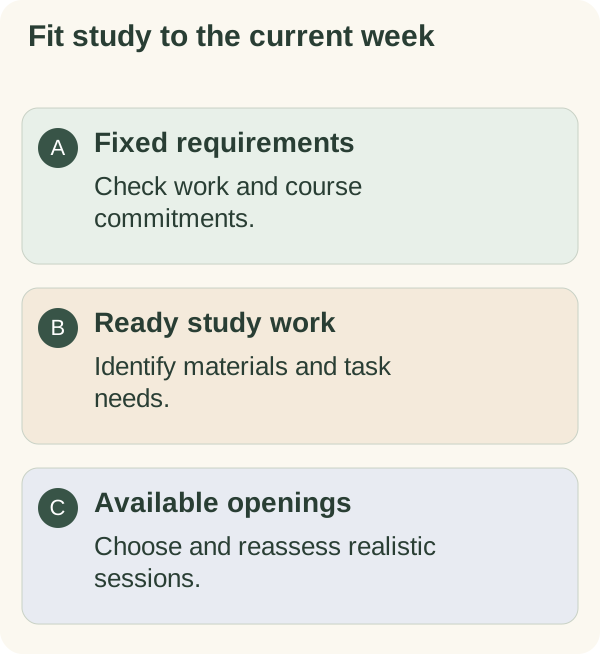
Plan study one week at a time, starting from the work rota you actually have rather than an ideal weekly timetable. Mark the fixed course items first (deadlines, live sessions, exams), then sort the rest of your study work by the kind of time it needs: short and interruptible, focused, or long and quiet. Match each piece to an opening that suits it. When work changes, re-sort the week instead of stacking up catch-up hours.
Start from the rota, not a perfect timetable
Most study advice for working adults recommends a fixed recurring slot, such as two evenings a week. That suits people with steady hours. It breaks quickly for anyone on shifts, on-call work, seasonal overtime or a job where meetings move. A slot that exists three weeks out of four teaches you to skip it.
Instead, plan when the rota or next week's diary is known. Write down work, travel, sleep after late finishes, caring duties and anything else that already has a claim on the week. Only then look for study openings. An evening that looks empty may belong to recovery after a hard day, and counting it as study time sets up a miss.
Separate fixed course items from flexible study
Two kinds of study work behave very differently:
- Fixed items have a date set by someone else: submission deadlines, exams, live classes, group meetings, lab or placement sessions. Check these on the provider's own timetable or course page. If something is unclear, ask the provider rather than guessing.
- Flexible work is everything you choose when to do: reading, watching recorded lectures, practice questions, drafting, revision.
Plan fixed items first, because the week has to fit around them. Flexible work fills what is left. If the fixed items alone do not fit around your job, that is a genuine conflict to raise early, not a planning failure to hide.
Sort study tasks by the time they need
Treating every study hour as interchangeable is where flexible plans usually fail. A twenty-page reading and a first draft of an essay need very different conditions. Sort your flexible tasks before you place them.
| Kind of task | What it needs | Openings that tend to suit it |
|---|---|---|
| Reviewing notes, collecting questions, flashcards | Can be interrupted and restarted | Short gaps, a break at work, travel as a passenger |
| Course admin: reading instructions, checking rubrics, emailing a tutor | Internet access, little focus | Short gaps on any day |
| Reading a chapter or watching a recorded lecture | Steady attention | A medium opening on a lighter work day |
| Drafting, problem sets, assessed exercises | Long, quiet, uninterrupted time | A day off or the start of a free day |
| Group work, live sessions | A fixed time with other people | Whatever the schedule sets; plan around it |
The same sorting idea works at work too; the guide on planning a work session between meetings applies it to a broken-up working day.
A weekly study sheet you can copy
Fill this in when your rota or diary for the coming week is settled.
Week of: ________

Fixed course items this week (date, time, what):
1.
2.

Work and other commitments that limit study:
(shifts, travel, late finishes, caring, rest after nights)

Openings I can see:
Short gaps:        ________________
Medium openings:   ________________
Long quiet block:  ________________

Flexible tasks, sorted:
Short-gap tasks:   ________________
Focus tasks:       ________________
Long-block tasks:  ________________

If the long block disappears, I will: ________________
Where I will resume next week: ________________
The line "If the long block disappears" matters most. Deciding in advance means a lost day off does not quietly wipe out the week's hardest task.
Plan this week's study
- Mark the fixed items.
Copy dates from the provider's timetable, not from memory.
- Mark the job.
Shifts, travel and the rest you need after late or long days.
- List the openings.
Label each one short, medium or long.
- Sort the flexible tasks.
Put each task in the group that matches what it needs.
- Match and set a fallback.
Place tasks into openings and decide what moves if a long block goes.
Example: Daniel on a changing shift pattern
The example below is illustrative; the person in it is not real. Daniel works a rota that changes every week and is part way through a part-time evening course. He had set Monday and Thursday evenings as study nights. Half the time he was on a late shift, and the other half he was too tired after an early start to do more than open the laptop.
He switched to planning each Sunday once his next rota was confirmed. That week had two early shifts, two lates and one day off. He put the course's live session (fixed, Wednesday evening) in first. He kept the day off morning for the assessed exercise, which needed a long quiet block. Lecture recordings went to the evening after an early shift, when he could focus for a while but not write. Flashcards and reading the assignment brief went into breaks on late-shift days.
His fallback line said: "If the day off gets swapped, the exercise moves to the next day off, and I email the tutor if that is after the deadline week."
What changed after trying it: the day off did get swapped once. Because the exercise already had a fallback, he did not try to cram it into a late-shift evening. He also stopped scheduling anything on the night after his second late shift, having noticed nothing useful ever happened then.
When a shift change collides with a deadline or live session
Flexible study plans often skip the moment that matters most: when work and a fixed course item land on the same day.
- If a new shift clashes with an exam, assessment or compulsory session, tell your employer as early as you can and ask whether a swap is possible. At the same time, read the provider's policy on extensions, alternative sittings or recordings, and use its stated process.
- If you are offered overtime during an assessment week, check the fixed items before you agree. Turning down extra hours is a money decision only you can make, but make it with the deadline in view.
- If your employer funds or sponsors the course, check whether the agreement includes study time or leave, and ask the person who manages it rather than assuming.
- If you are exhausted after a run of nights or long shifts, plan admin or nothing for those days. If tiredness is persistent or affecting your health, talk to a doctor.
- If the workload simply does not fit your job, contact the provider about pausing, reducing modules or changing your study pace through its official route. Doing that early keeps more options open.
Moving a task in your own plan never changes an official date. Only the provider can do that.
Missed a study opening? Re-sort, do not double
When a planned session does not happen, the reflex is to add it to the next one. That makes the next session longer, harder to start and more likely to slip too. Instead, look at what is left before the next fixed item, and re-sort it into the openings that remain. Some tasks may need to drop to a lighter version, such as reading the instructions instead of drafting.
Use the daily goal calculator for a defined amount of work across chosen workdays. The weekly review can help you compare that plan with your actual schedule before you restart after missing days.
Studying around paid work is a clear case of the approach behind the habits and goals guides: one manageable piece in the opening you really have, re-chosen each week, rather than a fixed plan your job keeps breaking.
Use the opportunity and first-action fields in the Practice session planner alongside the verified course requirements for the current week.
Questions people often ask
Is it better to study a little every day or in bigger blocks? It depends on the task. Interruptible tasks suit small daily gaps; drafting and assessed work usually need a longer block. Sorting tasks lets you use both.
What should I do on days I am too tired to study? Plan nothing, or plan a short-gap task such as checking the next week's instructions. A rested day off often does more for a long task than a tired evening.
Should I tell my manager I am studying? That is your choice. If you may need shift swaps around exams, telling them early usually gives you more room to ask.
How far ahead should I plan? Plan the fixed items for the whole course, and the flexible work one week at a time, once your hours are known.