Is gifting crypto safe? It can be, if you send to the right place, keep claim links and codes private, and never share a seed phrase. Most of the risk has little to do with the blockchain itself. It comes from scams that imitate gifts: fake claim links, "support agents" asking for recovery phrases, and giveaways that promise to double your coins.
Below are the most common crypto gift scams, how to verify a real gift, why claim links need special care, the basics of tax rules, and a checklist to use every time.
Is gifting crypto safe? The honest answer
Sending crypto as a gift is as safe as the habits around it. Three facts shape everything else:
- Transfers are usually final. The FTC points out that crypto payments don't come with the legal protections that credit and debit cards have, and typically can't be reversed.
- Whoever holds the key controls the funds. That applies to seed phrases, and it applies to claim codes too.
- Scammers love the word "gift". It creates excitement and urgency, the two feelings most likely to make people skip a check.
You can still give crypto. Give it the way you'd hand over cash: deliberately, privately, and to someone you've confirmed.
Common crypto gift scams
Fake claim links
A message arrives: "You've received a crypto gift! Claim within 24 hours." The link leads to a site that asks you to connect your wallet and approve a transaction, or to type in your recovery phrase. Real gifts need neither. Jupiter Send gifts, for example, are claimed only inside the Jupiter Mobile app, not on a random website.
Jupiter also warns that some unknown tokens are designed to drain your wallet when you approve a transaction, so surprise tokens and "claim" prompts deserve suspicion.
Seed-phrase phishing
Your seed phrase, or recovery phrase, is the master key to your wallet. Jupiter's help pages put it simply: anyone with it has full control over your wallet.
A variant targets hardware wallets: a device arrives with a recovery phrase already printed in the box. Ledger says a legitimate device never comes with a recovery phrase pre-configured. Don't use it.
Impersonation
Scammers pose as friends, family, exchanges, wallet support teams or even government agencies. The FTC describes scammers impersonating government agencies and celebrities to get people to send crypto. If a "friend" suddenly messages from a new account about a gift that needs a fee before you can receive it, check with them another way first.
Giveaway and "doubling" scams
"Send 1 token, get 2 back" is never real. The FTC is clear that only scammers guarantee profits or big returns, and that no legitimate business demands crypto in advance. A genuine gift never asks you to pay first.
How to verify a crypto gift is real
Before you claim anything, ask yourself these questions.
- Do you know the sender? Confirm through a channel you already trust, such as a phone call or an existing chat thread, not by replying to the message itself.
- Were you expecting it? A surprise is lovely from a friend, and suspicious from a stranger.
- Where does the link go? Real gift flows send you to a known app or the official site you expected. Look closely at the web address before you tap.
- Is anyone asking for your seed phrase, a password or an upfront fee? If so, stop. That's a scam.
- Is there pressure? "Claim in 10 minutes or lose it" is a classic manipulation tactic.
- Does the token check out? For Solana tokens, compare the mint address with the project's official source. Our guide on how to gift Solana tokens explains how.
Bearer links: why a claim link is like cash
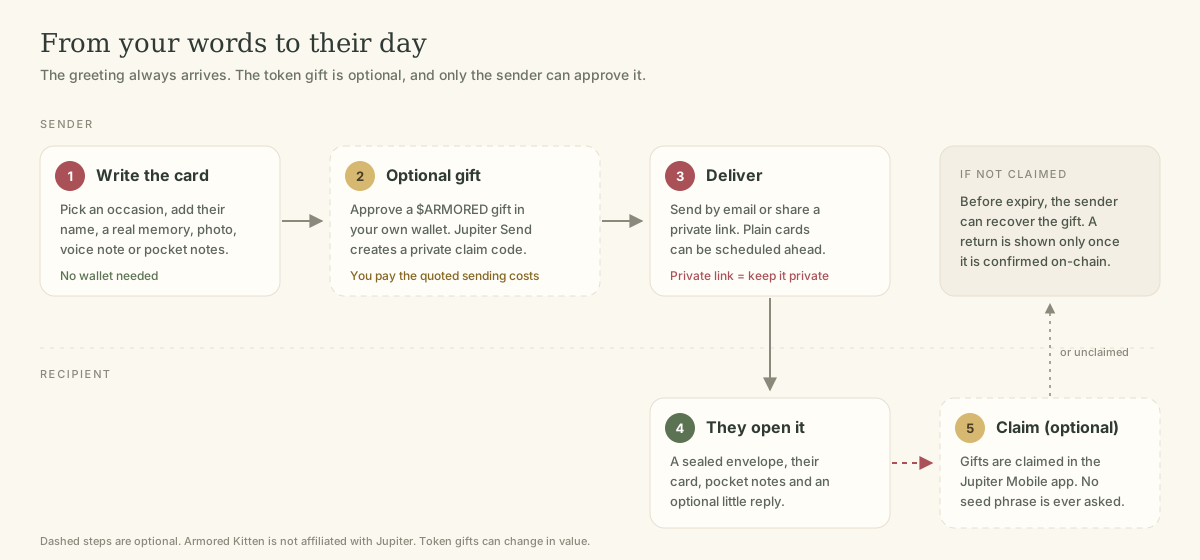
Many crypto gifts use a claim link or code. These are bearer secrets: whoever holds the link can redeem it. Jupiter's developer docs say invite codes should be treated like passwords or seed phrases, and that exposure may result in permanent loss of funds. Binance gives similar advice for its gift cards, noting that anyone with the code can redeem it.
For senders, that means:
- Share links one to one, never in public posts or large group chats.
- Don't paste them into shared documents or photo albums.
- If a link leaks before it's claimed, cancel it with the provider's revoke or clawback option.
- If a gift expires, check your wallet to confirm the tokens actually came back. Expired is not the same as refunded.
Our guide to Jupiter Send covers expiry and clawback in more detail. Armored Kitten is not affiliated with Jupiter.
Crypto gifts and tax: check your local rules
Tax treatment of crypto gifts varies by country, so check your local tax authority's guidance or ask a qualified professional. Two examples show how far apart the rules can be:
- United States. The IRS says that if you gave a gift of digital assets, you use Form 709, the gift tax return, where required. The IRS lists an annual exclusion of $19,000 per recipient for 2026 and says the donor is generally responsible for paying any gift tax.
- United Kingdom. HMRC guidance says giving cryptoassets to another person can count as a disposal for Capital Gains Tax, unless it's a gift to your spouse, civil partner or a charity.
A safe crypto gifting checklist
Run through this before every crypto gift.
Safe crypto gifting checklist
- Choose the right method for the person.
Not everyone wants crypto. Our guide on how to send crypto as a gift compares the options.
- Give a modest amount.
Tokens can lose value or be hard to sell. Give it as a gesture, not as an investment tip.
- Verify the recipient's address.
Check it directly with them, or plan a private way to share a claim link.
- Confirm the token's mint address.
Take it from an official source.
- Review everything in your own wallet.
Before approving, check the token, amount, destination and fees.
- Never share your seed phrase.
And never ask for theirs.
- Tell the recipient to expect it.
Then they can tell your real gift from a fake one.
- Track it after sending.
Confirm it was received, or that an unclaimed gift really returned to you.
- Keep simple records
in case your local tax rules require them.
Where a personal card fits in
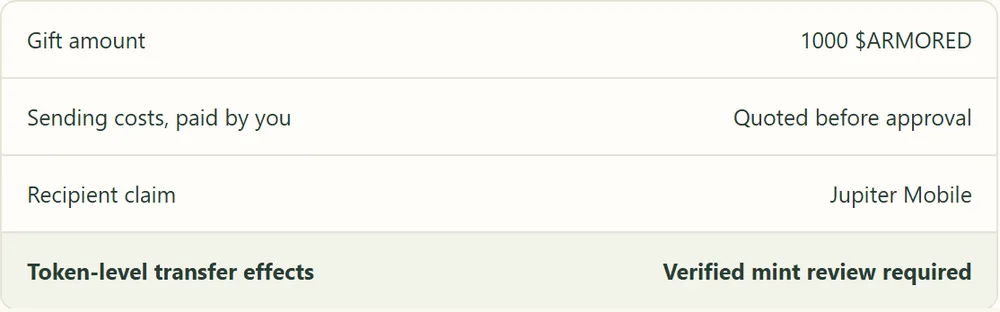
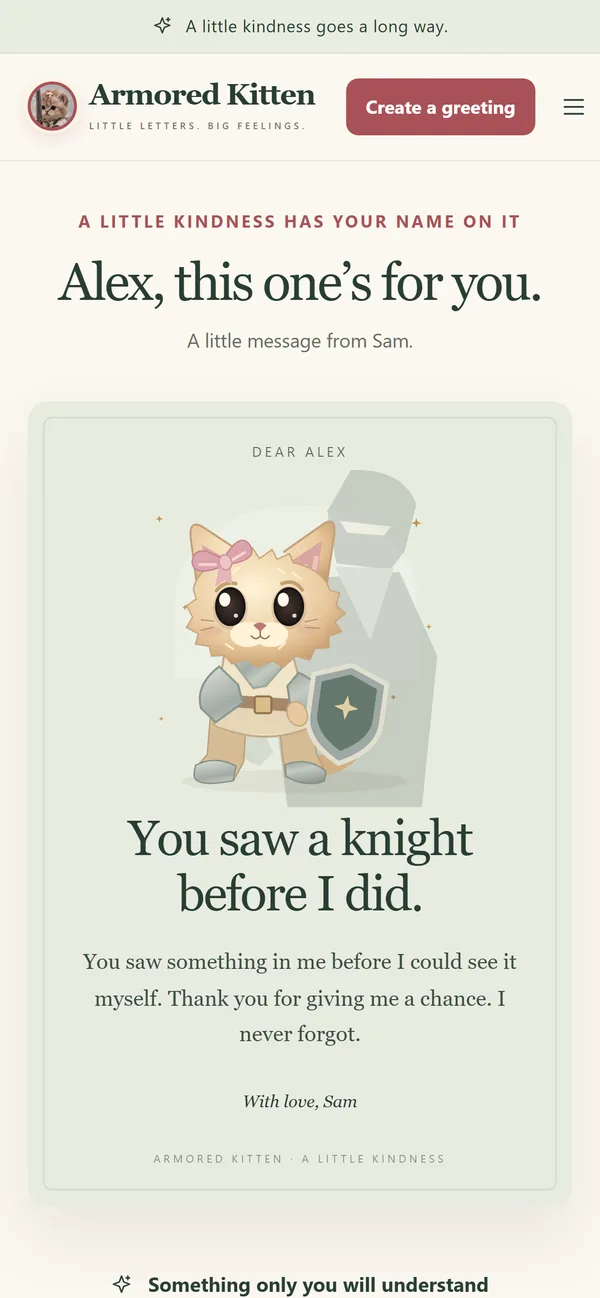
Sending a greeting has a quiet safety benefit: context. Your friend knows the gift is from you, what it's for, and that you'll never ask for anything back. With Armored Kitten, you write a real card for one of 16 occasions, such as a birthday, with your own words, an optional photo and a voice note of up to 20 seconds. No wallet is needed to make or read it.
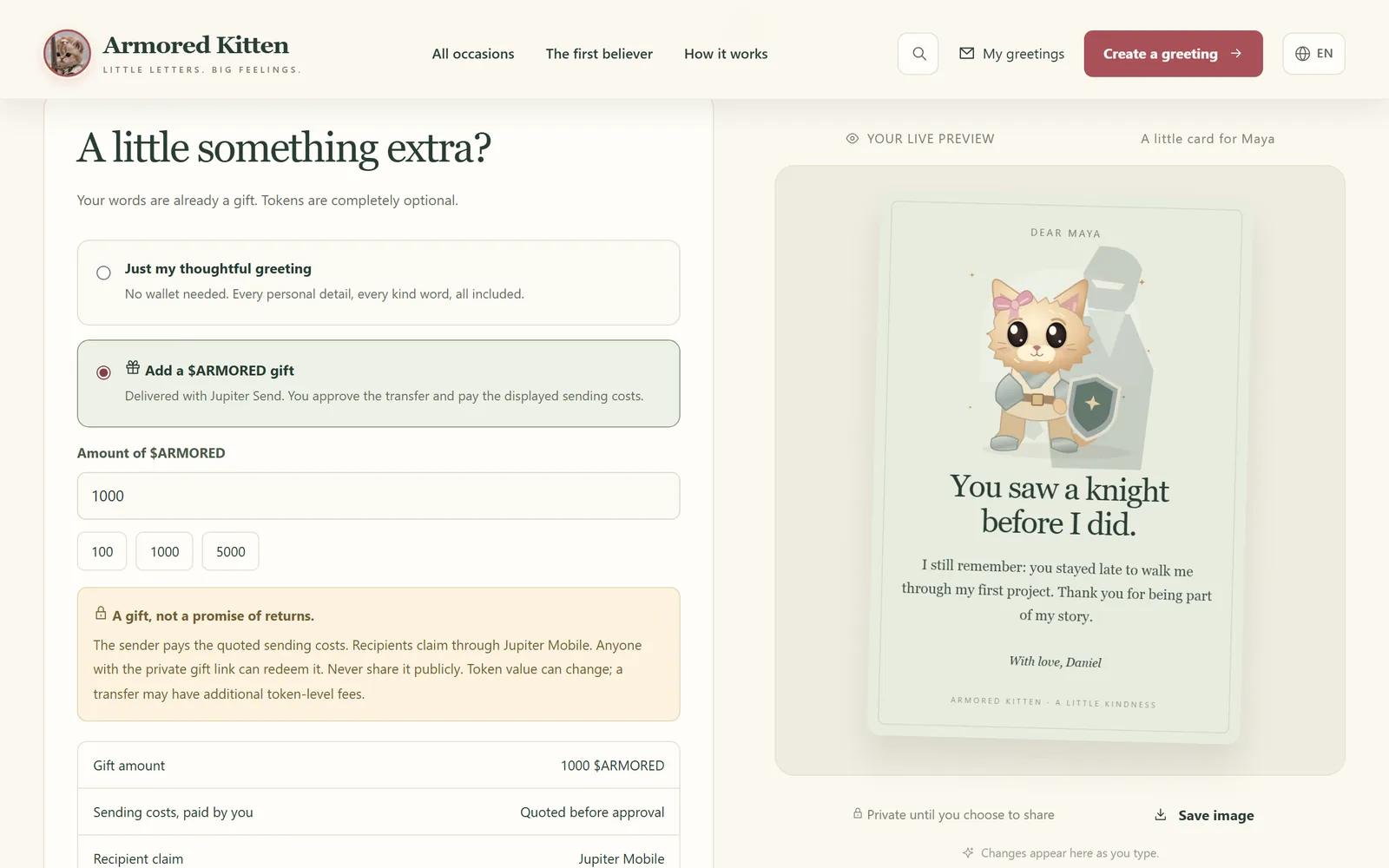
Where enabled, you can attach an optional $ARMORED token gift created with Jupiter Send. You approve it in your own wallet and pay the displayed sending costs, the recipient claims it in Jupiter Mobile, and the gift link stays private between the two of you. If the token part isn't right for them, the card still says everything that matters.
Frequently asked questions
Is it safe to send crypto to a friend?
Yes, if you verify their address directly with them, double-check the token and amount, and approve the transaction in your own wallet. Remember that transfers usually can't be reversed.
Can someone steal a crypto gift link?
Yes. Claim links and codes are bearer secrets, so anyone who has one can redeem it. Share them privately, and revoke an unclaimed gift if you think the link leaked.
Will a real crypto gift ever ask for my seed phrase?
Never. No legitimate gift, wallet support team or greeting site needs your seed phrase. Anyone asking for it is attempting theft.
Do I have to pay tax on a crypto gift?
It depends on your country and circumstances. In the US, gifts of digital assets may need to be reported on Form 709, while in the UK a gift can count as a disposal for Capital Gains Tax. Check your local guidance.
Where can I report a crypto scam?
In the US, the FTC accepts reports at ReportFraud.ftc.gov. Elsewhere, contact your national consumer protection or fraud reporting agency.
Give with care, receive with care
Crypto gifting is safe when you treat it like handing over cash: confirm the person, keep the envelope sealed, and never hand anyone the key to your wallet. A few honest words in your own voice tell them it's really you. If you're thinking of someone new to crypto, start with our guide on giving crypto to someone new to crypto.
Plain-language disclaimer: this guide is general information, not financial, legal or tax advice. Crypto can lose value or have little liquidity, and transfers are usually final. Check your local rules and each provider's current terms. Armored Kitten never asks for your seed phrase.
Armored Kitten is an independent greeting studio and is not affiliated with or endorsed by Jupiter. Token gifts are optional, can change in value, and are not investment advice. Check the rules that apply where you live.