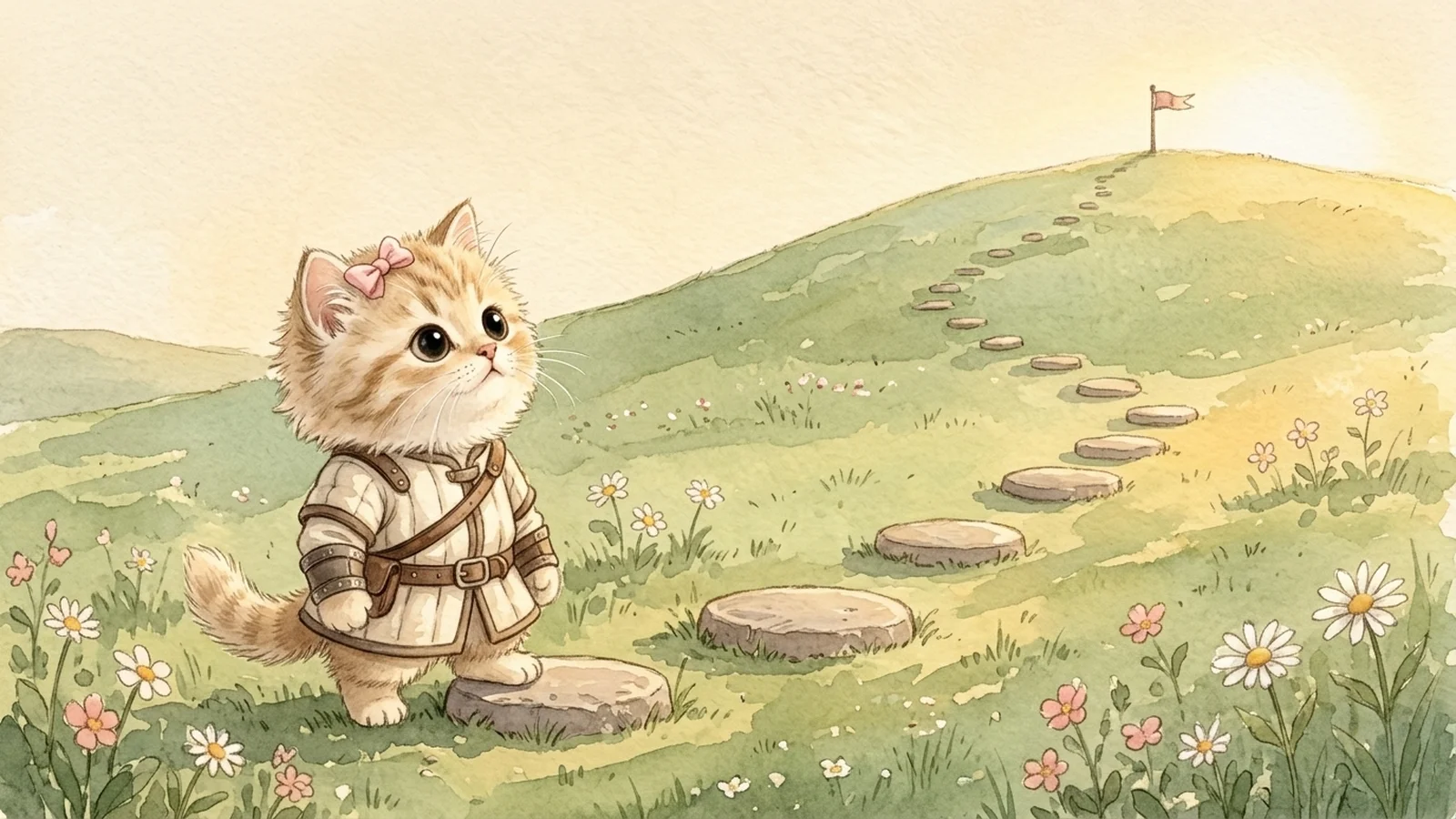
Say you've agreed to give a ten-minute talk to your team next Friday. "Prepare the presentation" is too big to start on a Tuesday night. "Ask a colleague what the team wants to hear" takes two minutes. That's how you break down a goal: go from the result you want, through a few checkpoints, to one small step you can do now.
Goals, milestones, tasks and habits
These words get mixed up a lot. Keeping them apart makes the next step easier to see.
- Goal: the result you want. "Give a clear ten-minute talk to my team on Friday."
- Milestone: a checkpoint on the way. "The outline is written and checked."
- Task: one action with a clear end. "Write the three main points on one page."
- Habit: something you keep doing. "Practise the talk out loud for ten minutes after lunch."
Not sure which is which? The goals vs. tasks vs. habits guide has a quick way to sort them.
Step 1: Say what done looks like
Write one sentence about what will exist, or be true, when you're finished. Add a deadline only if there's a real one. A good check: could a friend tell when it's done?
- Vague: "Get better at presenting."
- Clear: "Give a ten-minute talk on the new booking process to my team on Friday, with time for questions."
You can keep the ambition big. Just make it something you'd recognise. For a very large goal, like changing careers, pick a nearer result for now: "Decide whether to apply for the evening design course before applications close."
Step 2: Pick a few milestones
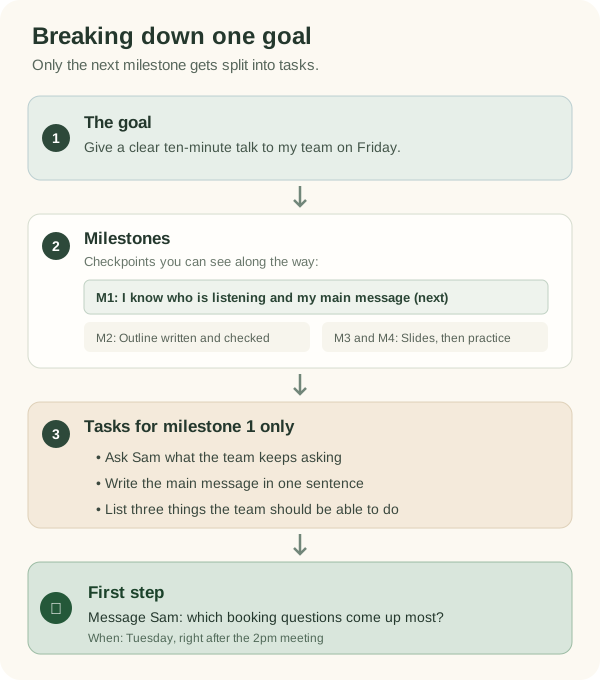
Milestones are the checkpoints between today and the result. Each one should be something you can see or show. For the talk:
- I know who's listening and what my main message is.
- The outline is written and checked.
- The slides are drafted.
- I've practised the talk out loud twice.
For a goal that takes days or weeks, two to five milestones is plenty. If you've written fifteen, most of them are tasks. The milestones guide shows how to decide when each one counts as done.
Step 3: Turn the next milestone into tasks
Take the first milestone only and list what it needs. Leave the rest alone for now. You'll know more about them once the first one is done.
For "I know who's listening and what my main message is":
- Ask a colleague which questions the team keeps asking about the booking process.
- Write the main message in one sentence.
- List three things the team should be able to do after the talk.
A good task starts with a verb, has a clear end and fits in one sitting. If a task still feels hard to start, there's usually a question hiding inside it. Make the question the task: "Ask Sam if the talk should cover the new prices."
Step 4: Choose a first step you can do now
Pick the task you can start with what you have today. It doesn't need to be the most important one. It just needs to get things moving.
For the talk, a message to a colleague is a good first step. It takes a few minutes, and the answer shapes everything after it. Three quick questions help:
- Do I have what I need to do this?
- Is anything else waiting on it?
- Could I finish it today?
If the answer to the last one is no, make the step smaller. Feeling stuck? The smaller-steps tutorial shows how to ask the Armored Kitten companion for a smaller next step.
Step 5: Give it a time
A step with no time attached tends to wait. Pick a moment that fits your real day: "Tuesday, right after the 2pm meeting." If your week is already full, that tells you something useful. Maybe the deadline or the size of the goal needs to change.
When you have several tasks across a week, the weekly goals to daily tasks guide helps you fit them into the time you have. If everything feels urgent, start with the prioritisation guide.
UC Berkeley's Greater Good Science Center suggests something similar in its goal visualization exercise: pick a realistic short-term goal, write down the steps and set aside time to do them.
Step 6: Look again and adjust
When the first milestone is done, come back to the plan. Turn the next milestone into tasks and pick the next first step. Things may have changed by then. Maybe the team only needs a five-minute update, or a one-page handout would work better than slides. Changing the plan as you learn is normal. That's what the check-in is for.
For goals that last longer than a week, a short weekly check helps. The weekly review guide has four questions to look back on what helped and what got in the way.
The whole example in one place
Here's the talk from start to finish. The names and details are made up.
From big goal to first step
- Result.
Give a clear ten-minute talk on the new booking process to my team on Friday.
- Milestones.
Audience and message clear; outline checked; slides drafted; practised twice.
- Tasks for milestone 1.
Ask what the team wants to know; write the main message in one sentence; list three things the team should be able to do afterwards.
- First step.
Message Sam today and ask which booking questions come up most.
- When.
Tuesday, right after the 2pm meeting.
- Check-in.
Wednesday morning. Is milestone 1 done? If yes, turn milestone 2 into tasks.
Want more? Goal breakdown examples walks through three more: one for study, one for work and one at home. For goals with real deadlines or other people involved, see the personal goal action plan guide.
Try it on your own goal
The goal breakdown worksheet turns these steps into ten short prompts. Copy them into a notebook or notes app. Your first one takes about ten minutes.
If you use the Armored Kitten companion on Telegram, the goal tutorial shows how to save a goal and its steps in your private chat. Paper works just as well.
Pick your goal, then pick one small step you can do today.