When everything feels important, go through your tasks one at a time and ask four questions. Is there a real deadline soon? Is someone waiting on it? Does it move a goal that matters? Does it fit the time and energy you have today? Do the tasks that pass the first questions first. Most of the rest can be moved, made smaller, handed off or dropped.

Why everything feels important
On a long list, every item shouts equally loud. Often the number of tasks is fine. The trouble is that they're all written the same way: "Finish report", "Call dentist", "Plan birthday". With no dates or goals next to them, it's hard to tell them apart. The four questions fill in what's missing.
The four questions
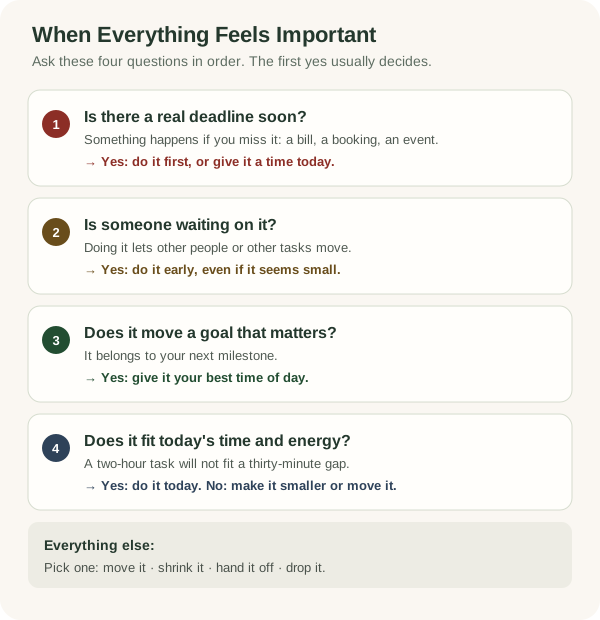
1. Is there a real deadline soon?
A real deadline means something happens if you miss it: a bill, an application, a booking, a promise to someone. Check the actual date. A task can feel urgent just because it's been on the list for ages.
2. Is someone waiting on it?
Some tasks hold up other things. Sending a file, answering a question or making a booking can take minutes and let several other things move. Do these early, even if they seem small.
3. Does it move a goal that matters?
If you're working towards a goal, check whether the task belongs to its next milestone. A task that moves your main goal usually comes before one that just tidies things up. The goal breakdown guide shows how milestones make this easier to see.
4. Does it fit the time and energy you have today?
A two-hour task won't fit in a thirty-minute gap. A task that needs careful thinking may not suit the end of a long day. Pick the important task that fits now, or make it small enough that it does.
An example
Here's a made-up list of seven tasks for someone with about three free hours today:
- Pay the electricity bill (due tomorrow).
- Send the venue the guest count (they asked yesterday, and the caterer needs it).
- Draft section 2 of the course assignment (due Friday).
- Reorganise the photo folders.
- Reply to a friend about weekend plans.
- Research new running shoes.
- Clean out the kitchen cupboards.
Running through the questions:
Choosing the order
- Pay the bill.
Real deadline tomorrow. Ten minutes.
- Send the guest count.
Someone's waiting on it. Five minutes.
- Draft assignment section 2.
Moves the most important goal. Fits the remaining two and a half hours if started early.
- Reply to the friend.
A quick message so they can plan their weekend. Five minutes, if there's time.
- Move or drop the rest.
Photo folders and cupboards move to the weekend. Shoe shopping waits until the old pair actually wears out.
Now there's a short, clear plan for today, and a decision about everything else.
What to do with the rest
Once you've picked what comes first, make a call on every other task:
- Move it to a day when it fits better.
- Shrink it. "Clear one cupboard shelf" instead of "Clean out the kitchen".
- Hand it off if someone else can do it and has said yes.
- Drop it if, looking at it again, it doesn't need doing.
Tasks with no decision next to them are what keep everything feeling important. If your list is mostly work before a busy day, how to make a task list shorter has a quicker version of this.
When the first task still feels too big
Sometimes you know what matters most and still can't start. Make the first step smaller. Open the document and write one heading, or just find the email you need to answer. The smaller-steps tutorial shows how to ask the Armored Kitten companion for a smaller next step.
From priorities to a plan
Priorities give you the order. A plan puts each task on a day. Next, read how to turn weekly goals into daily tasks to fit your chosen tasks into the time each day really has.