To turn a weekly goal into daily tasks, first look at how much time you really have each day. Then split the goal into tasks that fit those gaps, and keep a little room spare. You end up with a short list for each day. That's much easier to act on than one big goal hanging over the whole week.

Start with one to three goals for the week
A weekly goal is something you want done by the end of the week. If you're working towards something bigger, take it from your next milestone. Say the milestone is "report chapter drafted". This week's goal might be "draft the first half of chapter 2".
Keep the number small. With more than three, most people just shuffle tasks from day to day and finish none of them. The goal breakdown guide shows how milestones and weekly goals connect.
Check how much time each day really has
Before you plan anything, go through the week. How much focused time could you actually give each day? Count work, travel, family, appointments and rest. Some days will have none. Better to know that now.
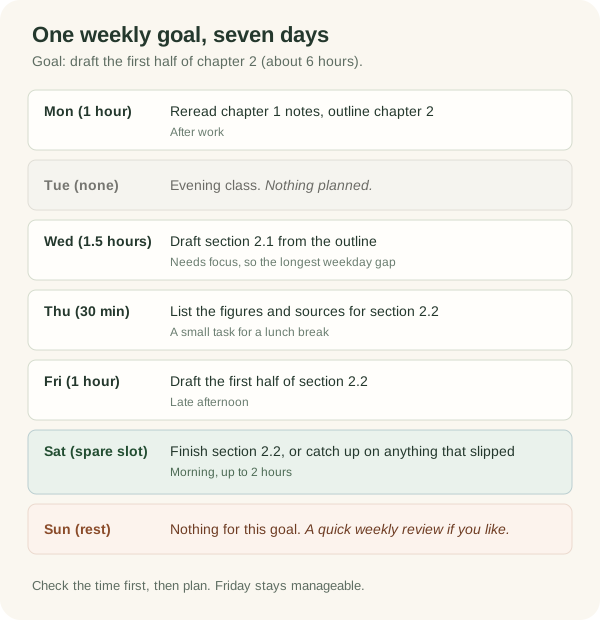
In this example week, the goal is to draft the first half of a report chapter. The writer thinks it'll take about six hours. Here's their week:
- Monday: 1 hour after work.
- Tuesday: none (evening class).
- Wednesday: 1.5 hours.
- Thursday: 30 minutes at lunch.
- Friday: 1 hour.
- Saturday: 2 hours in the morning.
- Sunday: rest.
That's six hours, exactly what the work needs, with nothing to spare. So either make the goal a bit smaller, or keep Saturday free to catch up on whatever slips.
Fit tasks to the gaps
Now split the goal into tasks that fit each gap. Thirty minutes suits a small, clear task. Two hours suits work that needs real focus.
Tasks for each day
- Monday, 1 hour.
Reread the chapter 1 notes and write the chapter 2 outline.
- Wednesday, 1.5 hours.
Draft section 2.1 from the outline.
- Thursday, 30 minutes.
List the figures and sources section 2.2 needs.
- Friday, 1 hour.
Draft the first half of section 2.2.
- Saturday, up to 2 hours.
Finish section 2.2, or catch up on anything that slipped.
Each task says exactly what to work on, so you can start right away. If a task needs something first, like a file from a colleague, ask for it a day or two before.
Keep some room spare
Plans fill up. A meeting runs late, a child gets sick, a task takes twice as long. Two things help:
- A spare slot: one session in the week kept free for catching up.
- A rest day: at least one day with nothing for this goal at all.
If the plan only works when every day goes perfectly, it's too full.
When everything feels important
If you have more tasks than time, choose what comes first before you spread them across the week. The prioritisation guide uses four questions about deadlines, who's waiting, what matters most and how much time you have. It also helps you decide what to move, shrink or drop.
To plan a single day in more detail, try the free daily priority planner.
Check in midweek
On Wednesday or Thursday, spend two minutes on the plan:
- Is the weekly goal still realistic?
- Has anything slipped that needs a new day?
- Is Saturday's spare time already taken?
Move tasks on purpose. If something won't fit, shrink the goal now. Sunday night is too late to find out.
End the week with a quick review
When the week's over, look at what got done and what carries over. The weekly review guide has four short questions, and the answers feed straight into next week's plan. If you're working towards something bigger, the personal goal action plan guide shows how weekly goals fit around dated milestones.