A personal goal action plan fits on one page. It answers six questions: what do you want, by when, through which milestones, with what time and help, what are you waiting on, and what will you do if something goes wrong? Use one when a goal will take several weeks or depends on other people.

When you need one
For a short goal, the six steps in how to break down big goals are usually enough. Write a full action plan when:
- the goal will take more than two or three weeks;
- there's a real deadline, like an application or an event;
- you're waiting on someone else, a payment, a document or a booking;
- you've tried before and got stuck at the same point.
The six parts
1. Result and deadline
Write the result in one sentence that someone else could check. Add a deadline only if it's real: an application closes, an event happens, a bill is due. If you set the date yourself, write that down too. Then you can move it later without feeling bad.
2. Milestones with dates
Pick two to five checkpoints and give each one a target date. Work backwards from the deadline, and leave a few spare days before the last one. The milestones guide shows how to say when each one counts as done.
3. Time and what you need
How much time can you really give this each week? What do you need: money, equipment, a quiet place, information, someone's help? If the work is much bigger than the time you have, change the goal or the date now. Finding out in the last week is much worse.
4. What you're waiting on
List anything that has to happen before you can go on: a reply, a document, an approval, a delivery. Ask for these early. Waiting is the part people forget to plan for.
5. One likely problem and a backup plan
Pick the one thing most likely to slow you down. Decide now what you'll do if it happens. "If I haven't heard back by the 10th, I'll call the office on the 11th." One backup plan beats a long list of worries.
6. Check-in date
Pick when you'll look at the plan again, like every Sunday evening or after each milestone. That's when you turn the next milestone into tasks and move dates if you need to. The weekly review guide has four questions for this.
A filled example
The course, dates and people below are made up.
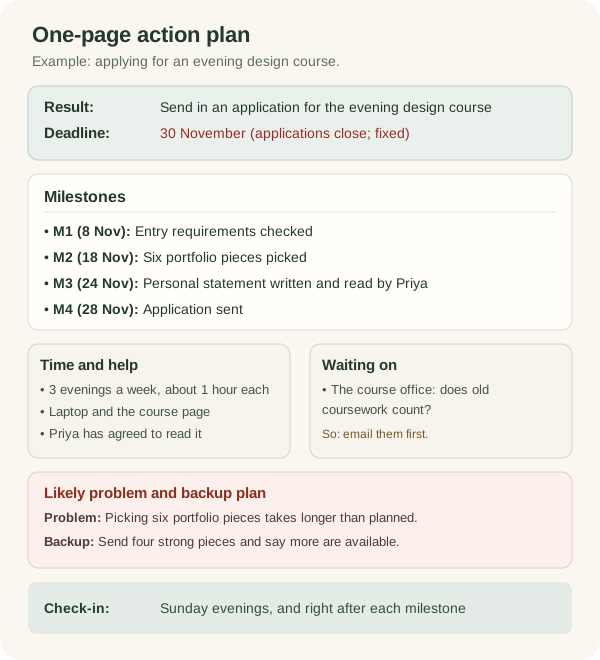
- Result: send in a complete application for the evening graphic design course.
- Deadline: applications close on 30 November. This one's fixed.
- Milestones: entry requirements checked by 8 November; six portfolio pieces picked by 18 November; personal statement written and read by a friend by 24 November; application sent by 28 November.
- Time and help: three evenings a week, about an hour each; a laptop; the course page; Priya, who's agreed to read the statement.
- Waiting on: the course office needs to say whether old coursework counts. Email them first.
- Problem and backup: if the portfolio takes too long, send four strong pieces and say more are available, if the course allows that.
- Check-in: Sunday evenings, and right after each milestone.
The plan doesn't list every task for the next four weeks. This week's tasks come from the first milestone: "find the entry requirements page" and "email the course office". The rest get planned when you get to them.
Turn the plan into this week's tasks
Each week, look at the next milestone. Pick the tasks that move it forward and fit the time you have. The weekly goals to daily tasks guide shows how to spread them across your days.
Prefer short prompts to a full page? The goal breakdown worksheet covers the same ground in ten fields.
Keep the plan useful
- Move dates in the open. If a milestone slips, change the date and note why. Pretending the old date still works only hides the problem.
- Keep other people's deadlines separate. Moving your own date doesn't move a deadline someone else set.
- Keep it private if you like. Paper or a notes app works fine. Don't write sensitive details anywhere you don't control.