A milestone is a checkpoint you can see. When you reach it, something exists, has happened or can be shown. Good milestones split a goal into stages and tell you when each stage is finished. They also give you natural points to stop and check the plan. For most goals that take a few weeks, two to five milestones is enough.
Goal, milestones and tasks
In the goal breakdown method, the goal is the result. Milestones are the checkpoints on the way. Tasks are the actions that get you from one checkpoint to the next.
- Goal: cook five weeknight dinners from scratch by the end of the month.
- Milestone: two of the five recipes have turned out well.
- Task: buy what you need for the lentil curry.
A quick test: if one action finishes it, it's a task. If it describes where you'll be after several actions, it's a milestone.
Step 1: Picture the finished goal
Write the goal as a result. Then ask: what would be true halfway there? What has to exist before the last step is possible? Your answers are your first draft of milestones.
Step 2: Describe a point you reach
Activities are easy to start and hard to finish. A point you reach is easy to check.
- Activity: "Work on recipes."
- Milestone: "Five recipes picked and their ingredients on one shopping list."
- Activity: "Practise cooking."
- Milestone: "Two recipes cooked once each, with a note on what to change."
Step 3: Say what counts as done
Write one short line saying exactly what "done" means. It stops you polishing forever, and it makes check-ins quicker.
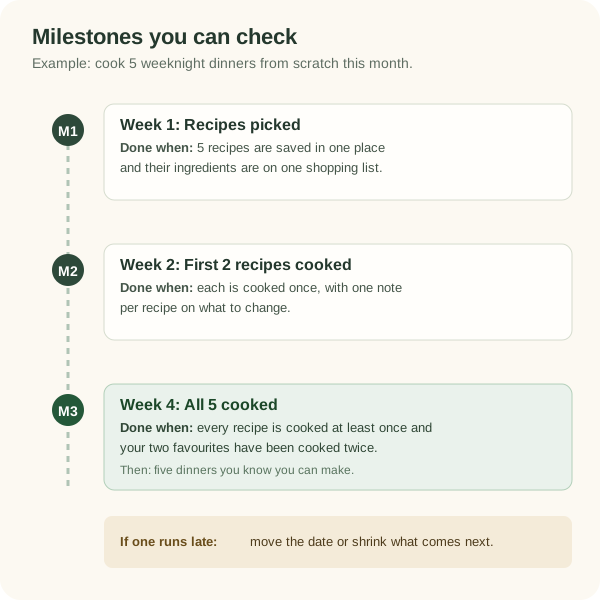
For the cooking goal:
Three milestones and what "done" means
- Recipes picked (end of week 1).
Done when five recipes are saved in one place and the ingredients are on one list.
- First two recipes cooked (end of week 2).
Done when each has been cooked once, with one note per recipe on what to change.
- All five cooked (end of week 4).
Done when every recipe has been cooked at least once and your two favourites have been cooked twice.
Your own version should match what "done" really means for your goal. It might be a document sent, a form submitted, a room cleared or a talk you've finally had.
Step 4: Space them out
If milestones are too far apart, weeks go by with no sense of progress. If they're too close together, they're really a task list. A rough guide:
- Goals of two to six weeks: two to four milestones.
- Goals of two to six months: three to five, with the later ones left a bit loose.
- Longer goals: set milestones for the next few months only. Plan the rest at a check-in.
These numbers are a starting point. If you're waiting on something, like an approval, you may want a milestone right after it arrives.
Step 5: Know what you'll do when one runs late
Some milestones will take longer than planned. Decide ahead of time how you'll handle it:
- Move the date, and push later milestones back if there's room before the deadline.
- Shrink a later milestone if the deadline can't move.
- Ask for help or information if you're stuck waiting on something.
- Pause the goal on purpose if something more important has come up.
Cramming all the remaining milestones into less time rarely works. Pausing on purpose is a perfectly good choice.
Use milestones as check-ins
Reaching a milestone is a good moment to stop and look at the plan. Turn the next milestone into tasks. Check the later ones still make sense, and notice what helped. For more sets of milestones, see the goal breakdown examples. To add dates, help you need and backup plans, read the personal goal action plan guide.