It's often easier to see a goal broken down than to read about how. Here are three: getting ready for an exam, running a small work project and clearing out a spare room. Each one goes from the result to milestones, then tasks for the first milestone, then one step you could take today. The people and dates are made up.

New to the method? How to break down big goals explains each step.
Study example: pass a statistics exam
Maya studies part-time. Her exam is in five weeks, and she's behind on two topics.
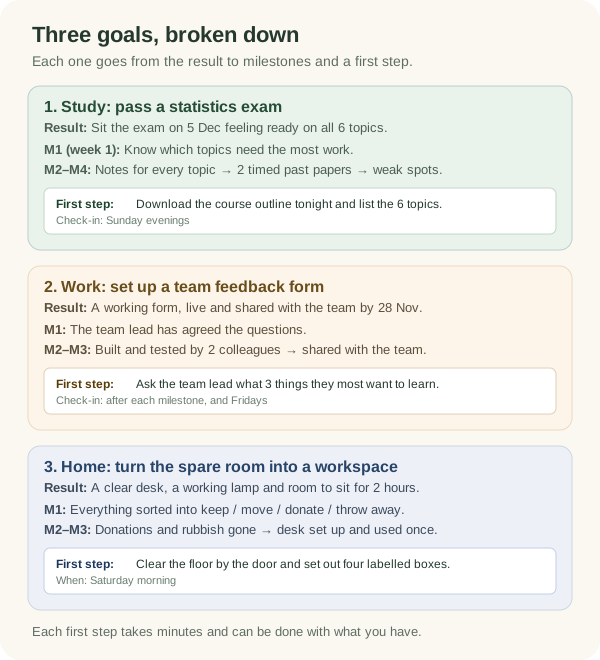
Result: sit the statistics exam on 5 December feeling ready on all six topics.
Milestones
- She knows which topics need the most work (end of week 1).
- She has notes for all six topics (end of week 3).
- She's done two past papers against the clock (end of week 4).
- She's gone back over the weak spots those papers showed (week 5).
Tasks for milestone 1
- Download the course outline and list the six topics.
- Mark each topic: confident, unsure or lost.
- Check whether past papers are on the course site.
First step: download the course outline tonight and write the six topics on one page.
Check-in: Sunday evenings, when she plans next week's study time.
Why this works: Maya felt behind on everything. Marking each topic turns that feeling into a list she can plan around.
Work example: set up a team feedback form
Jonas has a month to set up a feedback form for his team's internal service.
Result: a working feedback form is live and shared with the team by 28 November.
Milestones
- The team lead has agreed the questions.
- The form is built, and two colleagues have tested it.
- The form is shared, with a note on how answers will be used.
Tasks for milestone 1
- Find out the three things the team lead most wants to know.
- Draft six to eight short questions.
- Book fifteen minutes with the team lead to go over the draft.
First step: send the team lead a two-line message asking what three things they most want to learn from the form.
Check-in: after each milestone, and for a few minutes every Friday afternoon.
Why this works: the biggest risk is building the wrong form. Agreeing the questions first saves redoing it later. And the first step is a quick message. Jonas doesn't have to block out an afternoon to get started.
Waiting on someone's reply, like the team lead's here, should go early in the plan. The personal goal action plan guide shows how to plan around waiting time.
Home example: turn the spare room into a workspace
Sam wants a quiet place to work, but the spare room has turned into storage.
Result: the spare room has a clear desk, a working lamp and space to sit for two hours.
Milestones
- Everything in the room is sorted into keep, move, donate and throw away.
- The donate and throw-away piles have left the house.
- The desk is set up, and Sam has used it for one full session.
Tasks for milestone 1
- Clear the floor by the door so there's room to sort.
- Find four boxes or bags and label them.
- Sort one shelf at a time.
First step: on Saturday morning, clear the floor by the door and set out four labelled boxes.
Check-in: Saturday afternoons, when Sam decides what next weekend's session covers.
Why this works: "sort the room" sounds like one job, but it's really a goal. "Clear the floor and set out boxes" is something Sam can finish, and every session after that is easier to start.
What the three have in common
- A result you can see. Someone else could check each one: exam sat, form live, desk usable.
- Only a few milestones. Three or four is enough for a goal that takes weeks.
- Tasks for the next milestone only. Planning everything up front means guessing. Planning one milestone at a time lets you use what you learn.
- A small first step. Each takes minutes and clears up the next unknown.
- A regular check-in. Each person picked a time to look again and plan the next milestone.
The milestones guide has more on choosing checkpoints and deciding when each one is done.
Write your own
Think of a goal you've been putting off. Use the goal breakdown worksheet to write your own version of one of these examples. Start with the result. Stop once you've picked a first step and a time to do it.