Write a teacher thank-you message around one lesson, kindness or moment you remember. Say what it meant from your own point of view, then thank the teacher plainly. A student and a parent can describe different parts of the same school year.
A short message to start from
From a student:
Thank you for giving me time to work out the answer instead of moving on immediately. I started putting my hand up again, and I wanted you to know how much I appreciated your patience.
From a parent or caregiver:
Our evenings have included so many stories about the books you read together. Thank you for giving our child something they have been eager to tell us about.
These are illustrative examples. Use a detail that actually happened, and describe what you observed rather than assuming how the teacher or child felt.
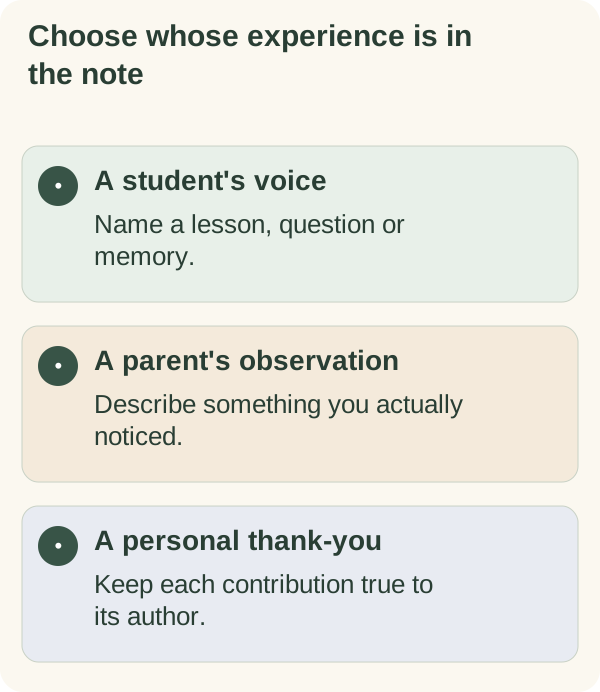
Choose the voice of the note
A student can name a lesson, a question the teacher took seriously or a moment that helped them try again. Use words the student would naturally say. A younger child might prefer a drawing or one sentence in their own spelling.
A parent's note can describe something they noticed: a new interest, a conversation at home or support during a transition. Let a child's contribution remain their own rather than turning it into an adult's polished testimonial.
If a whole class is contributing, agree what names, images and messages may be included before sharing the result beyond the intended recipient.
Thank-you messages from students
- Thank you for explaining the question another way when I did not understand it.
- I enjoyed the stories we read this year. The discussion about our different endings was my favourite part.
- Thank you for noticing my effort on the project, not only the final mark.
- I used to avoid asking questions. Thank you for making room for mine.
- The note you wrote on my work helped me understand what to try next.
- Thank you for the time you gave me after class to finish explaining my idea.
- I will remember the way you listened when people disagreed in our discussions.
- Thank you for this year. I am especially glad we got to try the group science project.
Choose a line that matches the actual experience and replace the subject, activity or detail. There is no need to claim that every class was your favourite if that is not what you mean.
Thank-you messages from parents and caregivers
- Thank you for keeping us informed during the move to a new class. The clear updates helped us understand what was happening.
- Our child has been showing us the stories they are writing. Thank you for encouraging that interest.
- We appreciated the time you took to explain the next steps at our meeting.
- Thank you for noticing when an extra explanation would help and making time for it.
- The project came home with a long account of how it was made. Thank you for giving the class that experience.
- Thank you for your patience and the care you have brought to this school year.
Keep private learning, health or family details out of a card that others may read. A separate appropriate school channel can carry information that needs a private discussion.
End-of-year and Teachers' Day wording
For the end of a term, name something from that period:
- Thank you for a year of questions, stories and new things to try. I especially enjoyed our work on the class play.
- As the term ends, I wanted to thank you for the clear feedback and the chance to improve my work.
- Thank you for helping us settle into the new class this year. We appreciated your updates and explanations.
For Teachers' Day, the occasion can be the opening rather than the whole message:
- Happy Teachers' Day. I still use the way you taught me to check my answer before starting again.
- On Teachers' Day, I wanted to thank you for the patience you brought to our class.
- Happy Teachers' Day, and thank you for making room for all those questions.
Which Teachers' Day date should you use?
The international observance and national celebrations do not all share one date. Check the current school or local announcement before scheduling a message. These references were checked on 24 October 2026:
- World Teachers' Day: 5 October each year, according to UNESCO.
- Australia: AITSL's 2026 campaign gives Friday 30 October for that year's celebration. Check its current announcement for another year.
- India: 5 September each year, described by the University of Mysore in its account of Dr Sarvepalli Radhakrishnan.
- China: 10 September each year, as stated in this 2026 government report.
- United States: Missouri NEA's 2026 announcement lists National Teacher Day on Tuesday 5 May, during Teacher Appreciation Week on 4–8 May. Use a current announcement when planning a later year.
You can also send a thank-you on an ordinary day or at the end of term. It need not depend on a national observance.
Thanking a tutor, coach or teacher from years ago
Name the particular instruction or help you remember. A short update can explain why you are writing now.
I was in your class several years ago, and I recently used the way you showed us to prepare a presentation. It brought back the time you gave us to practise and ask questions. I wanted to thank you for that lesson.
For a tutor or coach:
Thank you for working through the same passage with me until I understood what to practise. I still keep the notes from those sessions.
Use the mentor thank-you guide for workplace mentors, first employers and other early supporters.
Make the card personal without adding everything
Choose a teacher card, then place the specific detail in the message. Read the headline as well as the body and change any wording that does not fit the teacher or relationship.
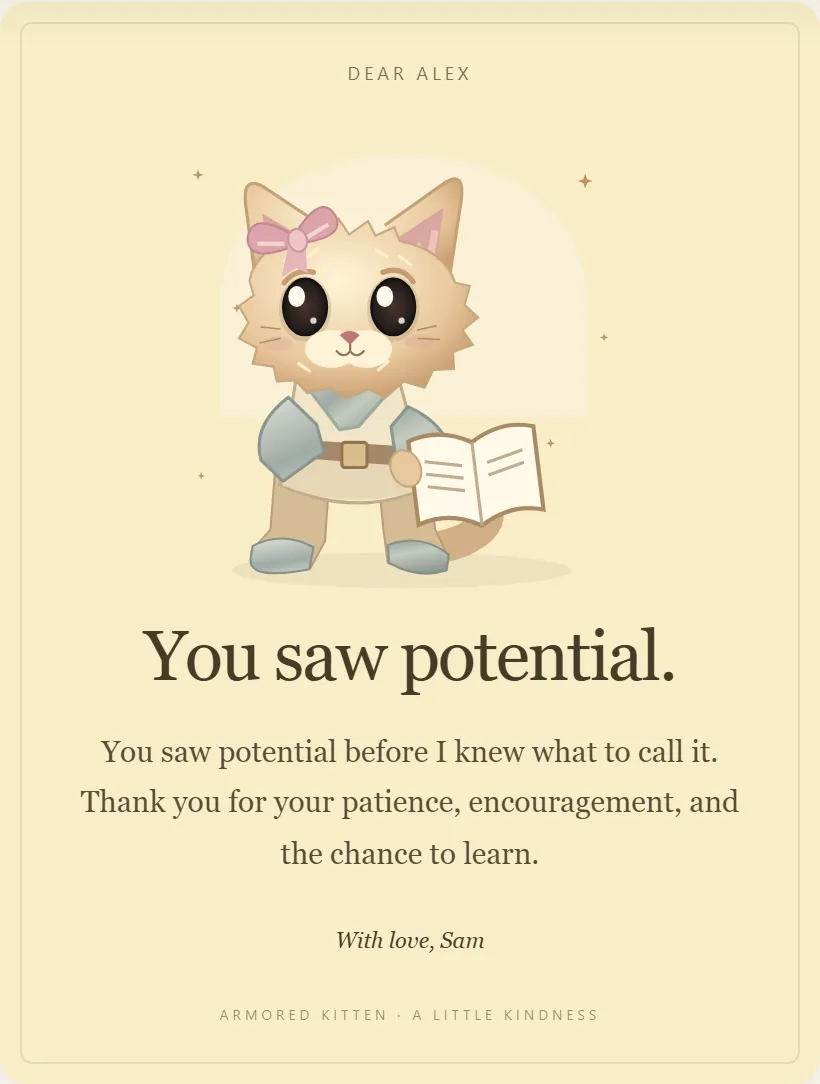
The thank-you message builder can organise the action and impact you supply into an editable starting point. A voice message is another optional format if the student wants to speak their thanks.
Check that any photo is appropriate to share and that the recipient and delivery choices are correct. The note can also remain text-only.
Questions about teacher thank-you notes
What is a good short thank-you message?
“Thank you for explaining the question another way when I did not understand it” identifies a particular kind of help. Add a true detail if one comes to mind. A brief note does not need to summarise the whole school year.
What should a parent write?
Describe a change or moment you actually observed and thank the teacher for the part you want to acknowledge. Avoid speaking for your child's feelings unless they have supplied those words themselves.
Can a child write only one line?
Yes. Let the contribution reflect what they want to say. A drawing, spoken message or short sentence is an option; it need not imitate a formal letter.
What if I am thanking a teacher years later?
Introduce yourself with enough context to be recognised, name the lesson or memory and give your thanks. Use a contact route appropriate to the relationship and respect any stated boundary.
Send the detail that belongs to you
Read the draft aloud, check names and remove lines you do not mean. Then make a teacher thank-you card, or use the message in the school or personal channel that fits. For someone who gave you a first opportunity, the First Believer collection offers another starting design.