Thank a mentor by naming a real moment, explaining what you took from it and sharing a brief update if you want to. Choose wording that fits your relationship, whether the note is for a coach, manager, first employer or someone you have not contacted in years.
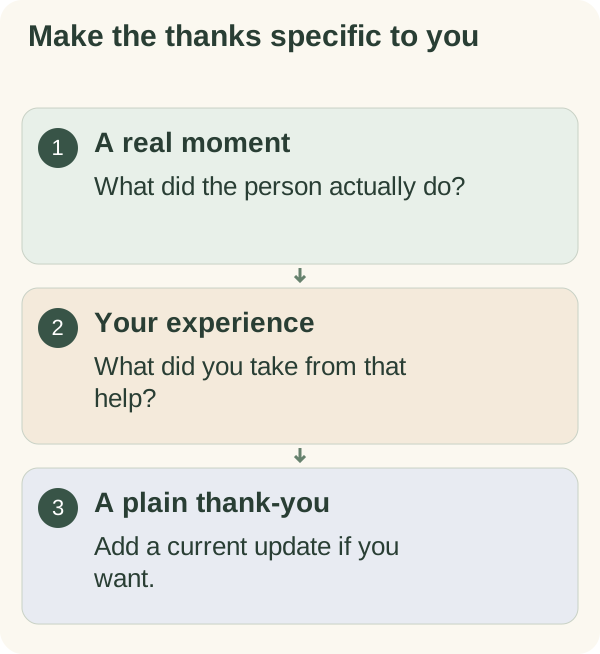
Start with a moment you can describe
“Thank you for your guidance” is a starting point. Add the detail only you can supply: the interview they helped you prepare for, the question they answered or the chance they offered.
Try finishing these lines privately before drafting:
- You helped me when…
- The part I still remember is…
- I use that lesson now by…
You do not need an impressive career milestone. A skill you still use or a decision you approached differently can give the note its substance.
A short mentor thank-you example
When you helped me prepare for my first interview, you suggested practising the questions I was avoiding. I still use that approach before a difficult meeting. Thank you for taking the time to work through it with me.
This is sample wording. Replace the interview and lesson with your actual experience. If you are writing after a long gap, add enough context for the person to recognise you.
The thank-you message builder can help arrange the action and impact you supply into an editable draft. Review the result rather than treating suggested wording as a record of your history.
Short thank-you messages for a mentor
Choose one that is true for you, then add a detail where it would help.
- Thank you for making time for my questions when I was new.
- I still use the way you taught me to prepare. Thank you for showing me.
- You gave me a first opportunity, and I have not forgotten it.
- Thank you for the honest feedback and the time to work through it.
- The question you asked in that meeting changed how I approached the project.
- I wanted you to know where that first chance led. Thank you for helping me begin.
- You noticed the part I was struggling with and offered practical help. I appreciated it.
- Thank you for trusting me with work I could learn from.
Match the note to the role
A manager or workplace mentor
Use a professional tone that feels natural between you. Name a skill, responsibility or piece of feedback, while keeping confidential project and client details out of a card that may be forwarded.
Thank you for walking me through the review process when I joined. I am leading my own reviews now, and your example still shapes how I prepare and give feedback.
For a farewell, a simple ending can be enough: “I have appreciated working with you, and I wanted to say this before I leave.” Keep a reference request or other favour in a separate, clear message.
A coach or instructor
Name something you learned or a moment you remember. Avoid turning the message into a claim about every student's experience.
Thank you for explaining the passage again when I could not work out where I was going wrong. I still mark my practice notes the way you showed me.
For a school teacher, the teacher appreciation guide has examples from students and parents.
A first employer or early-career supporter
Tell them what the opportunity meant to you without suggesting that you know every reason behind their decision.
You offered me my first job when I had very little experience. I learned how to speak with customers and ask for help when I needed it. Thank you for giving me that start.
A mentor you have not contacted in years
Introduce the connection, give a short update and explain why you are writing now. A long apology for the gap is optional.
Hello Maya, I was part of your team during my first year after college. I recently helped a new colleague prepare for a presentation and remembered how patiently you helped me. I wanted to thank you for that example.
If you do not have an appropriate current contact route, respect that limit rather than searching for private channels they have not shared.
A longer note and a farewell you can adapt
A note after a new milestone
Dear Daniel, I recently finished the first project I have led on my own. Preparing for it brought me back to the questions you asked when we worked together: what is the result, what is still missing and who needs to be involved? I used those questions throughout. Thank you for sharing a way of working that I could carry forward. I hope you are well.
A farewell to a mentor
Before you leave, I wanted to thank you for the time you gave me when I joined. You explained the work clearly and let me ask the questions I needed to ask. I have learned a great deal from that example. Wishing you well in what comes next.
Keep the details that reflect your experience and remove the rest. These examples are drafts to adapt, not quotations from real recipients or testimonials.
Turn the note into a personal card
The First Believer collection offers designs for thanking someone who supported a beginning. Choose a headline that matches your relationship and put the specific memory in the message underneath.
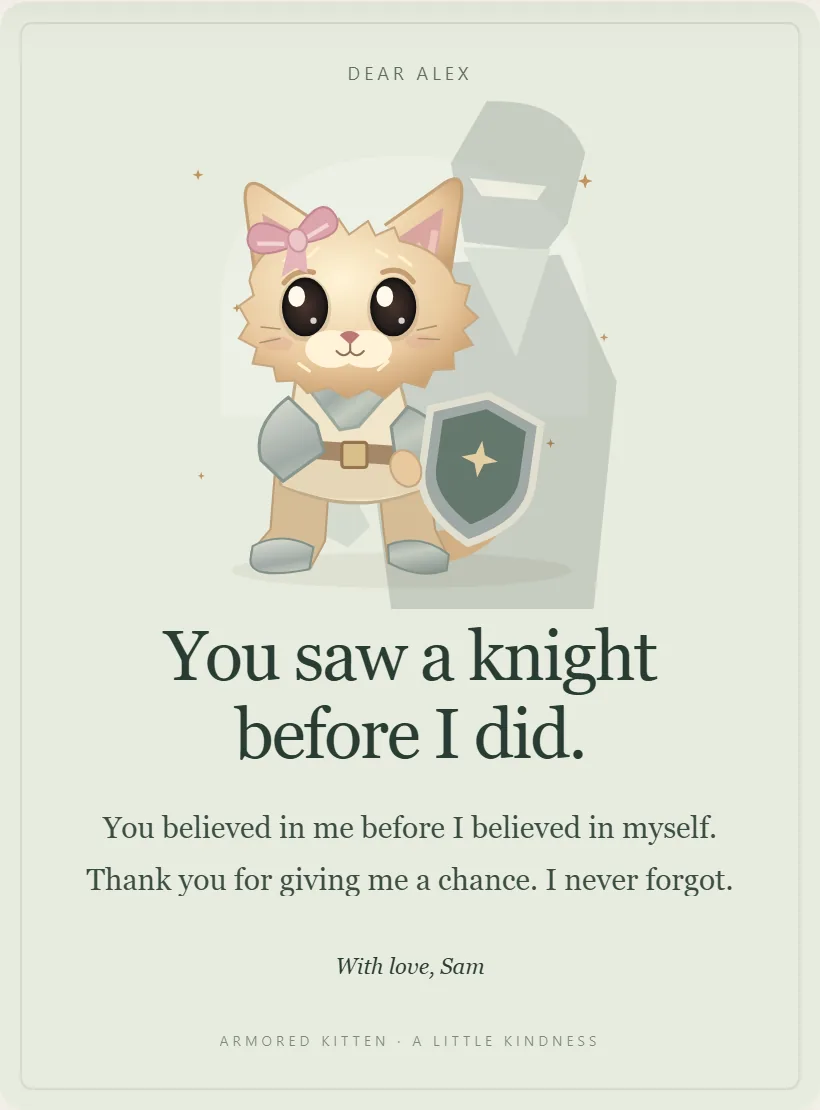
A photo or voice note is optional. Ask before using a photo that includes other people, and check the recipient and sharing route before sending. A text-only note is also a complete choice.
Questions about mentor thank-you notes
Is a late thank-you still appropriate?
If contact is welcome, you can write about a lesson you still remember. Explain who you are and why it came to mind. You do not need to claim that the person expected an update or will react in a particular way.
Should I send an email or a card?
Choose a channel appropriate to the relationship. An email can carry a direct professional note; a card can add a design and personal touches. Consider what you would be comfortable having saved or forwarded.
How much should I write?
Stop when the reader can recognise the moment, understand what it meant to you and hear your thanks. That may be a short paragraph. Keep a longer note if its detail is useful, rather than trimming it to an arbitrary length.
Can I thank them and ask for a favour?
Make the purpose of each message clear. If you want a recommendation, introduction or other help, ask directly in a separate request rather than hiding it inside the thanks.
Write the detail only you know
Read the note aloud and replace anything you would not naturally say. Check names, dates and the facts of the memory. Then make a mentor thank-you card, or keep the words for your preferred contact channel.