William Kamkwamba Had to Leave School. He Kept Learning and Kept Fixing His Windmill.
After school fees forced him out of class, William Kamkwamba learned at a library, built a windmill and kept improving it with family and a skilled team.
The lesson
When one road to learning closes, find another one, and bring people along.
- Use what is close to you: a library, a friend, spare parts.
- Treat a first success as a start, and keep improving it.
- Learn from people who know what you do not know yet.
The challenge
William Kamkwamba grew up in Malawi. He was a student who wanted to keep learning.
Malawi went through hard years in the early 2000s. A 2002 report by FAO and the World Food Programme described food shortages across the country. It pointed to a poor harvest in 2000/01, low stocks of maize, rising prices, uneven rain, floods and a dry spell. The report was about the whole country, not his family in particular.
The problem
Kamkwamba later told CNN that when he was about fourteen, his parents could no longer pay his secondary-school fees. So he had to leave school.
That closed the usual road to learning. The reason was money, something he and his family could not control.
The exact year he left school is not clear. Different accounts give different dates.
What they did
Kamkwamba found another way to learn. He said he went to the library to keep up with his schoolwork. In a later documentary, he recalled asking his friend Gilbert for lessons before going there.
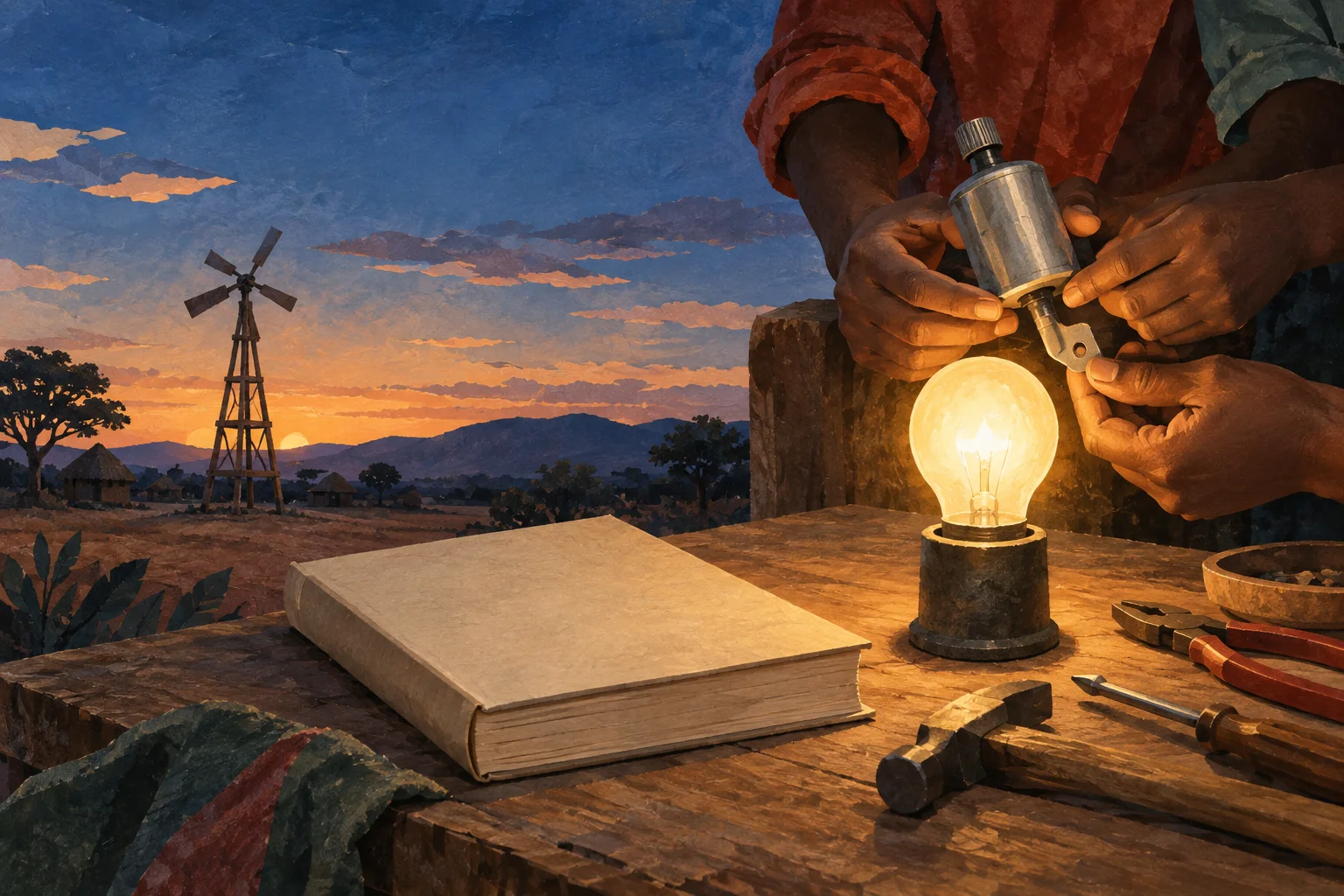
At the library, he found a book with a picture of a windmill. The picture gave him something to work from. It was not a full set of building plans. He said he used bicycle and tractor parts from a nearby junkyard to build his own.
Not everyone believed in him at first. A 2007 news report says his family questioned the work early on, based on his mother's account. But he later named two people who did not call him crazy: his cousin and his best friend.
Reports from that time say the windmill first lit one bulb at home, and later four. The year of that first build is also unclear.
The first light was not the end. Kamkwamba later wrote that many parts broke over two and a half years. He kept fixing them.
In June 2007, he spent three days with a team from National Solar and Power. He named them: Alfred Maele, Steven Machilika, Elias Lazaro and Ben Salala. He wrote that they showed him tasks he did not know yet, so he could learn them.
Family members joined in too. His cousin Geoffrey helped rewire the windmill. The team worked on brighter lights, more battery storage, new controls and changes to make it safer. The home had four bulbs, and the goal was ten. Kamkwamba reported that the new system worked in its first test.
In July 2007, he made another upgrade. Two colleagues at Baobab Health, Mike and Peter, gave him a treadmill motor and a voltmeter, a tool that measures electricity. The motor and some pulleys replaced the old bicycle dynamo, a small generator. Geoffrey helped fit the new motor.
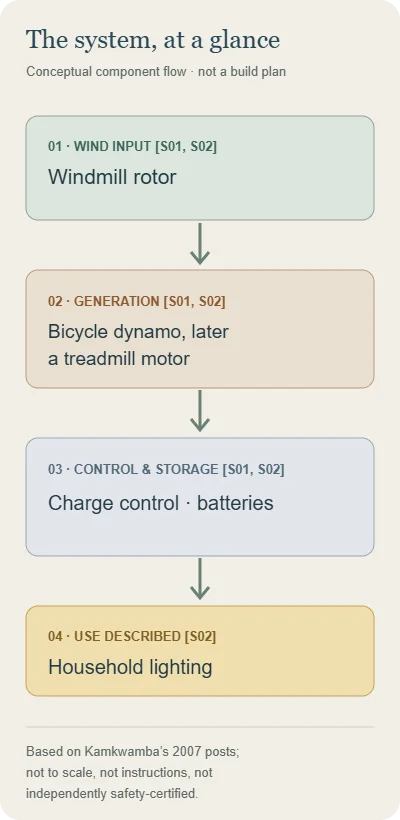
The main parts Kamkwamba described in 2007. This is a simple sketch, not a build plan or a safety guide.
He also took safety seriously. He wrote that he placed the windmill away from homes. He mentioned a lightning diverter and a fire extinguisher. These were his own choices, not an expert safety check.
What happened next
Other people helped his story reach further. A newspaper article from Malawi, reposted by Kamkwamba, credits an educator named Hartford Mchazime. It says Mchazime noticed the windmill and helped him get back to school.
The 2007 news report says Mchazime visited with local reporters. Then bloggers and TED organizers paid attention. After his story reached TED, supporters arranged funding for his schooling.
Attention had a cost too. The same report says curious visitors unsettled his quiet family. It also says the family's new comfort caused some tension nearby.
By 2012, Kamkwamba was an undergraduate at Dartmouth. He was studying environmental studies and engineering.
This story inspires because of what he did when a door closed. He found a library, asked a friend for lessons and used junkyard parts. Then he kept repairing and improving his work with the help of family and a skilled team.
One windmill did not end hunger in Malawi or power a whole village. And there is no record of an expert safety check on his home system, so it is not a plan to copy. But it shows how far learning can go when people share what they know.
Try this today
- Think of a skill you want but cannot study the usual way. Write down one free place to learn it, like a library, a video or a friend.
- Pick one thing you made that works "well enough." Spend 10 minutes listing one way to make it better.
- Ask someone with a skill you lack to show you one small task this week.
When a usual road closes for you, what is one other road you could try?
Sources for this story: S01, S02, S03, S04, S05, S06, S07, S08, S09, S10. Full list below.
Join the conversation
Vote in the community poll and see the latest results from Armored Kitten on Telegram.