Tu Youyou's Test Result Would Not Repeat. She Went Back and Asked Why.
When an early malaria extract gave mixed results in mice, Tu Youyou checked old sources, changed her method and helped move a large team effort forward.
The lesson
When a good result will not repeat, treat it as a clue and ask why.
- Check how you did the work, not only how hard you worked.
- Look again at old sources. One small clue can change your method.
- Do your part well inside a team, and credit the people around you.
The challenge
Tu Youyou was a Chinese researcher who studied medicines. People helped her get there. She later said her parents supported her education. Her mentor, Professor Lin Qi Shou, shared his research knowledge and his habit of hard work. In a 2019 interview, she also remembered her older brother writing to her, urging her to keep learning and not to lose heart over failure.
In 1967, China started a large secret programme called Project 523. Its goal was to fight malaria, a disease caused by tiny parasites in the blood. Malaria was a military and public health problem during the Vietnam War years. It was also the time of the Cultural Revolution in China.
Project 523 was big. Teams in many places looked for plant extracts, studied what made them work and later tested treatments in people.
Tu joined in January 1969. She led the herbal research group at her institute, the Institute of Chinese Materia Medica. She did not run the whole project. Her group had one piece of a much larger job.
The problem
Her group tested extracts of a plant called qinghao on mice infected with malaria. Tu later described what happened in a 2011 interview.
At first, the results looked good. One early test showed a 68% inhibition rate, which means the extract held back many of the parasites. It looked promising.
Then the team repeated the tests. This time, the results jumped around. Sometimes the extract seemed to work, and sometimes it did not.
A result that will not repeat is not proof of anything. The group did not have a treatment. They had a puzzle.
What they did
Tu did not just push ahead. She treated the mixed results as a question to answer.
First, she went back to the books. She reviewed the written sources again. She and her group ran many more experiments. She later said most of them failed.
Then she found a clue in a very old book. Ge Hong wrote a medical handbook in the fourth century. One short passage said to soak qinghao in water, wring it out and take the juice.
That gave Tu an idea. The usual way of making extracts used heat. Maybe the heat was damaging the very thing they were trying to test.
So the group changed the method. They used liquids that boil at lower temperatures. They also split the extract into acidic and neutral parts.
The neutral part gave them sample number 191. Tu said that on October 4, 1971, it was 100% effective against the parasites in infected mice and monkeys.
That was a big step. But it was an animal result. It did not mean patients were cured, and it was not yet a safe medicine.
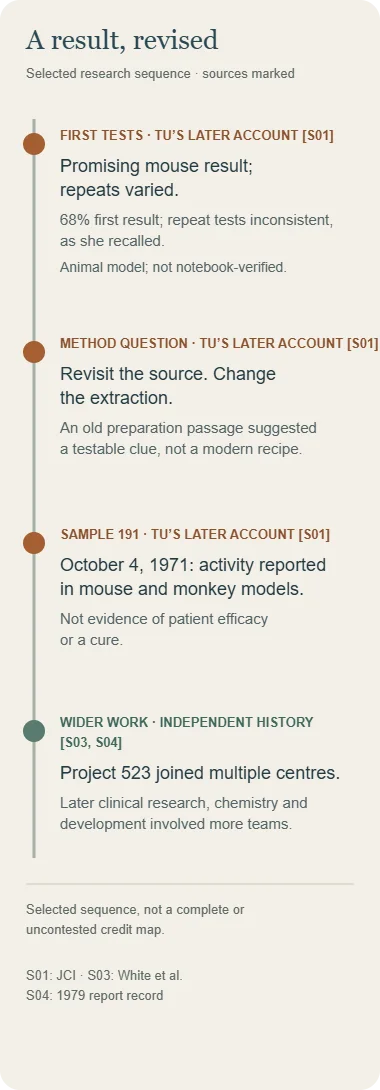
The research steps Tu later described, from mixed mouse tests to sample 191. These were animal results, not patient results.
What happened next
The path from that extract to a medicine took many more steps and many more people. Historians describe later work by many people, including teams beyond Tu's group. They identified the active material, worked out its structure, ran clinical research in people and developed related drugs and combinations.
In 1979, an English-language report on the work came out. It was published under the name of a group, the Qinghaosu Antimalaria Coordinating Research Group, with no single author listed.
In a 2019 interview, Tu described a national effort with many institutions and hundreds of specialists. That number is her own estimate.
This story inspires because of one quiet choice. When a result would not repeat, Tu asked why instead of pretending it worked. Then she changed the method and tested again.
Most of these details come from her own memories, told decades later. Changing a method cannot promise a breakthrough. And this story is history, not medical advice.
Try this today
- Think of something that worked once but not the next time. Spend 10 minutes writing down what was different each time.
- Look back at an old note, recipe or manual. Find one detail you skipped before.
- Send a short thank-you to someone who encouraged you after a failure.
Which result in your life is asking you "why?" instead of "try harder"?
Sources for this story: S01, S02, S03, S04, S05. Full list below.
Join the conversation
Vote in the community poll and see the latest results from Armored Kitten on Telegram.