Mae Jemison Drifted to the Back of the Class. One Professor's Lab Rule Gave Her a Way In.
Mae Jemison felt unwelcome in some Stanford classes until one professor's teamwork rule helped her join in, on a path that later led her to space.

The lesson
A small change in how people work together can give someone a real way in.
- Look for a way into the work, such as a partner or a shared task.
- If you lead a group, notice who has gone quiet and give them a real role.
- Bring your own preparation, so you are ready when a door opens.
The challenge
Mae Jemison finished high school at sixteen.
At Stanford University, she studied chemical engineering and African American studies. Chemical engineering uses science to design ways of making and changing materials.
Jemison was eager to learn. When she arrived, she sat near the front of her classes, ready to answer questions.
The problem
Things changed. Jemison later said that some professors did not seem glad to have her there. Little by little, she found herself sitting farther back in the room.
Moving to the back may sound small. But it can leave a person outside the work and the talk of a class.
Later in life, Jemison spoke about these kinds of barriers. She said a person's ability to find another way does not excuse unfair treatment. She said organisations have a duty to remove those barriers.
What they did
Help came from a simple teaching choice. In a fluid dynamics course, professor Channing Robertson assigned lab partners. He required students to work together.
Jemison said this gave her the first real chance to work with other students in her department. The professor did not do her work for her. But he changed the setup so she could take part.
Jemison kept building her own path. She earned her engineering degree in 1977. She then studied medicine at Cornell and earned her medical degree in 1981.
She worked as a general practitioner, a family doctor. Then she served as a Peace Corps Medical Officer in Sierra Leone and Liberia.
Next, she applied to become an astronaut. A newspaper interview from 1987 says she applied before the Challenger disaster. In January 1986, the Space Shuttle Challenger was lost, and seven crew members died. Jemison kept her goal. She renewed her application after the disaster.
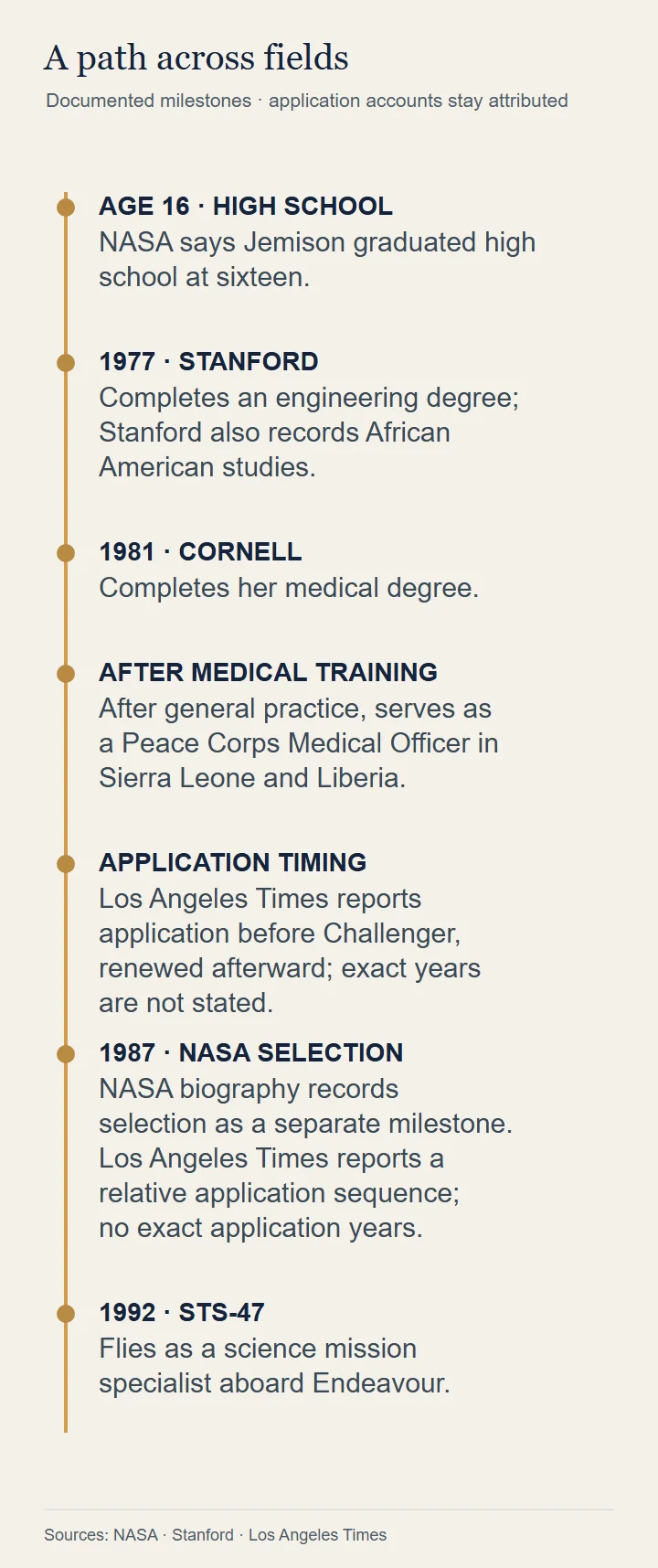
Key steps in Jemison's path, from Stanford to space. The exact years of her astronaut applications are not known, only that one came before Challenger and one after.
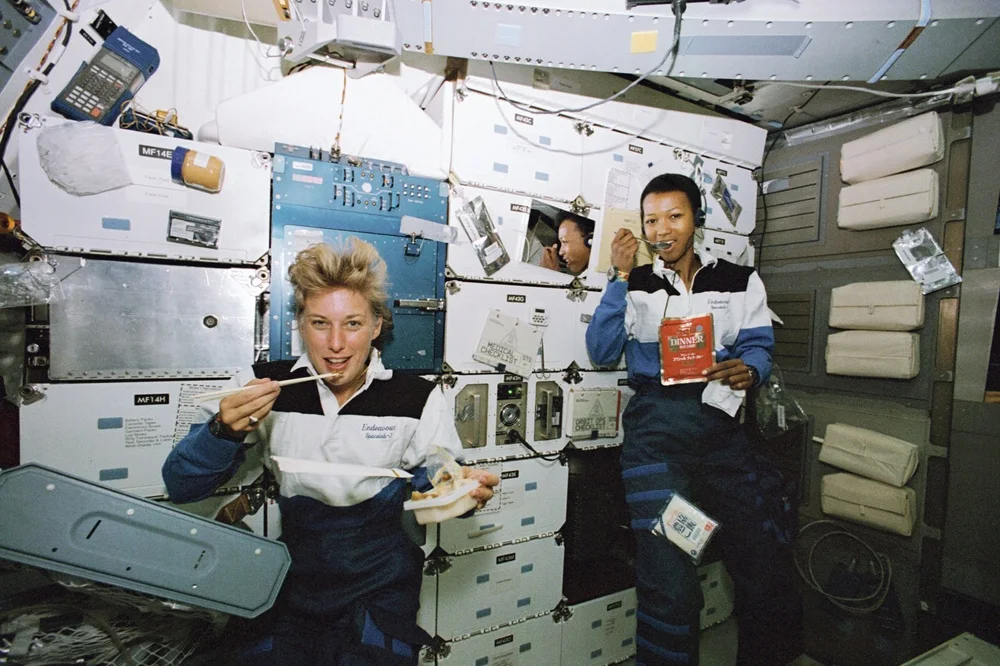
Jemison and crewmate Jan Davis in the middeck of the Space Shuttle Endeavour during their 1992 mission. A NASA photo.
What happened next
In 1987, NASA selected Mae Jemison as an astronaut candidate.
In September 1992, she flew into space aboard the Space Shuttle Endeavour, on mission STS-47. This was a joint U.S.–Japan science mission. As a science mission specialist, she worked on life science and materials studies and helped with an experiment on bone cells.
Jemison became the first African American woman to travel in space.
Her story inspires because both parts mattered. She brought the study, the skills and the effort. A professor changed one rule so she could join the work. Later, NASA chose her from a large group of applicants.
One honest note: no lab partner rule can promise anyone a future in space. And one good teacher does not remove every barrier. But a small change in a room can help someone step back into the work.
Try this today
- Think of a group you belong to. Notice one person who has gone quiet. Invite them into one small task this week.
- If you feel pushed to the edge of a class or team, name one thing that would help you take part. Ask for it.
- Think of a teacher or boss who gave you a way in. Send them a short thank-you message.
Who in your life could use a partner to help them join in?
Sources for this story: S01, S02, S04, S05, S06, S07, S08, S09. Full list below.
Join the conversation
Vote in the community poll and see the latest results from Armored Kitten on Telegram.