Katalin Karikó Kept Her mRNA Question Alive. Colleagues Helped Her Answer It.
Katalin Karikó spent years on an idea that struggled to win grants, and colleagues, a partner and a growing team helped turn it into Nobel Prize-winning work.
The lesson
A hard question moves forward when you break it into smaller tests and let the right people join you.
- Turn a stuck problem into one clear question you can test.
- Name and thank the people who help you stay in the work.
- Team up with people whose skills are different from yours.
The challenge
Katalin Karikó moved from Hungary to the United States in 1985. In 1989, she joined the University of Pennsylvania, often called Penn.
She was interested in messenger RNA, or mRNA. Cells use this molecule to carry instructions for making proteins. Karikó wanted to know if mRNA could be used to tell cells to make useful proteins. She worked on that question for years.
The problem
Her idea had a big problem. When scientists put man-made RNA into cells, it could set off a strong immune response. That is the body's defence system reacting as if under attack. This was not a small issue. It stood in the way of the approach she wanted to explore.
Money was also hard to find. In a 2024 interview, Karikó recalled applying for at least one grant every month for two years. She did not get any of them.
Her place at Penn was also at risk. Later profiles describe this time in different ways. One says she missed a promotion and was offered a lower position. Another says she was told the university no longer wanted her. Neither is an official staff record.
What they did
Karikó did not stay in the work alone. She has named and thanked two people who helped her remain at Penn before she met her future partner: Elliot Barnathan and David Langer.
In 1997, she met Drew Weissman at Penn. He was an immunologist, interested in vaccines and the immune system. She had experience with RNA. Karikó later recalled that they began talking while waiting to use a copier.
Their skills fit together. They now had a shared, specific problem: how to calm the immune reaction to the RNA.
They tested changes to nucleosides, the small building blocks of RNA. In 2005, they published a paper with two more co-authors, Michael Buckstein and Houping Ni. It reported that some changed RNAs set off weaker immune signals in the human cell systems they tested. The paper also records grant support from the NIH.
This was a lab finding, not a vaccine. But it changed what the team could ask next.
The work kept growing. Later studies in 2008 and 2010 built on it, with changing teams of authors. In 2015, Karikó and colleagues published work that combined changed mRNA with lipid nanoparticles, which are tiny fat-based particles. This way of delivering the molecules helped make them usable in cells.
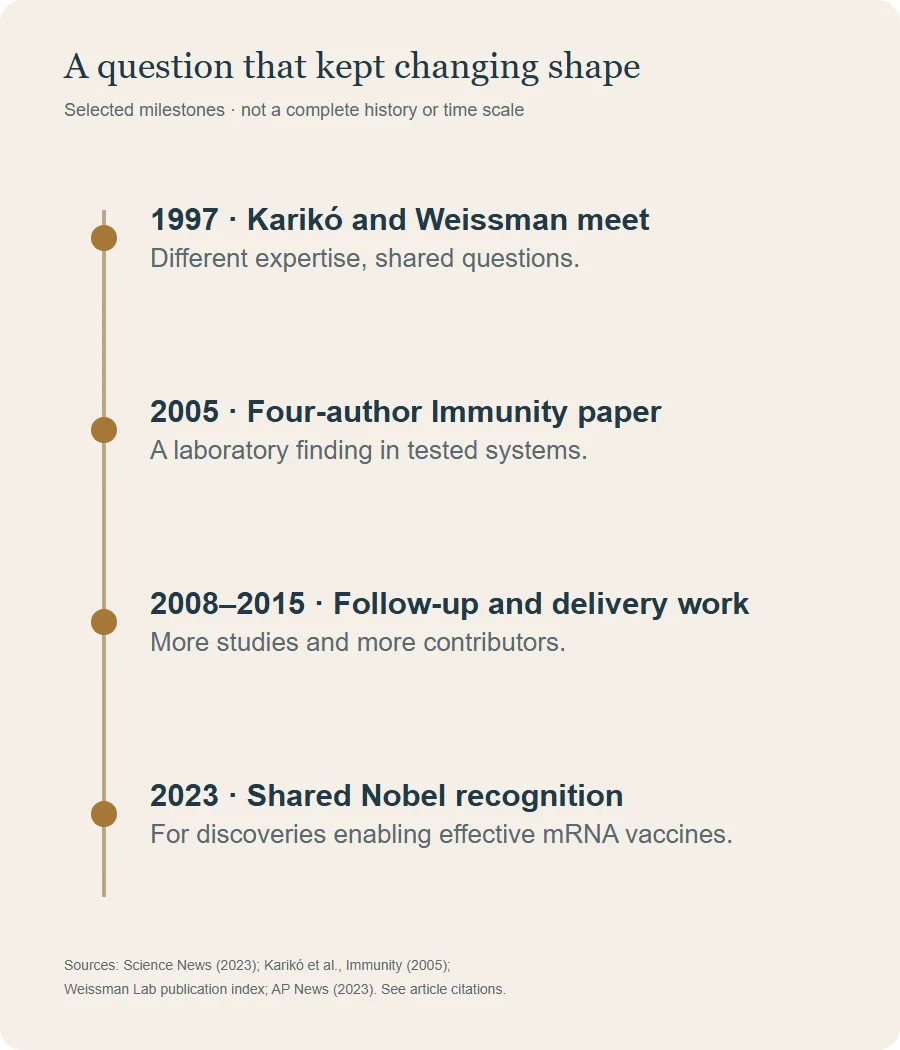
Key steps from the 1997 meeting to the 2023 Nobel Prize. It shows selected moments, not everyone who helped.
What happened next
In 2023, Karikó and Weissman shared the Nobel Prize in Physiology or Medicine. The prize honoured discoveries that made effective mRNA vaccines against COVID-19 possible. Their key finding was about changing the building blocks of RNA.
Their work was one part of a much bigger effort. Delivery systems, clinical trials, factories, safety reviews, and many other researchers also mattered. No single paper turned straight into a vaccine.
Karikó's story inspires because her question stayed alive for years. It survived failed grants and an unsure job. Then it met the right partner and a growing team.
One honest note: careers in science depend on money, jobs and chances that not everyone gets. Keeping going is not the only good choice. Sometimes changing methods, asking for help, or choosing a new goal makes more sense.
Try this today
- Pick one project that feels stuck. Write down the one specific thing that is not working.
- Name one person whose skills are different from yours. Ask them for 10 minutes of advice on that one thing.
- Think of someone who helped you stay in a job or a course. Send them a short thank-you message.
Which part of your challenge could you turn into one small question to test?
Sources for this story: S1, S2, S3, S4, S5, S6, S7, S8. Full list below.
Join the conversation
Vote in the community poll and see the latest results from Armored Kitten on Telegram.