The Work Angicos Finished—and the Work Brazil Interrupted
Angicos completed its 1963 literacy pilot through local language, shared preparation, and reflection. First and last class dates differ from its April 2 closing ceremony; a proposed national program was revoked in 1964.
The phrase “40 hours” can sound like a promise of instant transformation. Angicos tells a more grounded story. In 1963, adults in this town in Brazil’s northeastern state of Rio Grande do Norte took part in a literacy pilot built through local conversation, study, and the work of a coordinating team. The pilot reached its last class in March and its closing ceremony in April. A proposed national expansion was a separate next step: Decree 53,465 established it in January 1964, and Decree 53,886 revoked it on April 14, after the Angicos 50 Anos chronology dates the coup to April 1. The decrees establish the legal acts; the chronology supplies that political sequence. The retrospective Angicos chronology and the two published decrees make the distinction visible.
That difference matters. The Angicos pilot was not a failure. It was completed. The larger effort built from it was interrupted before it could become a sustained nationwide program. And neither fact belongs to Paulo Freire alone.
A pilot made with a team
The surviving account of Angicos is not a neat story of one educator arriving with a finished method. Researchers Francisco Canindé da Silva and Marisa Narcizo Sampaio interviewed 13 people they describe as co-authors of the experience, including former students and people who had served as culture-circle coordinators. Their study traces a project shaped by discussion, local knowledge, and ongoing preparation—not simply a script carried from classroom to classroom. Their 2015 article places those voices alongside the educational work of the period.
The commemorative chronology for Angicos records a local partnership among state, university, and federal actors, and says that 21 coordinators were selected for the culture circles. It credits educator Elza Freire with helping form the team. Because the page is a later retrospective compilation that draws on books and testimony, its detailed chronology is best read as a documented account, not a day-by-day administrative register. Still, it makes a crucial correction to the lone-hero version: the work depended on people who recruited, learned, coordinated, and taught together. The chronology records the team and preparation; the researchers’ interviews add the perspective of people who helped carry the pilot.
The method’s invitation was to begin with language and questions already present in people’s lives. The scholarly account describes how vocabulary research and dialogue shaped the work, while the Angicos chronology notes that an early literacy class used “belota,” a local word associated with ornaments used on nets and leather whips. That detail is small but revealing: the first word was not chosen because it looked grand on a poster. It belonged to the world people knew. The research study discusses the collaborative process; the chronology gives the word and its local meaning.
That approach did not make learning effortless, nor did it make social conditions disappear. It treated adult learners as people with knowledge and a stake in the questions being discussed. The researcher interviews also show coordinators reflecting on their practice while classes were underway. In other words, preparation did not end when instruction began: the team kept learning how to teach by looking at what happened in the circles. Silva and Sampaio’s study supports this account of reflection and shared work.
Generated symbolic editorial illustration, not a photograph or historical reconstruction. It does not depict Freire, identifiable participants, or a documented Angicos classroom.
Forty hours, across a season
The “forty hours” were not forty elapsed hours in a single burst. Silva and Sampaio date the first regular class to January 24, 1963, and the last class to March 16; they describe April 2 as the closing ceremony. A separate retrospective chronology calls the April 2 presidential event the “40th hour (lecture).” These are distinct milestones, so April 2 should not be read as the date of the final class. The researchers’ account gives the class dates, while the Angicos chronology uses that wording for the ceremony-day event. The chronology also reports 380 residents at the January 18 inauguration and 300 participants considered literate in its April evaluation entry, citing Carlos Lyra’s 1996 book. These are counts reported at different stages; the sources do not establish whether the same people appear in both counts, so no individual attrition can be inferred. The Angicos chronology is retrospective reporting, not a modern independent assessment.
The phrase still captures something real: an ambitious, concentrated pilot was completed in a short span. But the real achievement is not a stopwatch trick. It is the organization around it—local language research, coordinator training, discussion, participants’ effort, and a public evaluation that helped make the experiment legible to people beyond the town. A useful story can celebrate that work without promising that one method, one teacher, or one burst of will can guarantee similar results elsewhere.
The next step was national—and political
Angicos drew attention beyond the state. Decree No. 53,465, dated January 21 and published the next day, formally established Brazil’s National Literacy Program using the Paulo Freire system. The decree itself called for the education ministry to select two areas to begin operations and instructed the program commission to draw on a wide range of student, professional, community, religious, government, and other organizations. This was a national plan with a broad proposed network, not evidence that a fully scaled program had already reached the whole country. The original publication of the decree states those provisions.
The Angicos 50 Anos chronology dates the coup to April 1, 1964, and says Decree No. 53,886 revoked the National Literacy Program on April 14. The decree’s preamble gives its own stated reasons: restructuring literacy planning, requiring materials to convey democratic ideas and preserve institutions and traditions, and assigning administration to the National Education Department. It does not explicitly mention the coup. The decree confirms the revocation and orders the program’s materials collected. The chronology and the original revocation decree support those distinct points. The pilot had finished; a separate national plan was revoked before it could become a sustained nationwide program.
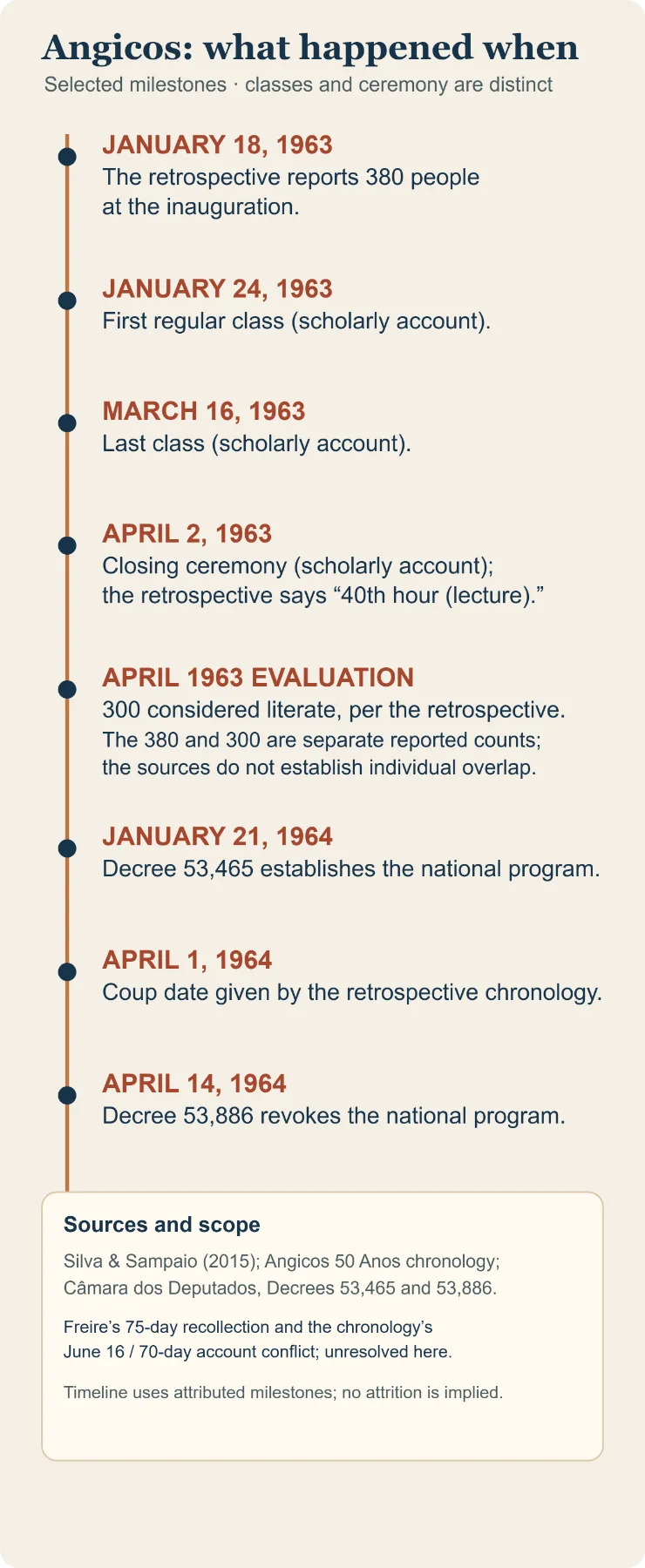
Selected chronology: Silva and Sampaio distinguish the Jan. 24 first regular class, Mar. 16 last class, and Apr. 2 closing ceremony. The Angicos retrospective calls the ceremony-day presidential event the “40th hour (lecture)” and reports separate 380 and 300 counts; the sources do not establish whether they cover the same people. The timeline distinguishes the Jan. 21 date on Decree 53,465 from its Jan. 22 publication date, and shows the retrospective’s coup date.
When the classroom could not continue
Freire’s 1994 interview gives a sequence he remembered decades later. He said he and Elza first stayed with their friend Luiz Bronzeado in Brasília. After about a month, he returned to Recife, presented himself to police, and was arrested by the Army. He recalled spending 75 days detained in Olinda before being transferred to Rio de Janeiro for further questioning; only after that transfer, he said, did a friend advise him to hide and leave Brazil. He then sought asylum at the Bolivian embassy and later went to Chile. Freire’s interview with Folha is first-person testimony, not an independent detention record.
The Angicos 50 Anos retrospective gives a materially different account of the detention episode: it dates Freire’s arrest to June 16, 1964 and says he spent 70 days in prison. Folha’s 1994 interview instead recalls a return to Recife, a 75-day detention in Olinda, and a later transfer to Rio. The sources therefore differ on the arrest date, stated duration, and sequence detail. No independent detention record in this package resolves the discrepancy, so both accounts remain attributed rather than combined into a single chronology. The Angicos chronology is retrospective, while Folha preserves Freire’s later recollection.
A useful lesson, without a guarantee
Angicos is a story of a completed experiment, a team that prepared and adapted, and a wider program stopped by political power. The people who took part were not props in a famous man’s biography; the coordinators and learners were part of what made the pilot possible. Nor does the story say that persistence always wins. The national expansion was revoked. Lives and institutions can be interrupted, even when the work is thoughtful and the people committed.
What remains useful is more modest and more durable: begin with what people know; prepare with others; listen closely enough to change the plan; and recognize that an idea’s reach depends on relationships and conditions beyond its author. Angicos finished its pilot. Its larger promise needed a country—and a political space—that it did not get to keep.
Sources and limits
The Angicos figures and parts of its chronology come from a retrospective page that cites earlier books; they are not presented as independently re-evaluated statistics. Silva and Sampaio’s 2015 study reports first and last class dates and a separate closing ceremony, drawing in part on later interviews. The decrees establish the legal acts, and the revocation decree’s preamble states its own reasons without explicitly mentioning the coup. The Angicos chronology dates the coup and places it before the revocation. Freire’s 1994 interview is treated as a later first-person recollection. The official compilation intended to corroborate Elza Freire’s memoir could not be opened during this revision, so memoir-specific claims were removed; the account that she helped form the Angicos team remains attributed to the retrospective chronology. The archival item record at the Paulo Freire Archive was consulted for context, but its digitized contents were not used to support the article’s claims or as visual material.