Fannie Lou Hamer Lost Her Home for Trying to Register to Vote. She Organized With Others.
In 1962, Fannie Lou Hamer was forced off the plantation where she lived for trying to register to vote, and her choice grew into years of shared organizing.
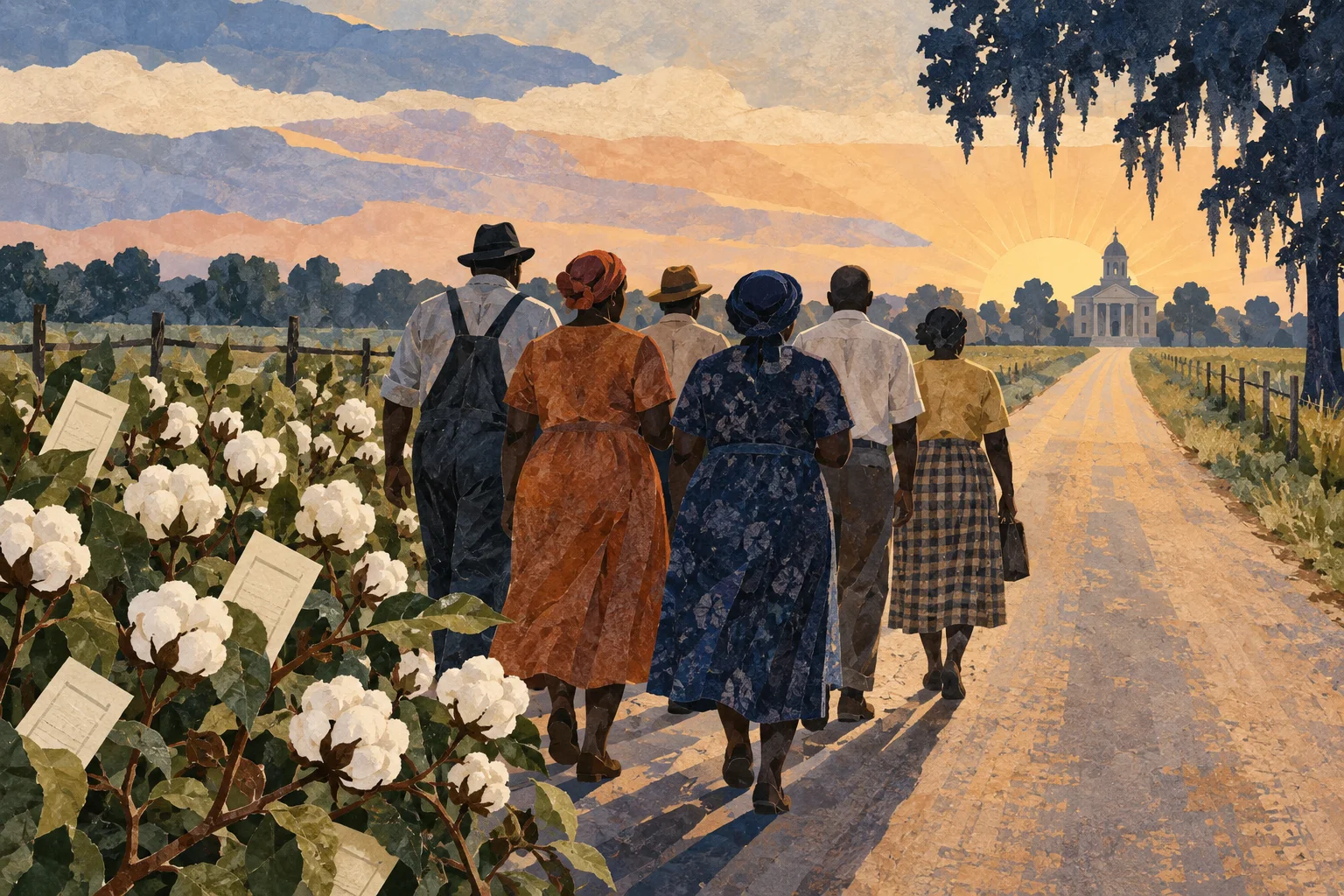
The lesson
Standing up for yourself can grow into lasting change when others stand with you.
- One honest choice can be the start of much bigger work.
- Say yes when others offer training, a ride or a place to stay.
- When a result falls short, keep the goal and find a new way to work on it.
The challenge
Fannie Lou Hamer grew up working hard. She left school at twelve to help her family survive. Later she worked as a farmer, a timekeeper and an insurance saleswoman.
For eighteen years, she worked as a timekeeper and sharecropper for a man named W. D. Marlow. A sharecropper farms someone else's land and pays with part of the crop. She also lived on his plantation. Her reading and writing skills helped her get the timekeeper job.
In Mississippi at that time, Black people faced hard rules that kept them from voting. One of those rules was a literacy test, a reading test that officials used to decide who could register.
Organisers from a group called SNCC held a voting-rights meeting in Ruleville. After that, Hamer joined a group of neighbours who set out to register.
The problem
On August 31, 1962, eighteen people travelled 26 miles from Ruleville to the courthouse in Indianola. Hamer was one of them. Police and highway patrol officers let only two people take the test. PBS says Hamer and one man took it, and both failed.
On the way home, the bus was stopped. Hamer later said the driver was charged with driving a bus "the wrong color". A man named Reverend Jeff Sunny drove her part of the way home.
Back at the plantation, her children told her that Marlow was angry. Hamer said he gave her a choice: take back her registration or leave. He also warned that she might have to leave either way. She refused to take it back. She had to leave that same night.
The cost was real. Hamer stayed with friends. Her husband, Perry "Pap" Hamer, stayed behind to finish the harvest and pay off their sharecropping debt. Later he brought Hamer and their daughters to live with relatives. The family had lost its home and its work.
What they did
Hamer did not face this alone. In the fall of 1962, a SNCC leader named Bob Moses sent an organiser, Charles McLaurin, to invite her to a conference at Fisk University.
After that, Hamer began community organising work. SNCC paid her a weekly stipend, a small regular payment for her work. After training with SNCC, she went back to Indianola and tried again. This time, she registered successfully.
The work was dangerous. In June 1963, Hamer was arrested in Winona after coming back from a voter-registration workshop. She later testified that she was beaten in jail.
She kept going, and so did the people around her. In the spring of 1964, Hamer and other organisers built the Mississippi Freedom Democratic Party. It was an alternative to the state's all-white Democratic Party. Its organisers, from several civil rights groups, included Bob Moses, Aaron Henry, David Dennis and Amzie Moore. Records give two dates for its start, April 24 and April 26.
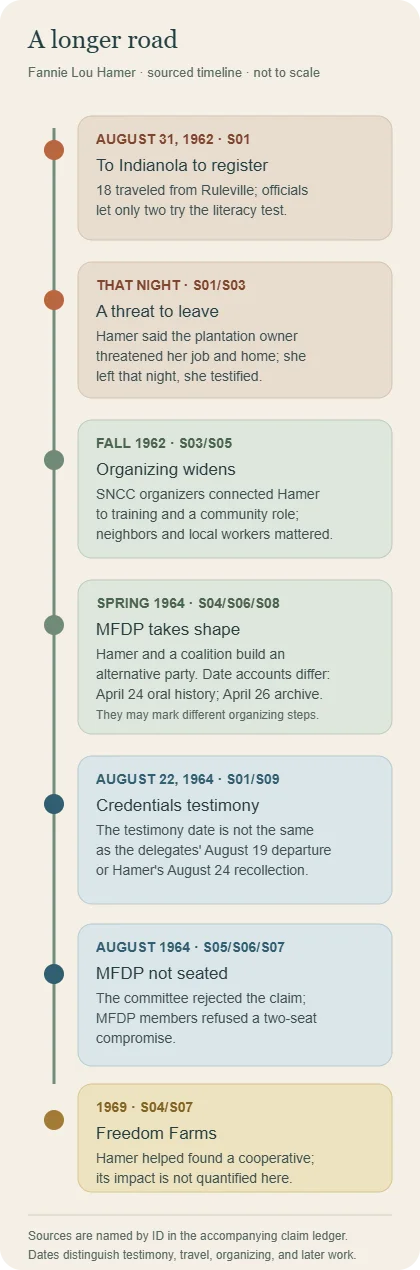
Key moments from Hamer's first try to register in 1962 to Freedom Farms in 1969. Sources give two different April dates for the new party's start.
What happened next
The new party went to the Democratic National Convention in 1964. It challenged the right of Mississippi's regular group of delegates to take their seats.
On August 22, 1964, Hamer spoke to the convention's Credentials Committee. She told them about the bus trip, the test, and the night she had to leave. She explained her choice in one short line: "I tried to register for myself."
Television networks began to show her testimony. Then President Lyndon Johnson scheduled a live speech, and the coverage moved to him. Her full testimony was shown later that evening, across the country.
The party was not seated as Mississippi's delegation. The committee offered a deal of two seats, and the party said no. It was not the result they had worked for.
Still, Hamer kept working in new ways. In 1969, she helped start Freedom Farms Corporation. It was a cooperative, a business owned by its members, set up to fight hunger among poor Black and white people in Mississippi.
Hamer's courage was real, and so was its cost. Her words were her own. But the work that carried them belonged to many people: neighbours, family, organisers and churches, all pulling together.
Try this today
- Write one sentence about something you want to stand up for. Start it with "I want to do this for myself because..."
- Think of one person who once gave you a ride, a meal or a place to stay. Send them a short thank-you message.
- If a recent plan fell short, write down one new way to keep working toward the same goal.
Who are the people who would stand with you if you took a hard step?
Sources for this story: S01, S03, S04, S05, S06, S07, S08, S09. Full list below.