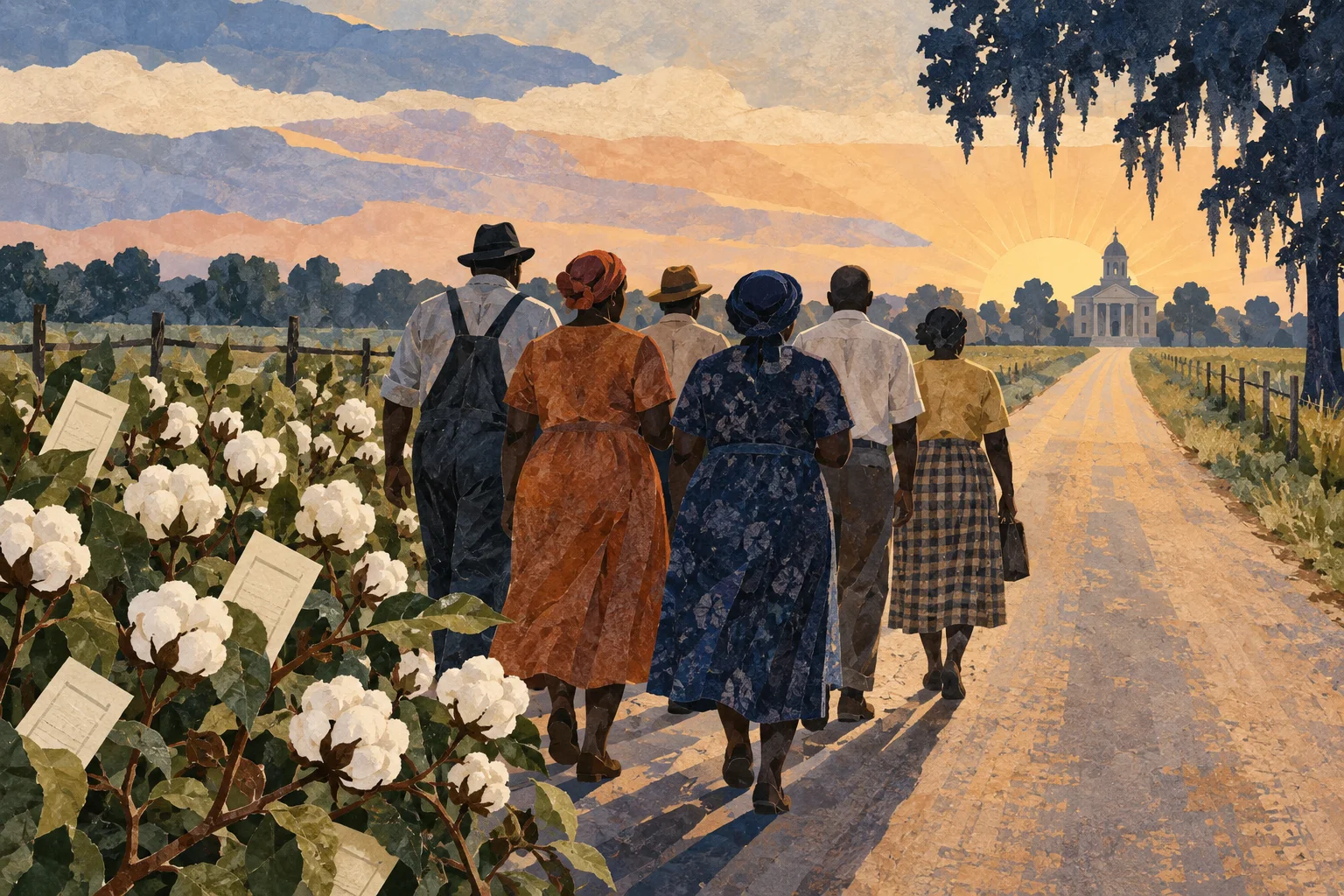
At 15, Claudette Colvin Refused to Give Up Her Bus Seat. Her Part Did Not End There.
Claudette Colvin's 1955 arrest did not start the Montgomery bus boycott, but she later joined three other women in the court case that ended bus segregation there.
The lesson
A brave act can keep mattering long after the first moment, even without the spotlight.
- Keep showing up for what you believe in after the first brave step.
- Join with others, because shared work can do what one person cannot.
- Give credit to everyone who helped carry the work.
The challenge
Claudette Colvin was 15 years old in Montgomery, Alabama, in 1955. At that time, the city's laws kept Black and white riders apart on its buses.
On March 2, 1955, she refused to give up her seat on a Montgomery bus. Police arrested her. Years later, she recalled that she did not intend to leave the bus on her own.
The Supreme Court Historical Society calls her the first person arrested in Montgomery for challenging its bus segregation laws. She was not alone for long. That spring, three more women were arrested: Aurelia Browder, Susie McDonald and Mary Louise Smith.
The problem
Colvin's arrest did not start a citywide protest. A group called the Women's Political Council thought about building a protest around her case. Then they decided not to.
Later accounts give reasons for that choice. Colvin recalled that leaders wanted an adult as the public face of the cause. She said they worried that teenagers would not be seen as reliable. Historian David Garrow, as NPR reported, also described concern about making a pregnant teenager the public symbol. These reasons come from later memories, not from meeting notes.
Months passed. On December 1, 1955, Rosa Parks was arrested. The Women's Political Council then spread flyers, and the Montgomery Bus Boycott began on December 5.
So Colvin's brave act was not the spark that people remember. She could have been left out of the story. But her part was not over.
What they did
On February 1, 1956, lawyers Fred Gray and Charles Langford filed a case in federal court. It challenged the bus segregation laws. The case became known as Browder v. Gayle.
Five women first signed on as plaintiffs, the people who bring a case to court. They were Aurelia Browder, Susie McDonald, Claudette Colvin, Mary Louise Smith and Jeanatta Reese.
Standing up in court carried real danger. Stanford's King Institute says Reese and her husband were threatened with violence and with harm to their income. Reese withdrew from the case on February 2. Four women stayed in the case, with Browder's name first. Colvin was one of them.
Rosa Parks was not part of this case. The King Institute says Gray did not want it to look as if they were going around her separate criminal case.
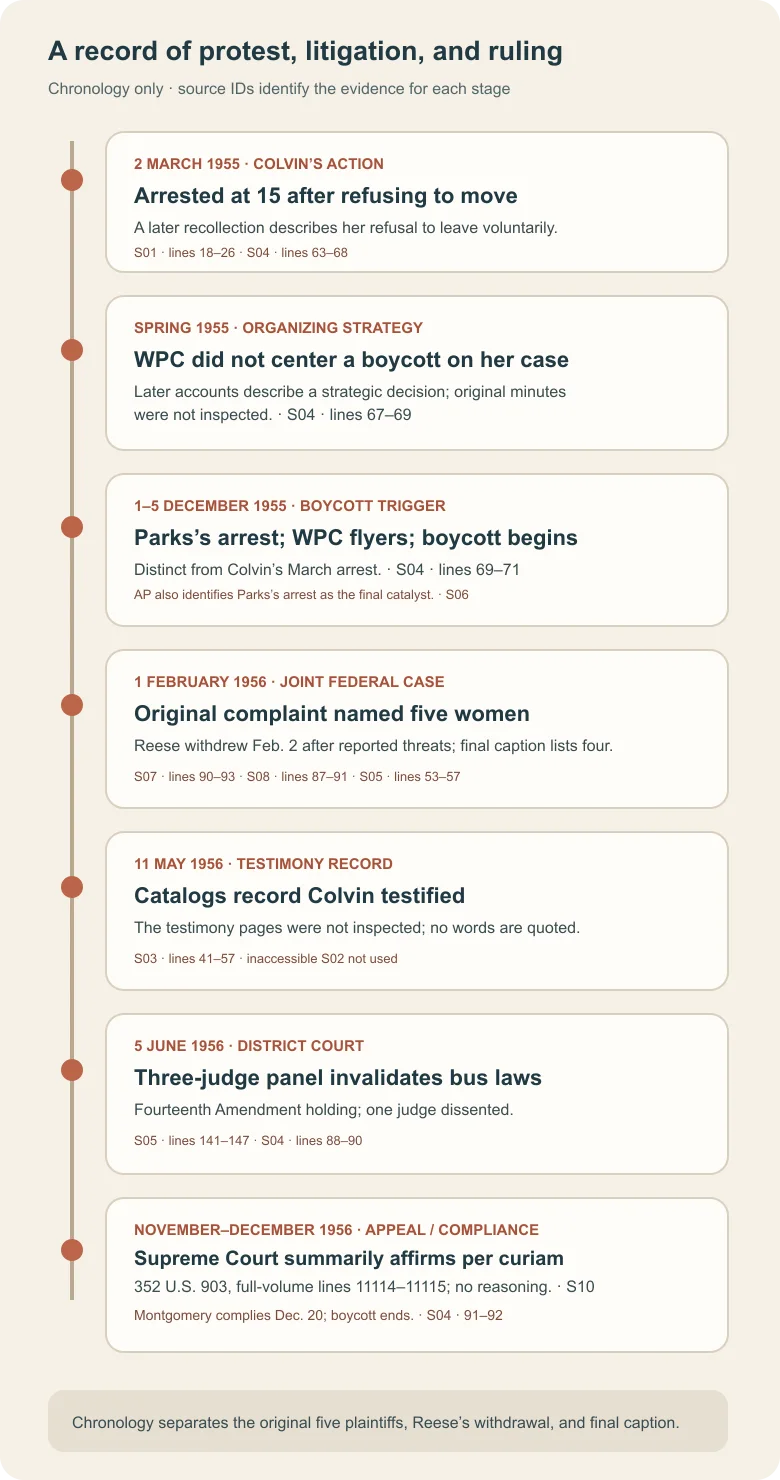
From Colvin's arrest in March 1955 to the court case of 1956. Five women first joined the case. One withdrew after threats, leaving four.
On May 11, 1956, Colvin testified in the case, according to an archive record. A 71-page court record from that day lists her name.
She did not do this work alone. Three lawyers, Fred Gray, Charles Langford and Robert Carter, argued for the women in court. Organizers and riders kept the boycott going. The four women put their names on the case.
What happened next
On June 5, 1956, a panel of three federal judges ruled. They said Montgomery's bus segregation laws broke the U.S. Constitution's Fourteenth Amendment. That amendment promises fair legal process and equal protection under the law. One of the three judges disagreed.
On November 13, 1956, the U.S. Supreme Court upheld the ruling. It did so without writing an explanation. In December, Montgomery obeyed the ruling. The boycott, which had lasted 381 days, then ended.
This win came from many people working together. It took four plaintiffs, their lawyers, the judges, the organizers and everyone who joined the boycott. No single person caused it.
Colvin's story inspires because her courage did not stop when the spotlight went elsewhere. She was arrested at 15, passed over as the public face of the protest, and still stood up again in court. Brave action does not always bring a quick reward. But her part shows that it can keep counting, step by step, alongside others.
Try this today
- Think of a cause or goal you once stood up for. Write down one small next step you could still take.
- Name two people who are working on the same goal. Send one of them a short message offering help.
- Thank someone whose quiet work helped you, even if they never got public credit.
Where could your effort still count, even if no one is watching?
Sources for this story: S01, S02, S03, S04, S05, S06, S07, S08, S09, S10. Full list below.
Join the conversation
Vote in the community poll and see the latest results from Armored Kitten on Telegram.