Raye Montague Was Denied Computer Training. She Learned Anyway.
Turned down for training, Raye Montague watched, studied at night and fixed a computer when it mattered, then helped her team produce a Navy ship draft.

The lesson
When no one will teach you, you can still learn, and be ready when a chance comes.
- Learn by watching the people who do the work, and study in your own time.
- When a real problem appears, step in and show what you can do.
- Value the people who open doors and share the load with you.
The challenge
Raye Montague wanted to study engineering. She hoped to go to the University of Arkansas at Fayetteville. Instead, she earned a degree in business and education at Arkansas AM&N, now the University of Arkansas at Pine Bluff.
The sources give more than one reason for this. The Navy's history says women were not admitted to engineering at Fayetteville. Other accounts point to race, and to how few engineering degrees were open to Black women in the state. These barriers may have overlapped.
Her family believed in her. Raye later recalled that her mother encouraged her education. A 2017 Navy report says her mother and her eighth-grade teacher encouraged her to dream big.
In 1956, she started work for the Navy as a clerk-typist. Her job was at the Applied Mathematics Laboratory at the David Taylor Model Basin. A sister-in-law helped her get the job.
The problem
Part of Raye's job was careful checking. She compared typed data tapes with computer tapes. This put her close to the errors that could spoil a result.
She noticed problems and suggested fixes. Then she asked her manager to train her on the computer. Her manager said no.
This was not the only wall. Later, managers turned down her promotions. They said she lacked an engineering or maths degree. But those were degrees she had not been allowed to pursue. Again and again, there was a gap between the work she could do and the papers she was allowed to earn.
What they did
Raye found another way to learn. She watched the computer operators at work. She took night classes after her paid work day. She later said she learned the UNIVAC computer on the job and went to night school.
Then a chance came. A Navy history dates it to October 20, 1957. The computer operators were away, and the computer had a problem. Raye worked out what was wrong and fixed it. Her manager then made her a computer operator.
She kept learning. She learned to run, program and fix the UNIVAC. She also taught other workers who were not engineers.
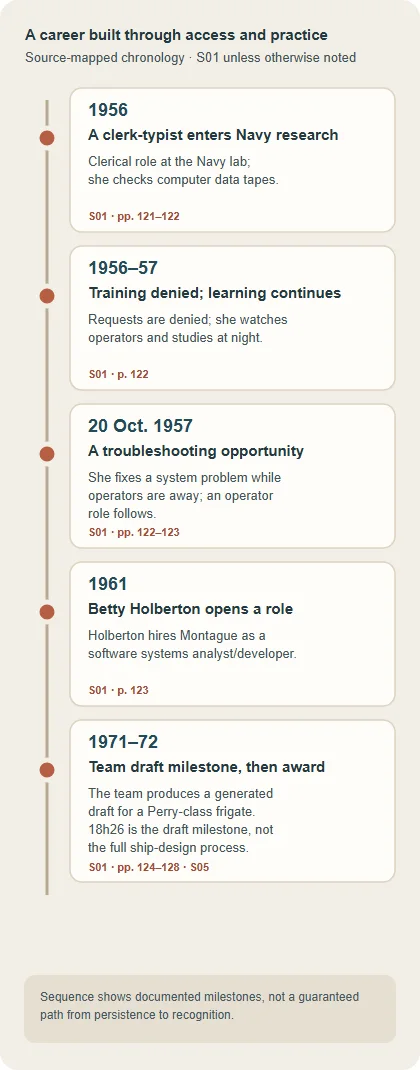
Key steps from 1956 to 1972. The 18 hours and 26 minutes was the time to produce a computer draft, not to design the whole ship.
In 1961, someone with power to help stepped in. Betty Holberton was a senior software leader at the lab. She hired Raye as a software systems analyst and developer. The Navy history says Holberton saw both Raye's ability and the unfair treatment she faced.
What happened next
Raye's best-known work came in 1971, according to the Navy's detailed history. Another account places it around 1970. She worked on a Navy computer ship-design program called CASDAC. The program had begun years before she joined. The Navy had tried using computers for ship design even earlier.
The task was a draft design for a Navy ship, the Oliver Hazard Perry-class frigate. The deadline was tight. Navy leaders asked for it in two months, and her manager set a one-month deadline. Accounts differ on this order of events.
Raye and her team produced a computer-generated draft design. The time recorded for making that draft was 18 hours and 26 minutes. It was not the time to design the whole ship. That work also rested on years of earlier research, computer systems and other people's labour.
She did not do it alone. Working overnight required an escort at the time. So her mother came with her, along with Raye's young son. Her supervisor later assigned staff to work evening hours. Her team helped carry the work.
In 1972, Raye received the Navy's Meritorious Civilian Service Award. The award praised her skill in bringing together thousands of ship specifications.
Her relationship with one supervisor also changed. It began as difficult and later became more supportive. Later, Wally Dietrich put her name forward for new opportunities.
Raye's story inspires because she kept learning when the official door was shut. She watched, studied at night, fixed a problem when it mattered, and taught others. Her success also depended on fair-minded people, her family and her team. Her effort mattered, but it could not fix unfair rules on its own.
Try this today
- Pick one skill you want but have not been taught. Find one person who does it, and watch or read how they work for 10 minutes.
- Write down one small problem at work or home that you could learn to fix. Spend 15 minutes learning the first step.
- Think of someone who opened a door for you. Send them a short thank-you message.
What could you start learning today, even if no one has offered to teach you?
Sources for this story: S01, S02, S03, S04, S05. Full list below.