A. P. J. Abdul Kalam's Rocket Missed Orbit. A Year Later, His Team Succeeded.
When India's first SLV-3 test flight failed in 1979, a caring colleague, an honest review and a leader who took the public blame helped the team try again.

The lesson
After a public failure, honest review and real support help a team try again.
- Look closely at what went wrong, together, before you try again.
- Own your share of a mistake, and help others carry theirs.
- Share the credit generously when things go right.
The challenge
In 1973, A. P. J. Abdul Kalam was given a huge job. He later recalled that his leader, Satish Dhawan, put him in charge of developing India's SLV-3 rocket. The goal was to put a payload into orbit. A payload is the load a rocket carries. Orbit is the path it follows around Earth.
Kalam did not do this alone. In a 2003 speech, he described the rocket as part of a national space effort. It brought together a large community of scientists, engineers and technicians. Teams at the Vikram Sarabhai Space Centre and at Sriharikota did long years of work on it.
Much of what follows comes from Kalam's own later speeches and his memoir, Wings of Fire. His co-author, Arun Tiwari, warned that the book is a short sketch. It may leave out some of the people who helped.
The problem
On August 10, 1979, the first test rocket, SLV-3 E1, lifted off. It carried the Rohini Technology Payload. This was an experimental flight to test a new rocket.
The payload did not reach orbit. The Indian Space Research Organisation (ISRO) marked the flight "Mission Unsuccessful" in its launch list. Its history page calls the flight "only partially successful" instead. Either way, the main goal was missed.
What went wrong? In 2003, Kalam said a control system on the rocket's second stage had failed. The full technical report has not been found, so that is his later description.
This was a very public failure. Kalam later wrote that the days after the launch were hard for him.
What they did
First, people showed up for Kalam. In his memoir, he remembered a colleague, Brahm Prakash, coming to see him. Prakash waited until Kalam woke up, and they shared a meal. Later, Kalam said, Prakash brought the team together around him.
Second, the team looked hard at what had happened. A committee examined the failure in a technical review. Kalam wrote that he accepted responsibility for a decision he had made as mission director. He remembered Dhawan responding with support.
Third, Dhawan took on the public side. In his 2003 speech to students, Kalam said Dhawan faced the press after the 1979 flight. Dhawan, not Kalam, took responsibility for the result in public.
So two different jobs got done. The leader handled the public story. The team handled the technical work of reviewing what went wrong. Meanwhile, the teams at the Vikram Sarabhai Space Centre and at Sriharikota kept working.
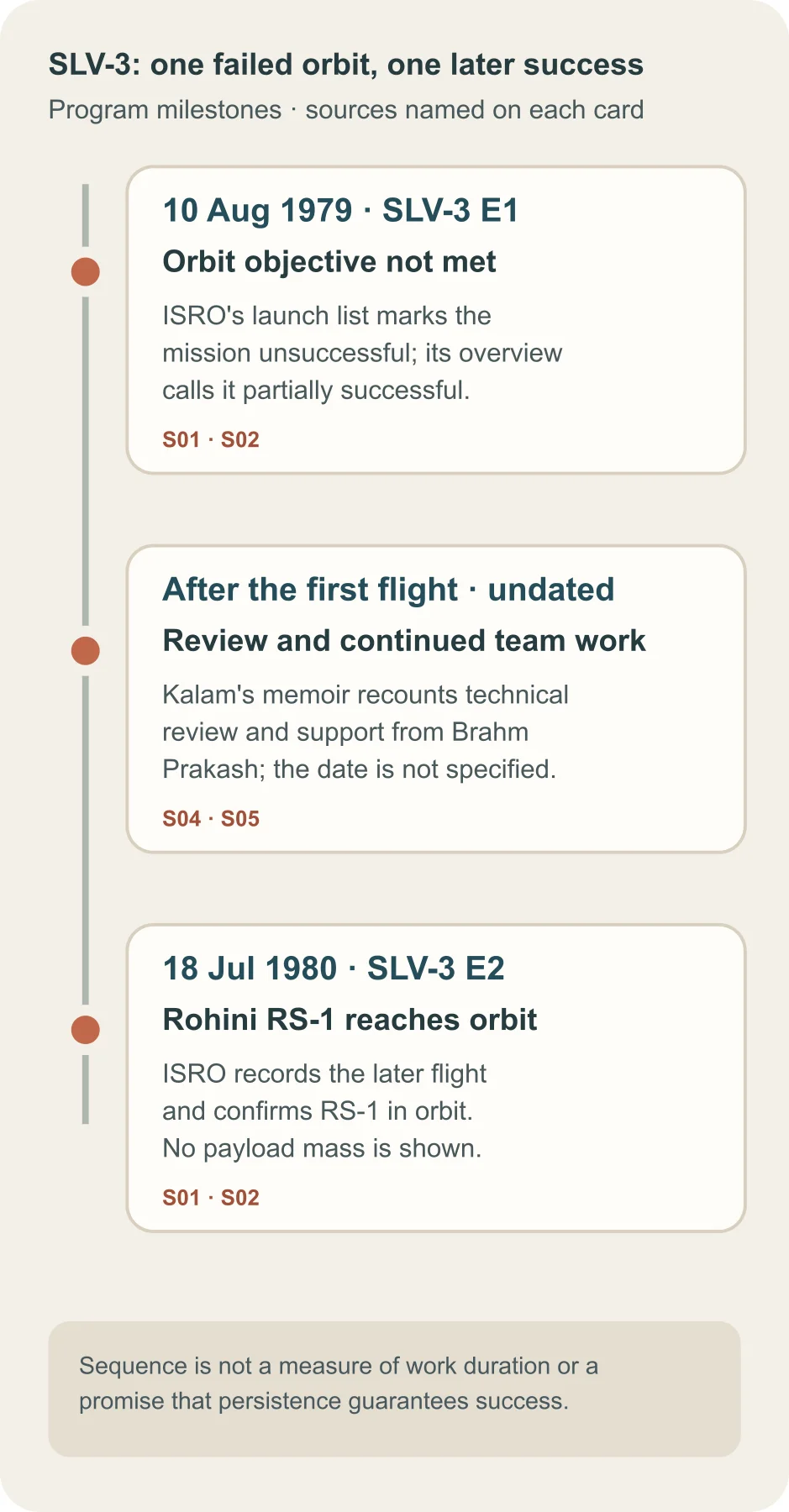
From the failed 1979 flight to the 1980 success. The sources do not say exactly how long the review and the work that followed took.
What happened next
On July 18, 1980, the team launched a second rocket, SLV-3 E2. It carried a payload called Rohini RS-1. This time, ISRO says, the rocket placed RS-1 in orbit. It was the goal the first flight had missed.
Then came another choice by Dhawan. Kalam later said Dhawan asked him to explain the successful launch to the press. After Dhawan's death, Kalam told the same story in a 2002 newspaper interview.
As Kalam remembered it, the pattern was clear. When the rocket failed, the leader stood in front. When it worked, he put his project director in front.
The success also belonged to many people. ISRO's records show more SLV-3 flights listed after 1980. The program kept going, built by large teams over many years.
This story inspires because it shows what helps a team recover. A colleague sat with Kalam after the failure. A review looked honestly at the problem. A leader took the blame in public and shared the credit later. Not every failure leads to success. But this kind of support gives people a real chance to try again.
Try this today
- Think of one thing that went wrong recently. Write down what happened, step by step, without blaming anyone.
- Write one sentence that owns your part of it. Then write one thing you will do differently.
- Send a short thank-you to someone who stood by you after a mistake, or share credit with a teammate today.
Who on your team could use your support, or your credit, this week?
Sources for this story: S01, S02, S03, S04, S05, S06. Full list below.
Join the conversation
Vote in the community poll and see the latest results from Armored Kitten on Telegram.