Junko Tabei Was the First Woman to Climb Everest. A Whole Team Helped Her Get There.
Junko Tabei's 1975 climb, the first ascent of Everest by a woman, grew out of years of club-building, practice climbs, fundraising, family help and the work of a large team.
The lesson
Big goals become possible when many people each carry a part of the work.
- Break a huge dream into smaller jobs a group can share: skills, money, permission and care at home.
- Build experience with smaller steps before the biggest one.
- Name and thank the people who help, including the ones who are easy to forget.
The challenge
Junko Tabei was born in Fukushima Prefecture, Japan, in 1939. She later said a school trip to Mount Nasu first got her interested in climbing.
After she graduated from Showa Women's University, she joined climbing clubs. She worked while she climbed. Accounts say people in those clubs responded to her in mixed ways.
In 1969, Tabei and other climbers started a new club for women. It was called the Ladies Climbing Club, or the Joshi-Tohan Club. Its aim was to plan climbs abroad together.
Tabei later gave practical reasons for a women-only team. She mentioned differences in climbing pace. She also mentioned simple needs, like changing clothes and using the toilet on a climb.
The club did not start with Everest. In 1970, members climbed Annapurna III in the Himalayas. That climb gave them real experience before a much bigger goal.
The problem
Everest was a huge task. A team needed official approval, a permit, equipment and a great deal of money.
The first door did not open. Tabei recalled that the Japan Mountaineering Association did not accept the club when it first applied. The reason is not known. The association recognised the club later.
In a 2013 interview, Tabei said the club applied for an Everest permit in 1971. She said they received it in 1972, for a climb in 1975.
Money was the next wall. Tabei said some possible supporters told her an all-women Everest team was impossible. The costs were large: tents, oxygen, equipment, staff, travel and places to stay.
What they did
The team found money in many different ways.
Two Japanese media companies, Yomiuri Shimbun and Nippon Television, agreed to sponsor the climb. But that did not cover everything. Tabei said each member also paid 1.5 million yen.
Members raised money themselves too. A 1991 newspaper report said five members washed windows after their regular jobs. Tabei also gave piano lessons to raise money.
Family helped at home. While Tabei was away, her sister cared for Tabei's young daughter. Tabei also spoke about the support of her husband.
The team itself was large. A climbing journal's 1976 report lists 15 Japanese members, led by Eiko Hisano. Sherpa climbers and porters also worked on the climb, and the expedition depended on their work.
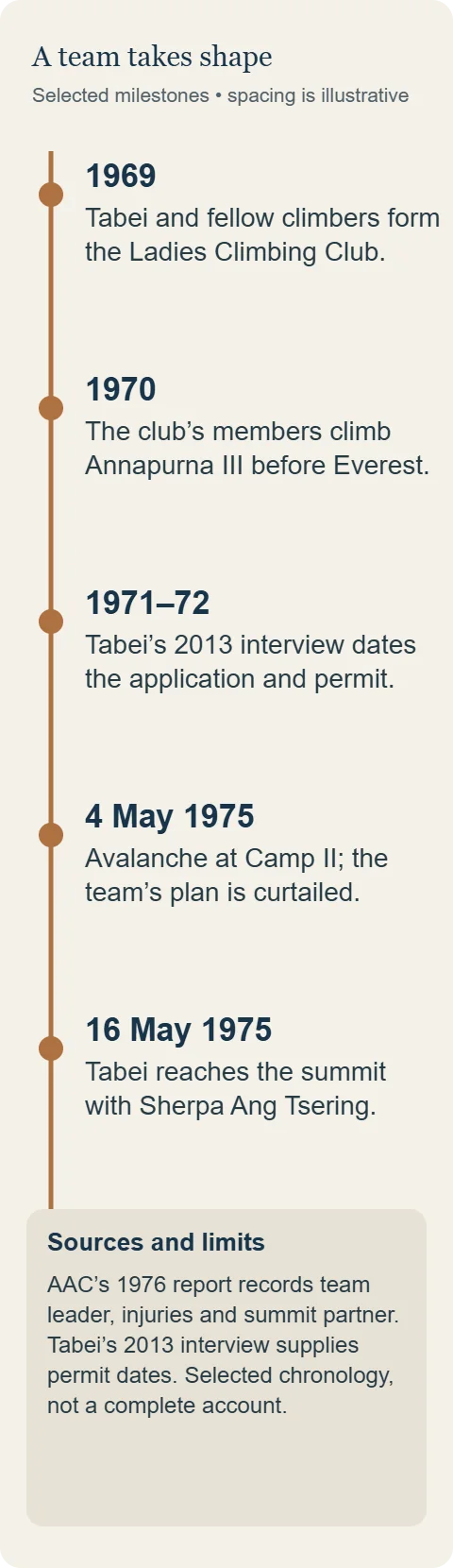
Selected steps from the club's start in 1969 to the summit in 1975. The permit dates come from Tabei's 2013 interview.
Then came real danger. On 4 May 1975, an avalanche hit the team's camp, called Camp II. The 1976 report says seven Japanese members and six Sherpas were hurt, and it lists Tabei among them.
Tabei remembered it differently. She later said none of the five women in her tent, including herself, was injured. She also said it took her three days to move normally again. The records do not settle who is right.
Accounts also differ on what was said next. Tabei later said the leader and the doctor at base camp advised the team to go down, and she said no. A 1991 report says a journalist from a sponsor objected to going on. In the end, the team continued.
This was a serious event that affected many people. It is not a lesson about taking risks.
What happened next
On 16 May 1975, Junko Tabei reached the top of Mount Everest. She was not alone. Sherpa Ang Tsering stood at the summit with her.
The 1976 climbing journal report called it the first ascent of Everest by a woman.
Tabei's name is the one most people remember. But her climb rested on many hands. There was a club that women built for themselves, and a practice climb on Annapurna III. There was a permit, sponsors, members who paid and washed windows, and a sister caring for a child at home. And there was a team leader, Eiko Hisano, with Sherpa climbers and porters.
That is why the story is useful. It turns a giant goal into a list of smaller jobs that real people did together.
Hard work did not remove every barrier or every danger. But the story shows how a group can make an "impossible" plan real, one task at a time.
Try this today
- Write down one big goal. Under it, list five smaller jobs it needs, like skills, money, time or help at home.
- Next to each job, write the name of one person who could help. Ask one of them this week.
- Thank someone whose help usually goes unseen. Set a reminder with Armored Kitten if you need one.
Who is on your team, even if their name never appears next to yours?
Sources for this story: S01, S02, S03, S04, S05, S06. Full list below.
Join the conversation
Vote in the community poll and see the latest results from Armored Kitten on Telegram.