Hidilyn Diaz Nearly Lost Her Place in Weightlifting. Help and Purpose Brought Her Back.
After a failed Olympic lift and a knee injury, Hidilyn Diaz leaned on coaches, specialists and a purpose bigger than herself on her way to Olympic gold.
The lesson
A setback feels lighter when you let others help and find a reason that includes other people.
- When a bad result feels like a verdict on you, ask what needs attention and who can help.
- Be kind to yourself on hard days, and let the feelings come.
- Give your work a purpose that reaches beyond your own next result.
The challenge
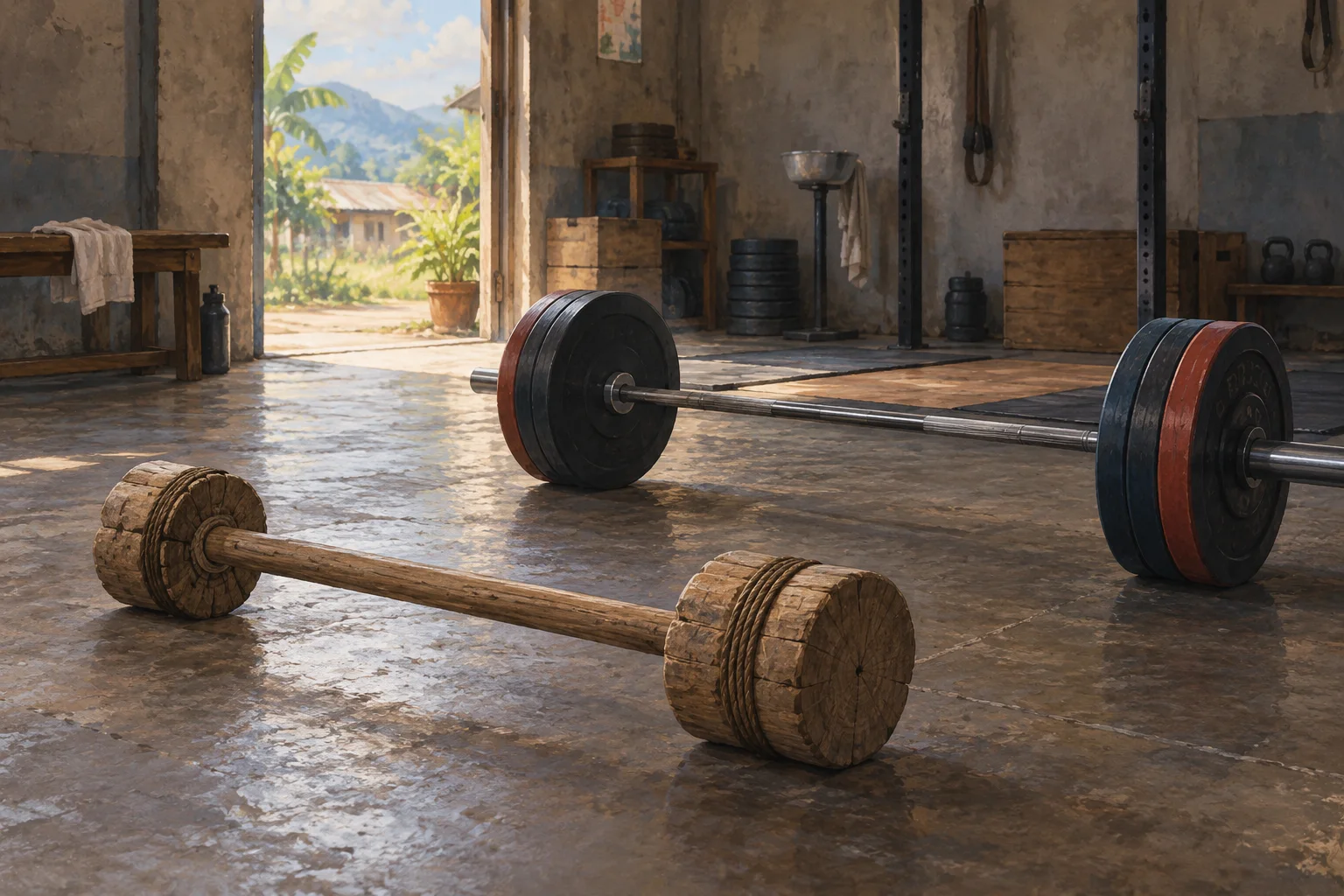
Hidilyn Diaz found weightlifting through her cousins in Zamboanga. She has said her family had several generations of lifters. As children, they practised with homemade bars made from wood and cement. An older cousin became her first coach.
At first, it was not love. Diaz said weightlifting was simply the sport where she felt she could improve. Her family was not well-off, and sport brought chances: scholarship support and travel. Over time, she said, she came to love the sport itself.
The problem
At the 2012 London Olympics, Diaz failed to complete a clean-and-jerk lift, so she finished without a total. The International Weightlifting Federation records it as a "bombed out" finish. Diaz later called her performance lacklustre.
She later said she had learned only about two months before London that she had qualified. She felt that was too little time to prepare. London became a painful memory.
Then came a harder year, when she hurt her knee in 2014. She missed the Asian Games, lost her coach, and came close to being dropped from the national team. In a later interview, she said she felt useless in the sport.
She had built so much of her life around lifting. She said that the thought of being outside it left her unsure who she was.
What they did
First, Diaz decided she still wanted the work. She said she kept training despite the knee injury. She wanted the people around her to see how much she wanted to stay. That was her choice, and it is not medical advice. Injuries need proper care, and sometimes stepping back is the right choice.
Second, she worked on her mindset and on how she treated herself. In a 2019 interview, she was asked what she would change about her early training. She said she needed to change her mindset and believe she could do it.
On bad training days, she said, she let herself cry and tried to understand what she was feeling. She tried not to be cruel to herself. Her coaches comforted her when she was close to quitting. They helped her see a bad day as something that would pass.
Third, she let a whole team help. The medal would have one name on it, but the preparation did not happen alone. She described coaches, psychologists, nutritionists and physical therapists, along with strength and conditioning staff.
Fourth, she found a reason bigger than a medal. After London, she began thinking about the children in Mampang who were curious about weightlifting. They might need a place to train. She started with a small backyard gym. When more children came, she wanted a proper space. She said she opened the Hidilyn Diaz Weightlifting Gym in 2017 to pass on what the sport had given her.
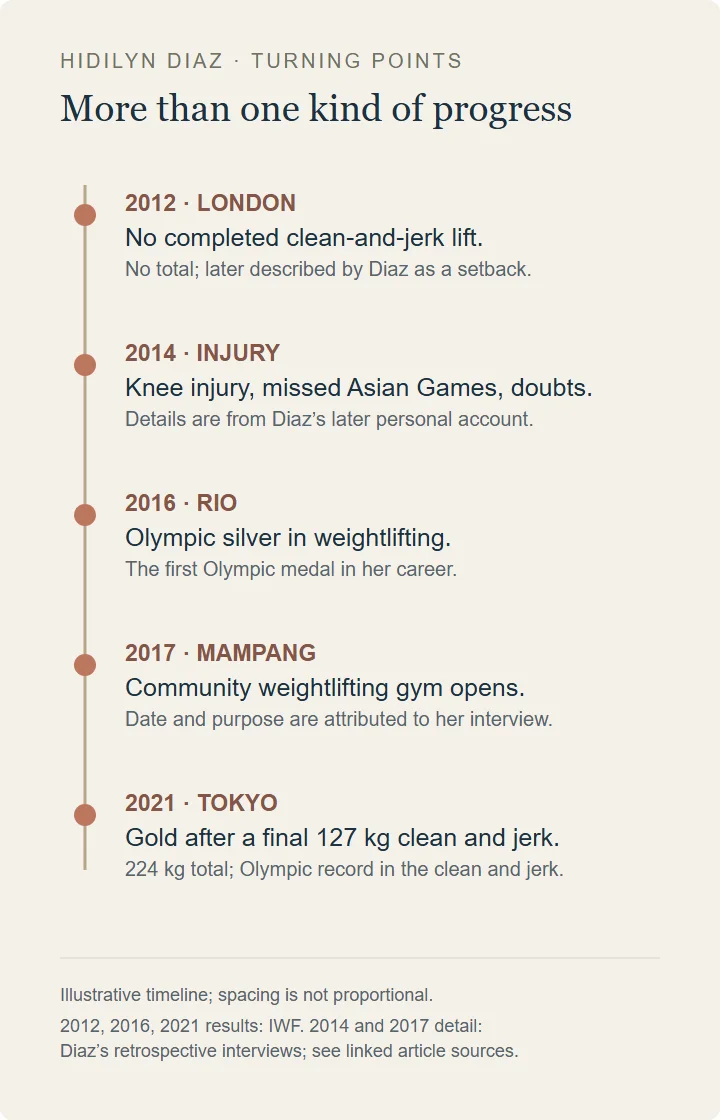
Key moments from London 2012 to Tokyo gold. The spacing is not to scale, and the personal details come from Diaz's own interviews.
What happened next
In 2016, Diaz won a silver medal at the Rio Olympics.
The road to Tokyo was not smooth. During the pandemic, lockdowns upset her planned training in Malaysia. She trained for more than a year in a makeshift gym at a village house. She said the people around her helped her through that time. Even at the Games, she said, she was anxious that a COVID test could end her preparation.
In 2021, at the Tokyo Olympics, she competed at her fourth Olympic Games. It came down to her final clean and jerk. If she lifted 127 kilograms, she would move ahead. If she missed, she would take another silver.
She made the lift, and it set an Olympic record in the clean and jerk, with a 224-kilogram total. She won the gold medal.
The medal was hers. But the road to it had many hands on it: cousins, coaches, specialists, and the young lifters who gave her a reason to return. One win cannot prove that pushing on always pays off. Her story shows what support and purpose can add.
Try this today
- Think of a recent setback. Write one thing it needs and one person who could help with it.
- On your next hard day, take five minutes to name what you feel, without blaming yourself.
- Think of one person who helped you on a bad day. Send them a short thank-you message.
Who could your effort help, besides you?
Sources for this story: S01, S02, S03, S04, S05, S06. Full list below.