Edna Adan Ismail Lost Her First Hospital. Many Hands Helped Her Build the Next.
Edna Adan Ismail's first hospital project was lost amid conflict, so she started again in Hargeisa, where a whole community helped her build it.
The lesson
After a big loss, a new start can grow strong when many people share the work.
- Keep your purpose, and be ready to change the place and the plan.
- Ask for what the project really needs: land, tools, money, hands and skills.
- Train other people, so the good work can last beyond you.
The challenge
Edna Adan Ismail trained as a midwife. A midwife is a health worker who helps women through pregnancy and birth.
Her early working life was not easy. When she returned home as a trained midwife, she waited 22 months to get her government pay. The Guardian reported the reason: there was no pay scale for a woman.
She kept working. In 1965, she became a nurse-educator with the World Health Organization. She worked with the organisation for 32 years. Over those years, she built deep experience in caring for patients and in public health.
She also had a goal: a maternity hospital, where mothers could give birth safely.
The problem
Edna said the government required her first hospital to be built in Mogadishu, not Hargeisa. So she started there.
The sources do not agree on when the building work began. Edna later recalled starting in 1982. A 2010 news report by IRIN says construction began in 1986.
The hospital was never finished, because conflict overtook the project and it was lost. Edna said it had used up more than $150,000 of her own money.
What happened to the building itself is not clear. IRIN reported that the unfinished building was destroyed. Edna said she never went back to the site. She had only heard that U.S. Marines used it for storage during Operation Restore Hope. In another interview, she said the property and the site were taken during the conflicts.
Either way, the project and the money she had put into it were gone.
What they did
Edna kept her purpose and changed the plan. In 1991, she saw the destruction in Hargeisa. She said that is when she decided to build a hospital there.
She returned to Somaliland in 1997, and in 1998 she laid the foundation stone for the new hospital. The government gave her the land.
This time, many people joined in. Edna later described how the building came together:
- Local merchants donated building equipment and materials.
- People lent their pickup trucks.
- The city brought sand.
- Workers gave their time for free.
- People from the region living abroad raised money, and a women's group in Connecticut helped too.
Most of these details come from Edna's own memory in a later interview. A 2010 news report also says local businesspeople, foreign charities and donors living abroad helped.
Edna brought her own money, her medical experience and a clear goal. She looked for partners and kept the work moving. Still, a hospital needs land, supplies, workers and trust. It needed many hands, and it got them.
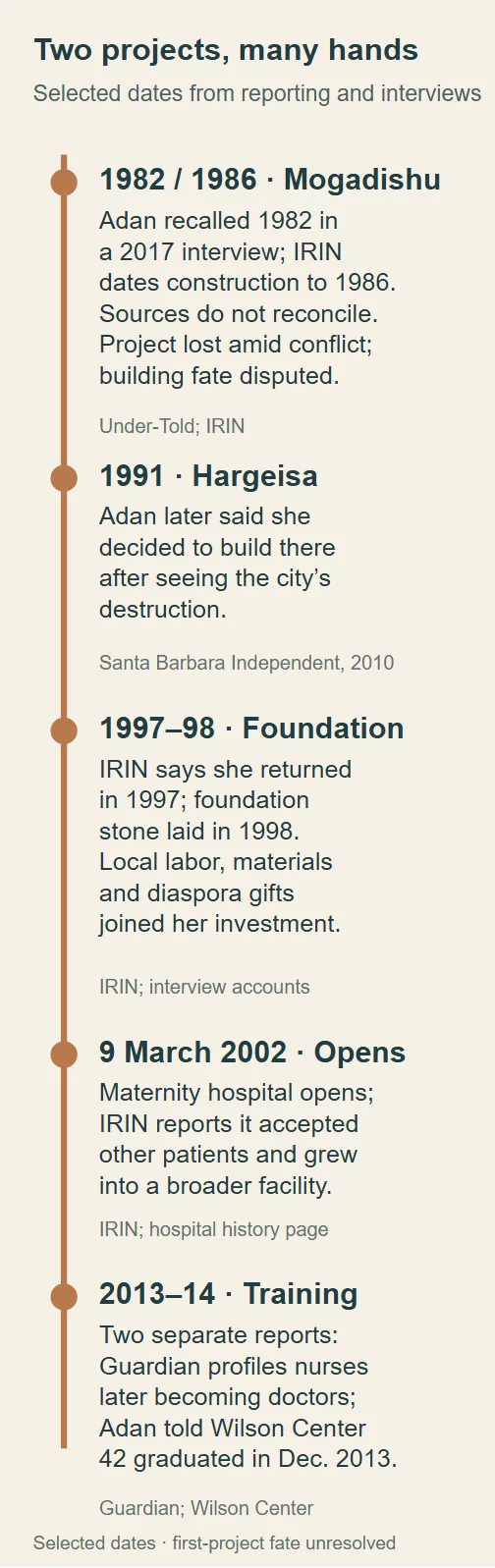
Key steps in the two hospital projects. The sources disagree on when the first one started, 1982 or 1986, and on what happened to its building.
What happened next
The hospital in Hargeisa opened on 9 March 2002. It was planned as a maternity hospital, but it took other patients from the very start. Over time, it grew into a bigger hospital that teaches health workers and takes patients sent from other clinics.
Training was part of the plan, too. Before the hospital opened, Edna recruited 30 trainees, The Guardian reported. Later, she paid for two nurse trainees to go through medical school. Both became doctors.
In 2014, Edna said 42 students had graduated in December 2013. She said the United Nations Population Fund supported groups of trainees.
Other partners, including the organisations Direct Relief and the Fistula Foundation, helped the hospital keep going.
Edna's first project was stopped by conflict, something no single person could prevent. Her second project took shape when her effort met the help of a whole community. One hospital cannot solve every health problem in Somaliland. But this one gave care, and it trained people who can carry that care forward.
Try this today
- Think of one project that stalled. Write down three things it needs besides your own effort, such as tools, money or skills.
- Name one person who could help with one of those needs. Send them a short message today.
- Teach someone one small thing you know well. Spend 10 minutes showing them how.
If your first plan was lost, what could a second plan look like with more people in it?
Sources for this story: S01, S02, S03, S04, S05, S06, S07. Full list below.