Savitribai Phule Became a Teacher for Girls. Many People Helped Her.
In 1840s Pune, Savitribai Phule trained to teach girls when no woman teacher was available, and friends, fellow teachers and students helped the work grow.
The lesson
Big, hard work becomes possible when many people share it.
- Get ready for a new role by learning from people who can teach you.
- Accept practical help, like a room to work in or a partner who shares the job.
- Listen to the people you serve. Their voices can carry the work forward.
The challenge
Savitribai Phule and her husband, Jyotirao, lived in Pune, India, in the 1840s. They wanted more children to get an education. They focused on girls and children from lower castes.
Caste is a system that sorts people into groups by birth. In their time, caste and gender shaped who could go to school. They also shaped who was allowed to teach.
Girls and lower-caste children faced real barriers to learning. The Phules wanted to open a door for them.
The problem
A school for girls needs a teacher. One account says that no female teacher was available. So Jyotirao asked Savitribai to teach.
That raised new problems. Savitribai had to learn how to teach. The school needed a room. And there was resistance to girls' education at the time.
Later accounts place an early girls' school effort in 1848. A year later, in 1849, the couple had to leave their home because of this education work. The accounts do not give the details of what happened. But they show the cost. This work could change where a family was able to live.
What they did
They did not try to do it alone. Many people helped, each in a practical way.
First, Savitribai had to get ready to teach. A newspaper report in The Indian Express says Jyotirao prepared her for teaching. Two of his friends, Sakharam Y. Paranjpe and Keshav S. Bhavalkar, took charge of her further education.
The same report describes teacher training at a school in Ahmednagar. It also mentions a "normal school" in Pune, which is a school that trains teachers. Teaching meant learning how to teach, with help from more than one person.
Second, the school needed a place. The report says an early school was linked to Bhide Wada, where space was made available. A wada is a large house. Later, the work moved to Usman Sheikh's wada.
Third, Savitribai did not teach alone. The report names Fatima Sheikh as a teacher who taught alongside her. So the work had more than one teacher and more than one address.
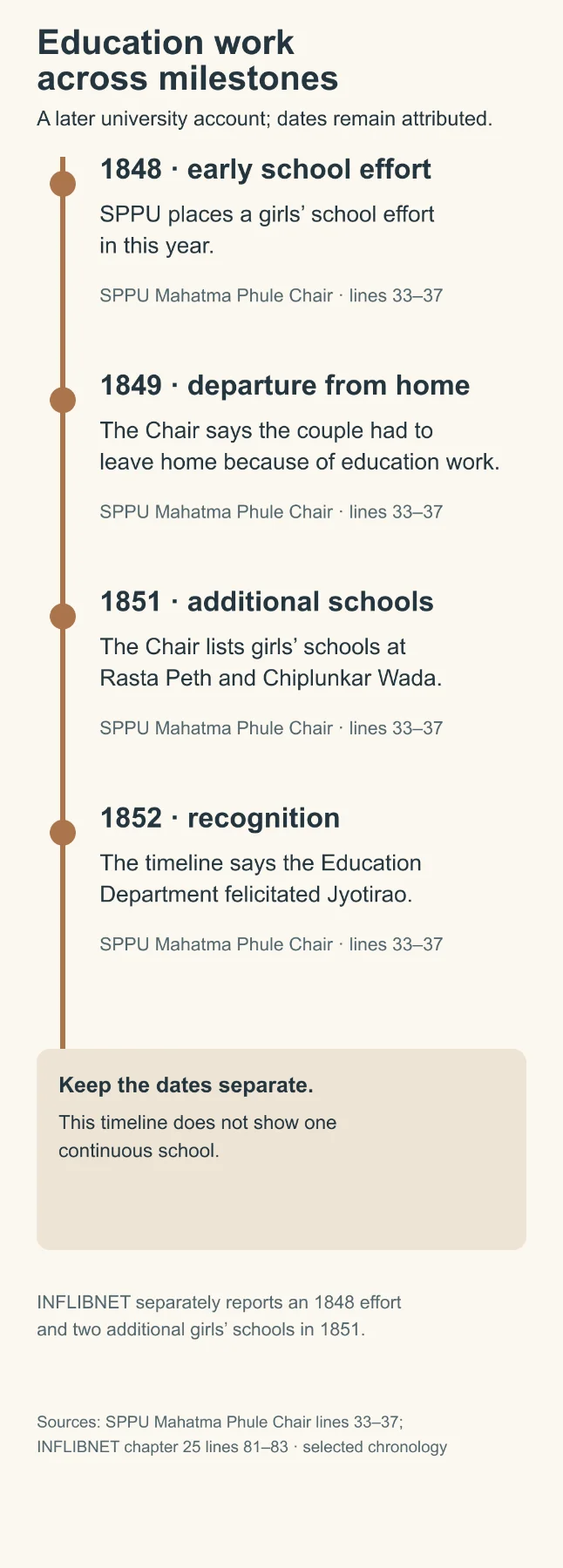
Key dates from later accounts. They do not prove that one school ran the whole time.
What happened next
The work grew. Later accounts report more girls' schools in 1851. One account says two more schools opened that year. In 1852, the Education Department honoured Jyotirao, according to a university timeline.
The students mattered too. One of them was Mukta Salve. A scholar named Sharmila Rege identifies her as a student connected with the Phule school.
In 1855, Mukta wrote an essay called About the Grief of Mahar and Mangs. It was printed in two parts. In 2009, Rege reproduced a passage from it in a lecture. A modern English translation by Braj Ranjan Mani was reprinted in 2020.
Mukta's essay ends with an appeal to her readers: "So please work hard and study. Get educated."
That is why this story inspires. A teacher got ready with help. Friends gave their time. Others made space for classes. Another woman taught beside her. And a student found her own voice and passed the message on.
The old records are not complete. Most dates come from later accounts, and we do not know how many students there were. But the parts we have show a school effort built by many hands, not by one hero alone.
Try this today
- Pick one goal you cannot reach alone. Write down one person who could teach you a skill for it. Ask them for 10 minutes this week.
- Think of someone who gave you practical help, like a space, a ride or their time. Send them a short thank-you message today.
- Ask one person you help what they think. Write down one idea from their answer.
Who is the person who shares the work with you, the way Fatima Sheikh did?
Sources for this story: S01, S02, S03, S04, S05, S06. Full list below.
Join the conversation
Vote in the community poll and see the latest results from Armored Kitten on Telegram.